
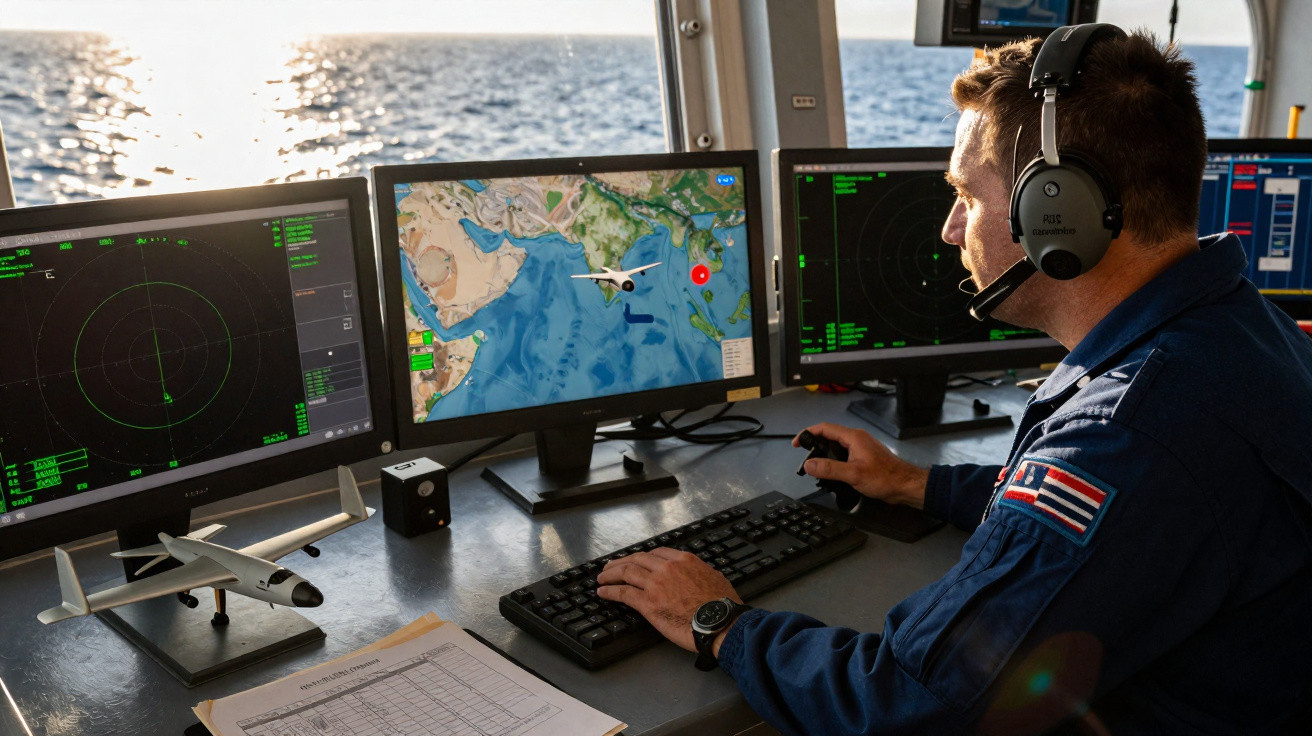
The US Navy has confirmed the loss of one of its MQ-4C Triton drones during operations in the Persian Gulf, according to an official report released several days after the event. The incident involves the US Navy, the United States, the MQ-4C Triton unmanned aircraft system, and a mission over the Persian Gulf in which the aircraft vanished after reporting an in-flight emergency.
What the official mishap report says
According to the Naval Safety Command’s Mishap Summary Report (MISHAP), the occurrence took place on 9 April 2026, although formal confirmation was only issued on 14 April. The document categorises it as a Class A incident and states: “9 April 2026 (location withheld – OPSEC) MQ-4C crashed, no crew injuries,” thereby confirming the total loss of the unmanned aircraft system.
MQ-4C Triton tracking loss and emergency transponder codes
A US Navy MQ-4C Triton unmanned aerial vehicle (UAV) dropped off flight-tracking systems while flying over the Persian Gulf. Before contact was lost, the aircraft broadcast squawk code 7400 via its transponder, signalling a loss of communications with the remote operator. It then descended from its cruising altitude of 52,000 ft (about 15,850 m) to roughly 9,500 ft (about 2,900 m), at which point the signal disappeared.
In the final stage of the incident, the system reportedly switched to code 7700, which denotes a general emergency, indicating a critical deterioration of the situation on board. The descent, which lasted less than 15 minutes, began near the Saudi Arabian coast. In its last moments, the drone appeared to be heading towards Iran, although the precise impact location has not yet been confirmed.
Possible causes and recovery considerations
The cause of the incident has not been established, but an investigation is presumed to be under way. Potential explanations include equipment failure-especially within the communications system-or, less likely, external interference or electronic-warfare activity that may have affected control of the platform.
As for what followed, it has not been disclosed whether the US Navy intends to recover the MQ-4C Triton wreckage or whether any such effort has already begun. Even so, any recovery attempt would likely require prior mine-clearance to protect naval units, particularly given reports that Iran has mined the Strait of Hormuz, adding further operational complexity.
Images for illustrative purposes only.
You may also be interested in: The US Air Force released images of the first in-flight refuelling of the new B-21 Raider bomber



Comments
No comments yet. Be the first to comment!
Leave a Comment