
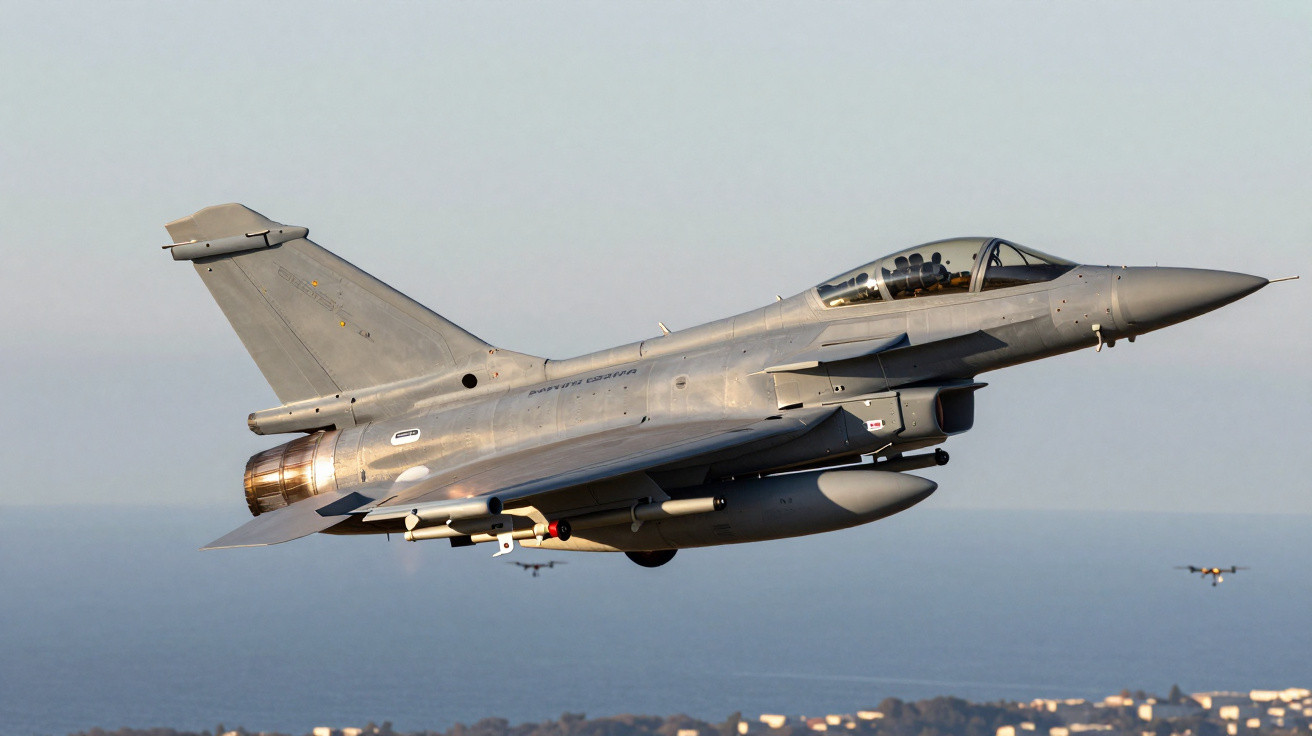
Rafale M1 sighted with Thales TELSON 12 JF rocket pod
Seeking a more cost-efficient tool for bringing down drones, the French Navy has begun fitting its Rafale fighters with new guided rocket pods-specifically the Thales TELSON 12 JF. Depending on the mission fit, this would give each fighter the ability to carry up to 24 68 mm rockets in total.
The development came to light after an image was shared on social media showing a Dassault-built Rafale flying near Istres–Le Tubé Air Base with one of these pods mounted under its left wing. The site is notable as the Direction générale de l’armement (DGA) operates a flight test centre there.
Test configuration: TELSON 12 JF and the TALIOS targeting pod
French observers added that the Rafale in question appears to be an M1 variant-understood to be the first production standard and one that is currently used to run various trials involving systems still in development. Alongside the Thales TELSON 12 JF pods, the aircraft was also carrying a TALIOS targeting pod installed near the right engine air intake, providing target acquisition and laser guidance capability.
Cutting costs versus MICA in counter-drone missions
If this configuration can be rolled out to a larger number of platforms, the French Navy could gain a practical alternative to employing its MICA missiles, which offer higher performance-and come with higher costs-than a 68 mm rocket.
That consideration is significant given the large quantities of such weaponry used by Rafale fighters and Tiger helicopters deployed by Paris in the Middle East, responding to Iranian attacks launched against multiple points across the region in retaliation for Operation Epic Fury. Although the aircraft’s built-in cannons were also seen in use, the firing of a substantial number of missiles raised concerns about remaining stockpiles looking ahead, which may have accelerated these test flights.
France would not, however, be the first Western country to back rockets as a means of downing drones, narrowing the cost gap created by using a high-end air-to-air missile against a one-way unmanned system such as Iran’s Shahed models. In that vein, the U.S. Air Force has progressed with integrating 70 mm rockets on its A-10 attack aircraft as well as on its F-15 and F-16 fighters. Ukraine’s Air Force has taken a similar approach with U.S.-built fighters donated by Western allies, while the Royal Air Force has done so with its Eurofighter Typhoon fleet.
Aculeus LG: how the guided rockets work and the cost gap
Finally, looking briefly at the characteristics of the rockets integrated on French Rafales-the Aculeus LG-it is worth noting that they are precision weapons that follow a ballistic trajectory for most of their flight and then correct their final path according to the target designated by laser.
In addition, the manufacturer states that they are activated by induction, which it says makes the warheads safer and prevents their later use as explosive devices should they be recovered by potential insurgent groups. When comparing prices with a MICA, the difference is more than considerable: each rocket is priced between 25,000 and 40,000 dollars, versus one million for each missile.
Images used for illustrative purposes





Comments
No comments yet. Be the first to comment!
Leave a Comment