
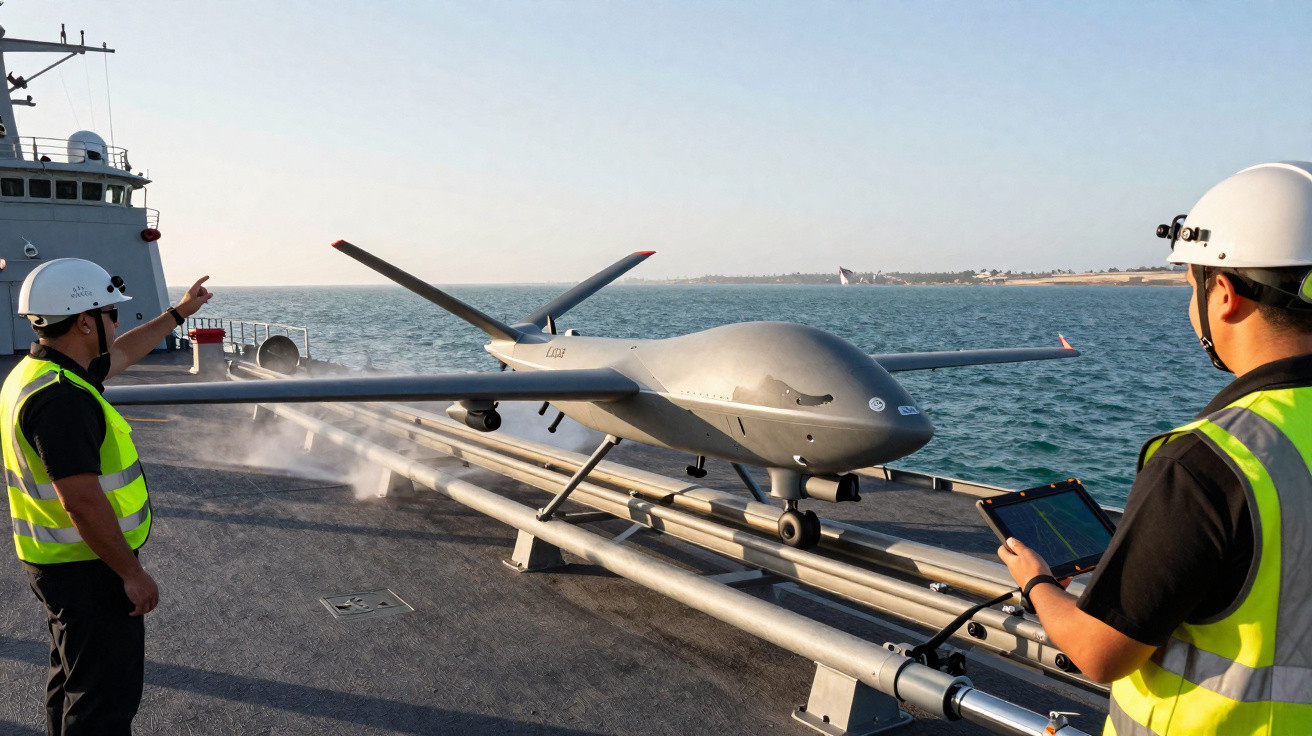
First at-sea LUCAS launch from USS Santa Barbara (LCS 32)
On 16 December, personnel from the 5th Fleet under US Naval Forces Central Command (NAVCENT/C5F) successfully carried out the first launch at sea from a ship of one of the United States Armed Forces’ new one-way attack drones. The test took place from the US Navy Independence-class Littoral Combat Ship (LCS) USS Santa Barbara (LCS 32) while it was operating in the Arabian Gulf.
During the event, the ship launched a LUCAS drone (Low-cost Unmanned Combat Attack System), an important step in bringing unmanned systems into US naval operations. The launch was conducted by Task Force 59, NAVCENT/C5F’s unit focused on unmanned and autonomous operations.
NAVCENT/C5F strategy and Task Force Scorpion Strike
Commenting on the test, NAVCENT/C5F commander Vice Admiral Curt Renshaw said: “This first successful launch of LUCAS from a naval vessel marks a significant milestone in rapidly delivering affordable and effective unmanned capabilities to the warfighter.” He also added: “This achievement demonstrates the power of innovation and joint collaboration in this critical region.”
The LUCAS system’s deployment forms part of a broader approach announced in early December. On 3 December, US Central Command reported that the first squadron of US Armed Forces one-way attack drones had arrived in the Middle East. The aircraft launched from USS Santa Barbara is part of Task Force Scorpion Strike, which was established to provide military personnel with new unmanned capabilities.
The LUCAS drones fielded by the United States in the Middle East are described as having extended range and being launchable by several methods, including catapults, rocket-assisted take-off systems, and mobile land platforms either vehicle-mounted or ground-based. In this context, Renshaw emphasised that “this platform will undoubtedly improve regional maritime security and deterrence”, referring to the operational effect these systems could have across the regional maritime environment.
LUCAS variants, satellite link and swarm use
Based on information released, imagery published by the Pentagon suggests LUCAS may appear in at least two identifiable variants. One version seems intended for striking fixed targets, while another appears to include a camera with a satellite communications link, enabling the drone to be re-tasked after launch and used against moving targets.
Analysts argue that this feature would support coordinated swarm employment, using sensor-equipped versions as control nodes for those carrying only an explosive warhead. They see this as a meaningful distinction compared with systems such as Iran’s Shahed-136, which has been used recently both in the Middle East and in the war in Ukraine and which is limited in terms of control beyond line of sight.
With this first ship-based launch, the US Navy is advancing the operational integration of low-cost attack drones from surface platforms, broadening the range of unmanned options available for missions in complex maritime settings.
Images sourced from the US Navy.
You may be interested in: The beginning of the end for a nuclear giant: aircraft carrier USS Nimitz returned to the United States after completing its final Pacific deployment




Comments
No comments yet. Be the first to comment!
Leave a Comment