
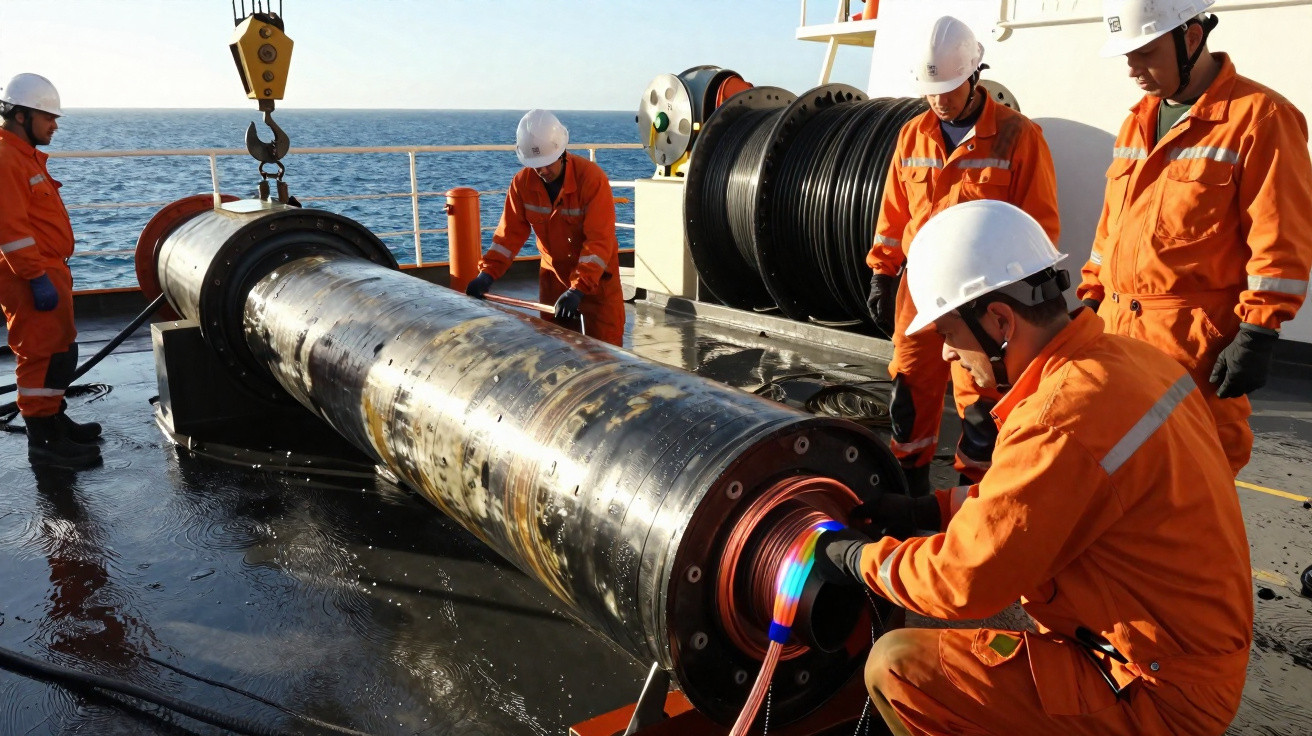
A specialist vessel in the Atlantic is working to retrieve the world’s first transatlantic fibre-optic cable link from several thousand metres down. The retired cable, known as TAT‑8, helped usher in the modern internet era in the late 1980s-and, decades on, it is now yielding valuable raw materials once again.
How a fibre-optic cable conquered the Atlantic
On 14 December 1988, AT&T, British Telecom and France Télécom brought online a system that, at the time, felt like science fiction. Instead of bulky copper conductors, pulses of light carried vast volumes of data through the deep ocean. The Atlantic gained its first connection built specifically for fibre optics.
That new benchmark was called TAT‑8. Behind the technical label sat a quiet revolution: phone calls, data transfers and even early video conferencing could suddenly run far more cheaply and reliably than via legacy copper routes and satellite links.
"With TAT‑8, global data traffic finally moved from copper to fibre optics-the starting gun for today’s high-speed internet."
One moment in particular became emblematic. Science-fiction author Isaac Asimov took part in a live video conference from New York to audiences in Paris and London-carried over the new cable. He described it as a journey across the sea on a beam of light, an image that fitted an era when many people were still dialling numbers on rotary telephones.
Success with a side effect: the cable filled up fast
Demand for capacity surged. In under a year and a half, TAT‑8 was fully utilised. The system made clear just how hungry business was for fast, transatlantic data links-and it served as a wake-up call for network operators.
New generations of fibre-optic cables with much higher capacity followed in quick succession. While TAT‑8 remained in service until 2002, by then it was already a veteran in the data network, eclipsed by ever more capable connections.
After that, a familiar fate for ageing subsea cables followed: a fault made continued operation uneconomic. Repairing it in deep water would have cost too much, so the line was switched off and left resting on the seabed.
TAT‑8 is now being pulled up from the deep
Today-more than 20 years after shutdown-the vessel MV Maasvliet is bringing the historic cable back to the surface on behalf of Subsea Environmental Services. The task may sound routine, but in practice it is highly complex and carries real risk.
Millimetre work with steel hooks and rough seas
Although charts show the route, wind, currents and shifts in the seabed make pinpointing the line difficult. The crew has to fix on each individual section with care. Using specialised gripping tools known as grapnels, the ship methodically feels its way along the ocean floor.
- Locating the cable route using sonar and historic laying charts
- Lowering grapnels on long steel wires
- Hauling in and securing the cable on deck
- Winding it manually to avoid damaging the fibres
Once aboard, the work becomes surprisingly hands-on: the crew winds the cable by hand onto large drums. That approach helps engineers avoid kinks which-even in a decommissioned cable-can still cause issues later on, for example when the different materials are separated.
Conditions add another layer of difficulty. On the current operation, the track had to be altered repeatedly because the cyclone season arrived unusually early. Cable recovery is an appointment with the ocean-and the ocean rarely sticks to a timetable.
Old cables as treasure: copper, steel and plastic
The effort is worthwhile because the cable contains more than a dose of engineering nostalgia. Even though TAT‑8 is classed as a fibre-optic cable, the fibre sits inside a complex structure made of metal and polymers. One component is especially sought after: high-grade copper.
"The International Energy Agency warns of a possible copper shortage in the coming decade-making old subsea cables highly desirable sources of raw materials."
Recycling TAT‑8 yields three main categories of material:
| Material | Use | Outlook |
|---|---|---|
| Copper | Conductor, shielding, power supply | Key resource for the energy transition and electric mobility |
| Steel | Armour against pressure and anchors | Melted down and reused as construction steel or for new cables |
| Polyethylene | Protective outer sheath | Processed into recycled plastic, e.g. for pipes or packaging |
Operators expect to recover a significant share of material costs. At the same time, the project clears the seabed, frees up corridors for new lines, and reduces potential hazards for fishing and shipping.
The network’s invisible lifelines
When many people think of the “internet”, they picture Wi‑Fi routers and 5G masts. Yet the real heavy traffic runs elsewhere: through thousands of kilometres of fibre on the ocean floor.
Experts estimate that roughly 95 to 99 per cent of intercontinental data traffic travels via subsea cables. Satellites play only a supporting role, such as for remote regions or specialist uses. They are slower, more prone to disruption and markedly more expensive.
Around two million kilometres of decommissioned cable currently lie unused in the oceans. Much of it dates from a period when recycling attracted little attention. A new market is now forming: companies are specialising in locating, recovering and reprocessing this old infrastructure.
Why old cables make room for new projects
The deep ocean is vast, but it is not an unlimited free-for-all. In many areas, subsea cables, pipelines and shipping lanes converge. Anyone planning to lay a new, higher-capacity cable benefits from clear routes. Every recovered legacy line simplifies planning and reduces risk.
There is also the broader trend: modern internet services-streaming, cloud computing and AI applications-keep pushing bandwidth demand higher. Operators are designing ever “thicker” data motorways with terabit capacities. Older systems like TAT‑8 no longer fit that picture, even if they might still work in purely technical terms.
How fibre optics under the sea works in the first place
At the heart of a subsea cable sits a hair-thin strand of glass. Lasers send pulses of light through that glass, which are converted back into electrical signals at the far end. Along the route, amplifier stations refresh the signal every few dozen kilometres.
Around the fibre, the protective build is surprisingly intricate: insulating layers, metal tubes, strain relief, steel armouring and plastic jackets defend the cable against pressure, corrosion, sharks, ship anchors and fishing gear. Near the coast the construction is typically especially robust, while in deep water a lighter design is often sufficient.
To non-specialists, a cut-open subsea cable looks more like a piece of industrial power line than high technology. The true data carrier-the fibre-accounts for only a small fraction of the overall diameter. Everything else exists so it can survive the harsh deep-sea environment.
What recovering TAT‑8 reveals about the future of the network
The operation off the Portuguese coast underlines how attitudes to infrastructure have changed. Thirty years ago, a cable like TAT‑8 was viewed primarily as an engineering triumph. Today, it is also about recycling, securing raw materials, and working out how to support an ever more data-hungry network more sustainably.
New projects are increasingly planning fibre routes alongside offshore wind farms or energy pipelines, sharing costs and concentrating impacts on the marine environment. In parallel, pressure is growing to remove old lines in a controlled way instead of simply leaving them behind.
For users in Europe or the United States, all of this is largely invisible-until a cable break makes video calls judder or streaming services stutter. Efforts like the recovery of TAT‑8 are a reminder that behind every email and every cloud upload sits a very physical, labour-intensive infrastructure that must be renewed, protected and, at the end of its working life, collected again.




Comments
No comments yet. Be the first to comment!
Leave a Comment