
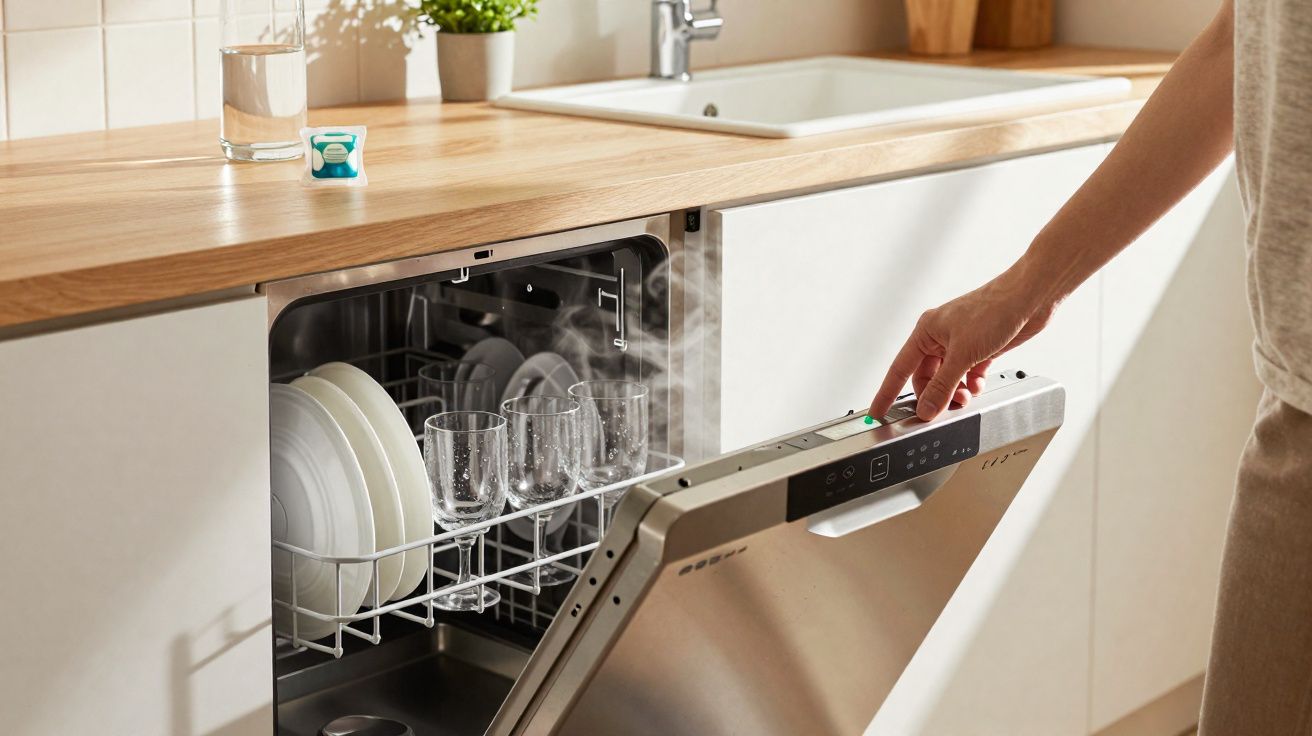
I clocked the moment my dishwasher had been quietly misleading me for years on an ordinary evening: I was barefoot in a calm kitchen, staring at the control panel as if it had just let something slip. The plates were piled up by the sink, a half-finished glass of wine sat nearby, and the usual weekday mess was finally settling.
As always, my hand went to the familiar “Quick” programme - then, for once, I stopped. I pulled the user manual out of a drawer where it had been buried for ages.
Five minutes later, I was sat on the floor with the booklet open, realising that the setting I’d been avoiding was actually the best choice for saving water and energy.
And the “eco” cycle I’d assumed was just marketing was, quietly, coming top in comparison tests.
The oddest part?
Most people are doing exactly the same thing - and they don’t even realise it.
Why the “eco” cycle quietly beats all the others
Watch how people use a dishwasher and you’ll see the pattern. Nine times out of ten, they tap “Quick”, “1h”, or “Intensive”. It feels satisfying: shorter, stronger, finished. Our brains are built to chase speed, particularly at 10:30 p.m. when all you want is an empty sink and the sofa.
Meanwhile, the eco cycle sits there at the end of the list looking slow - and, frankly, a bit suspect. Three hours? Four? It sounds like it must be wasting something. So we ignore it, assuming longer means more water, more electricity, and more guilt.
In practice, it’s the other way round.
If you look at figures shared by consumer associations and energy agencies, the same story keeps showing up. On the eco cycle, a modern dishwasher typically uses roughly 8 to 10 litres of water. Put that same machine on an intensive or short programme and it can jump to 13–15 litres, sometimes more. Wash a full load by hand? That’s often 40 to 60 litres, especially if you let the hot tap run.
The reason is straightforward. Eco heats the water less, then keeps it moving for longer - filtering and re-using it several times. Rather than firing extremely hot water at your dishes in a short blast, it works gradually and consistently, more like a gentle simmer than a rolling boil.
Less heat, more time, better efficiency.
Once you understand what the machine is optimising for, it clicks. The bulk of a dishwasher’s electricity goes on heating water, not spraying it around. Because the eco cycle runs at lower temperatures, energy use drops. The pump does run for longer, but the motor draws very little power compared with the heating element.
Cleaning-wise, grime doesn’t vanish just because the water is near-boiling. It needs time in contact with detergent, plus steady movement. That is exactly what a longer programme provides. Dried pasta, baked-on cheese, coffee marks - they gradually loosen, lift off, and rinse away without relying on very high temperatures to do all the work.
The cycle that looks “lazy” is actually doing the clever work behind the scenes.
The simple setting change that saves water and cleans better
The most useful change is almost embarrassingly simple: make the eco programme your default for nearly every wash. That’s all. Not “when you remember”. Not once a week. Before you even load the first plate, decide that eco is the norm - and everything else is for exceptions.
Save intensive for the truly heavy-duty moments: oven dishes with burnt-on sauce, very greasy pans, or serious mess after a dinner party. Keep quick for when you genuinely need speed, not just because you’re fed up waiting.
For everyday plates, glasses, and lunch boxes, eco tends to win - quietly, consistently.
That said, it only works if your other habits aren’t working against the machine. The classic one is rinsing everything under the tap “so it’s cleaner”. You’re not the only one. We’ve all had that moment where we practically wash a plate by hand… before loading it into the appliance designed to wash plates.
In fact, manufacturers formulate detergents to cling to food residues. If you remove every trace, sensors in many modern dishwashers may decide the load is already clean and dial the programme back. The result can be cloudy glasses and that irritating film on plastic tubs.
Scrape, yes. Over-rinse, no. Let the eco cycle do the job it was built for.
The German engineer who tested my dishwasher for a consumer lab told me this line I can’t forget: “The most ecological setting is not the one you like best, it’s the one you use correctly.”
- Use eco as your standard
Almost every mixed, everyday load can go on eco, even if a few bits have dried on. - Scrape, don’t pre-wash
Get rid of large scraps with a fork or spatula, and stop leaving the tap running. - Load with a bit of intention
Tilt bowls slightly, keep glasses from touching, and mix cutlery in the basket so water can reach everything. - Run full loads, not overloaded ones
Full means the racks are properly filled, but nothing should block the spray arms or the detergent flap. - Keep the machine healthy
Once a month, run a high-temperature maintenance cycle with no dishes and a cleaning product or vinegar.
Rethinking what “clean” and “efficient” really look like
When you switch to eco and stick with it for a few weeks, something unexpected happens: your sense of time in the kitchen shifts. The dishwasher runs in the background for three hours, and you stop fixating on the exact minute it will finish. You load after dinner, go to bed, and wake up to dry plates.
You also start noticing the savings without much effort. The water bill nudges down. You use fewer detergent tabs because you’re not re-washing half-clean items. And that nagging guilt disappears when you stop doing a “just this once” quick cycle on a barely-filled rack.
There’s a subtle mental reset as well. Instead of treating the dishwasher like a stubborn helper that needs constant managing, you begin to see it as a properly engineered tool that understands its purpose. Dishwashers are designed around the eco programme - that’s where engineers refine sensors, temperature curves, and water pathways.
The old assumption that hotter and faster must mean better starts to feel outdated, like leaving lights on “because it doesn’t make much difference”. One plain-truth realisation lands: the most effective move isn’t dramatic or complicated - it’s simply pressing a different button every day.
After that, the idea spreads naturally. You mention to a friend that your longest cycle is now the cheapest to run; they laugh, then they dig out their own manual that evening. Someone else admits they still rinse every plate “out of habit”. A neighbour finds out their eco programme even adjusts the time automatically depending on how dirty the water is.
This is where small household choices begin to match bigger questions: how we use resources, what we think efficiency looks like, and why slowness can sometimes win. No lectures, no guilt - just a different default that gets on with it while you sleep, saving water you never see and energy you never have to pay for.
| Key point | Detail | Value for the reader |
|---|---|---|
| Eco cycle uses less water and energy | Lower temperature, longer time, optimised water circulation | Lower bills and a genuinely lighter environmental footprint |
| Stop over-rinsing dishes | Scrape solids, let detergent work on normal food residues | Cleaner results, less water wasted at the sink, fewer rewashes |
| Reserve quick/intensive programs | Use them only for emergencies or heavily soiled cookware | Extends appliance life and keeps everyday use cost-efficient |
FAQ:
- Question 1Does the eco cycle really clean as well as the intensive or quick programs?
- Answer 1Yes, as long as the load is correctly arranged and not insanely dirty. Independent tests show that on normal soiling, eco matches or even beats many faster cycles. The longer time compensates for the lower temperature.
- Question 2Why does my eco program say 3–4 hours? Isn’t that too long?
- Answer 2The long duration allows the machine to re-use and filter water at lower temperatures, which drastically reduces energy use. You’re not paying for “extra work time”, you’re saving on heating water. Let it run when you sleep or go out.
- Question 3Should I still pre-rinse very dirty plates?
- Answer 3Only remove large chunks of food and very thick sauces. For the rest, the combination of detergent, hot water and long contact time on eco is designed to handle it. Pre-rinsing lightly is fine, scrubbing them almost clean is just wasted effort and water.
- Question 4My glasses come out cloudy. Is eco to blame?
- Answer 4Cloudiness usually comes from hard water, poor-quality detergent, or too much pre-rinsing, not eco itself. Try adding rinse aid, using a better detergent, checking salt levels, and loading glasses so they don’t touch.
- Question 5Can I run half loads on eco or is that pointless?
- Answer 5You’ll always get the best efficiency with a full load, but half loads on eco are still more economical than short, hot programs. If your model has a half-load or “top rack only” option, combine that with eco to avoid wasting water.






Comments
No comments yet. Be the first to comment!
Leave a Comment