
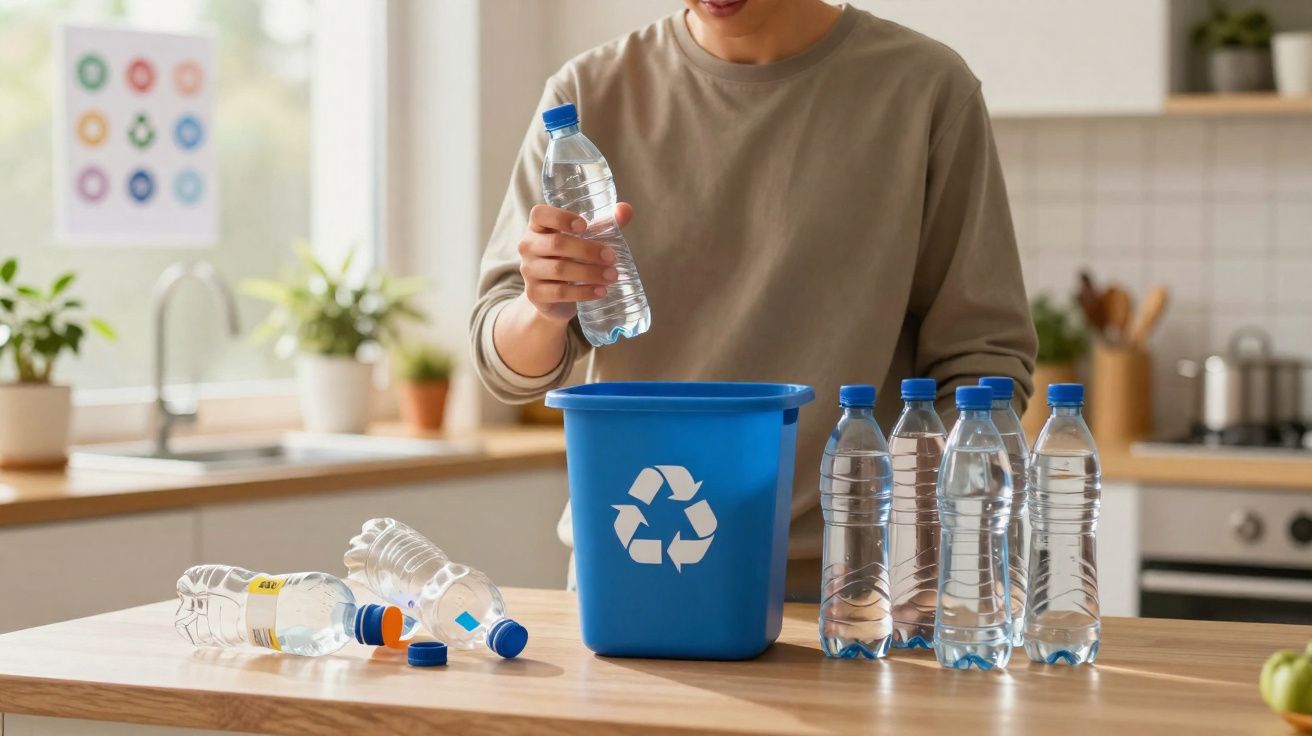
In the rush to tidy the kitchen or take the rubbish out, one small action has become a quiet habit: twisting, crushing or flattening a plastic bottle.
Many people do it without thinking, convinced they are saving space and “doing their bit” for the planet. Yet behind the scenes at recycling centres, this very common behaviour can produce the opposite outcome to what most people expect.
The myth of the crushed bottle that helps the planet
For years, recycling messages have pushed the idea of keeping things neat, reducing volume and making recycling look “tidy”. That’s how the habit took hold: standing on the bottle, twisting it by hand, turning a cylinder into a flat plastic disc.
The issue is that kitchen logic doesn’t match the logic of a sorting line. Sorting equipment is designed to detect items with a particular shape and weight. Once a bottle loses its form, it can all but disappear to the sensors.
Flattening a bottle may make your household bin easier to manage, but it makes life harder for the machines doing the heavy lifting in recycling.
The result is that a PET bottle-material that could become a new bottle, textile fibre or rigid packaging-has a much higher chance of being sent the wrong way on the line, or even rejected and treated as general waste.
How sorting centres (MRFs) actually work
Modern sorting centres-often called Materials Recovery Facilities (MRFs)-are like production lines in reverse. Instead of making products, they “unmake” mixed waste and separate it using conveyor belts, magnets, air jets and optical readers.
These systems are set up to recognise patterns such as:
- shape: cylindrical bottles, cans, tubs, flat paper items;
- weight: differences between light plastics, metals and glass;
- colour: optical sensors that distinguish materials by the light they reflect.
A full-shaped PET bottle, whether lying down or upright, has a recognisable profile. A flattened “plastic pancake”, however, can behave like something else entirely: it may drop with paper, travel with thin plastic film, or be flagged as unidentified residue.
When this happens at scale, the whole chain becomes less efficient. More good material is lost, more manual re-sorting is required, and more time and money are spent.
One poorly sorted batch doesn’t just harm a single bottle: it contaminates the flow and reduces the recovery of tonnes of material.
The environmental cost of sorting errors
PET from drinks bottles is valuable. It can be recycled through multiple cycles while retaining much of its performance-especially when it arrives clean and correctly separated.
When bottles are misread and mixed with the wrong stream, two knock-on problems appear:
- they fail to become recycled feedstock, increasing demand for virgin, oil-based plastic;
- they can contaminate loads of paper, card or other plastics, lowering the quality of the recycled output.
A common example is plastic fragments ending up in paper bales. That mix makes the paper harder to use and, in some cases, the only remaining option becomes incineration or landfill.
Labels and caps on PET bottles: what to do (and what not to do)
Another frequent point of confusion is whether you should remove the label and what to do with the cap. Many people assume they must dismantle the bottle piece by piece to “help” recycling. In most cases, that level of effort isn’t necessary.
The role of the cap on a PET bottle
More up-to-date guidance often runs against common sense: it is usually better to keep the cap firmly screwed on.
Key reasons include:
- loose caps are small, fall off conveyors, clog machinery and get lost;
- when attached to the bottle, they follow the same PET stream and can be separated later;
- although caps are often made from a different plastic (commonly HDPE), they can be handled together initially and separated further downstream if required.
Empty bottle, cap screwed on, and no crushing: this simple combination improves plastic recovery rates.
As for labels, many recycling processes remove them during washing and reprocessing. What tends to cause far more trouble than the label itself is dirt and food or drink residue.
The actions that genuinely make a difference
If your goal is to make recycling work better, these habits help far more than crushing bottles:
- empty the bottle completely;
- give it a quick rinse if it held sugary or fermentable liquids;
- keep the bottle’s shape (don’t flatten it);
- screw the cap back on;
- follow your local kerbside recycling rules.
The rinse does not need to be spotless. A brief swill is usually enough to reduce bad odours, insects and-most importantly-cross-contamination of other recyclables with sticky drink residues.
When crushing can make sense
In some areas, upgraded sorting facilities use technology that focuses more on chemical composition and less on an item’s shape. In those places, crushing a bottle may cause fewer problems.
The catch is that this is not yet the reality for most local authorities. As a general rule today, an uncrushed bottle works better for the system.
| Common habit | Effect on recycling | Recommended alternative |
|---|---|---|
| Crushing bottles to save space | Makes recognition harder for sorting machines | Put bottles out intact, with the cap screwed on |
| Collecting caps separately in a container | Small pieces get lost during sorting | Leave caps attached to bottles |
| Not rinsing sugary drinks | Contaminates loads and attracts pests | Give a quick rinse before disposal |
What “contamination” means in recycling
People working in recycling cooperatives and sorting sites use the word “contamination” a lot. It doesn’t only mean dangerous or toxic dirt. Very often, it simply means the wrong materials mixed together.
Typical examples include:
- plastic mixed into the same bale as paper;
- food leftovers inside “recyclable” packaging;
- broken glass mixed in with other streams.
These mixes reduce the value of the batch. Sometimes reprocessors cannot use the material at the required quality and reject the load, which cuts income for recycling groups and increases the amount that ends up being disposed of.
A practical scenario: two homes, two outcomes
Picture two flats in the same building. In the first, the household crushes every bottle, removes the cap, and throws some away with leftover fizzy drink still inside. In the second, the household keeps bottles in shape, gives them a quick rinse and screws the cap on.
From the pavement, both blue bags look equally “green”. At the sorting centre, the outcomes diverge:
- in the first bag, some bottles drift into the paper stream; loose caps vanish on the conveyor; spilled drink soils other materials;
- in the second bag, most bottles stay in the correct line, with a high chance of becoming new raw material.
The difference comes from seconds-long actions multiplied across thousands of homes.
The risks and limits of good intentions
The biggest risk with a “well-meant wrong idea” is that it creates a false sense of doing things correctly. If someone spends years believing crushing helps, they may never question that the habit can undermine recycling.
The same pattern appears with other materials too: carrier bags inside carrier bags, glass thrown in with metal lids still attached, greasy paper put out for recycling. These are all examples of good intentions that create technical problems further down the line.
Extra UK considerations: kerbside rules and storage at home
In the United Kingdom, what you can recycle-and how-varies by council and by contractor. Some areas accept plastic films at collection points but not in kerbside bins; some take only bottles and not pots, tubs and trays. If you want your PET bottles to be captured reliably, it’s worth checking your local authority guidance rather than relying on national “one-size-fits-all” tips.
How you store recyclables at home also matters. Keep bottles empty, caps on, and avoid stuffing them inside one another with food packaging still dirty, as that can trap residue and transfer contamination. If you use a liner in a recycling container, check whether your council allows bagged recycling-some sorting systems struggle with closed bags because they cannot “see” what’s inside.
Future paths towards smarter recycling of PET bottles
Until sorting technology becomes more consistent everywhere, consumer behaviour remains crucial. Reverse logistics schemes, return systems that keep bottles intact, and improved scanners that identify plastic types more accurately are already spreading-but at different speeds from place to place.
Until those solutions are firmly established, one simple principle helps: treat an empty bottle as a product that still has value, not as meaningless waste. Keeping it recognisable is the first step towards ensuring it truly completes the recycling cycle.






Comments
No comments yet. Be the first to comment!
Leave a Comment