
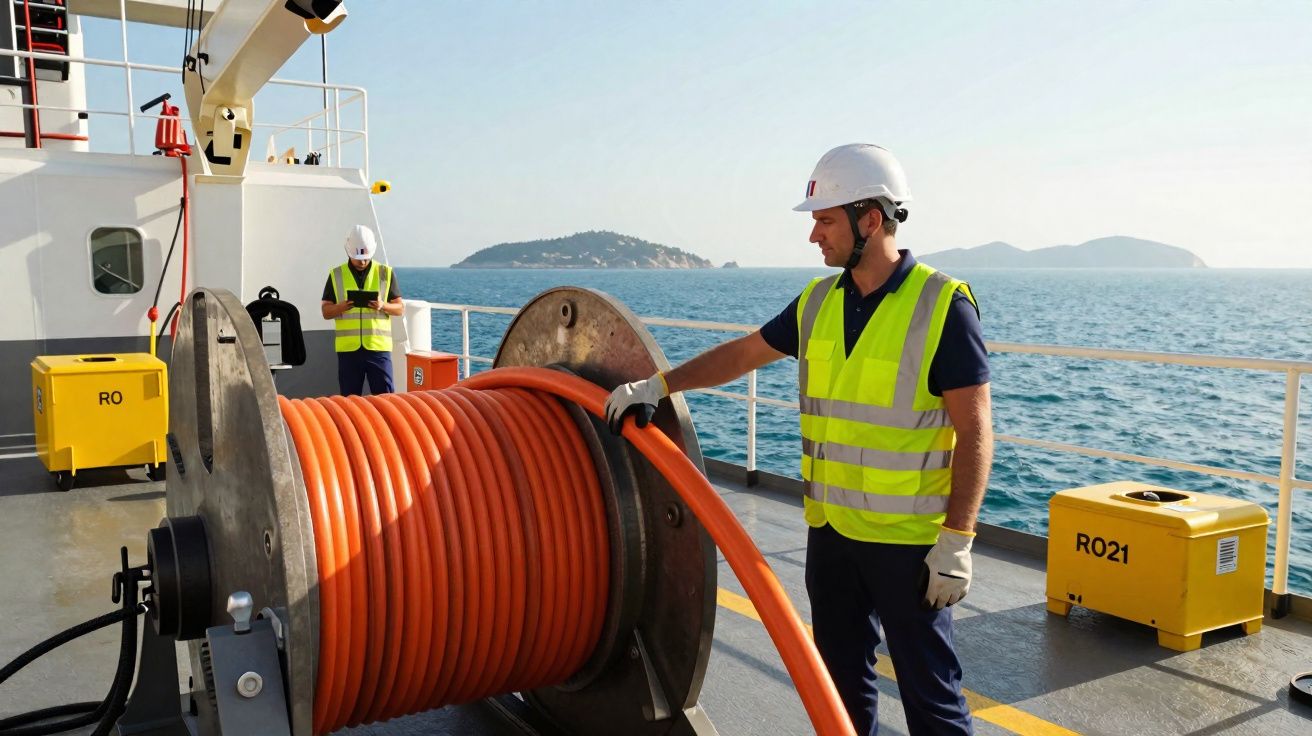
While arguments in France swirl around deindustrialisation, one of the country’s flagship industrial groups is quietly preparing something most nations cannot pull off: installing a high‑voltage subsea power cable at unprecedented depth between Italian islands, in the pitch-black, near-silent pressure of the deep ocean.
France’s “sick industry” narrative meets the Nexans reality check
France is frequently described as a declining manufacturing force, wedged between low-cost Asian competitors and US technology giants. Even so, in a specialised field that has become strategically important for both electricity and data, French expertise sits at the very top of the global table.
A clear demonstration comes from Nexans, France’s subsea cable specialist. The group has been chosen for one of Europe’s most demanding energy infrastructure schemes: Tyrrhenian Link, an underwater electrical “corridor” designed by Italy’s grid operator Terna.
The Tyrrhenian Link will tie together Sardinia, Sicily and mainland Italy using high‑voltage direct current (HVDC) cables laid across hundreds of kilometres of seabed. On part of the route, the installation will descend to 2,150 metres below sea level-establishing a new world record for an HVDC power cable.
At 2,150 metres under the Mediterranean, this French-made HVDC cable is set to become the deepest link of its kind ever installed worldwide.
For Paris, this is not merely a welcome export win. It shows that strategic industrial capability remains intact in domains tied to sovereignty, energy security and-more and more openly-geopolitics.
Tyrrhenian Link: an invisible backbone beneath the Mediterranean
At its core, Tyrrhenian Link is intended to solve a straightforward but consequential weakness in southern Italy: electricity generation and electricity demand do not always align between regions.
Sardinia, boosted by strong wind resources and expanding solar capacity, can produce an electricity surplus at certain points in the day. Sicily, together with the heavily populated Campania area around Naples, faces more uneven demand patterns and depends heavily on imports from the mainland.
Balancing islands and mainland in real time
Nexans is delivering the western section of the project, spanning from southern Sardinia to Fiumetorto on Sicily’s northern coastline. The plan involves laying several hundred kilometres of cable along the seabed, including the deepest segment beyond 2,150 metres.
The operating logic is uncomplicated, yet the system effect is significant. When Sardinia generates more renewable electricity than it can use, the link will move that surplus to Sicily and onward into the mainland grid. When demand rises in Sicily, the flow can be reversed.
Functioning as an unseen electrical bridge, the cable effectively turns three separate systems into a single, more agile network.
HVDC (high‑voltage direct current) is used because it transmits electricity over long distances with lower losses than classic alternating current solutions-an advantage that becomes decisive when you are moving hundreds of megawatts through a cable stretching for hundreds of kilometres along the seabed.
- Technology: HVDC subsea power cable
- Depth record: 2,150 metres beneath the Mediterranean
- Western route: southern Sardinia to Fiumetorto (Sicily)
- Total project cost: €3.7 billion invested by Terna
- Key supplier: Nexans (France)
Engineering beyond 2,000 metres: accuracy under crushing pressure
What the sea conceals is the true technical difficulty. At depths greater than 2,000 metres, pressure is around 200 times higher than at the surface. Water temperatures are close to freezing, currents can shift with little warning, and there is virtually no tolerance for improvisation.
To carry out the work, Nexans is deploying some of the most advanced cable-laying ships currently operating, including the Nexans Aurora. This specialist vessel is 149 metres long, can transport more than 10,000 tonnes of cable, and is equipped with dynamic positioning systems, remotely operated vehicles and subsea trenching equipment.
Every metre must be positioned with near-surgical precision, following a mapped route designed to avoid steep gradients, rocky ground and existing subsea infrastructure.
From the onboard control room, teams track cable tension, laying speed, seabed topography and weather conditions continuously. Excessive tension risks damaging the cable; too little tension can create loops or bends that may compromise long-term integrity over decades.
After placement, sections are often protected by being buried using underwater ploughs or jetting tools. This reduces exposure to anchors, fishing activity and the possibility of deliberate interference.
Record-setting depth-and a proving ground for Europe
The depth milestone attracts attention, but for European energy planners the bigger story is what Tyrrhenian Link proves: deep, long subsea routes are now feasible not only technically but commercially.
Subsea “power highways” can connect far-flung islands, offshore wind clusters and entire national grids. Interconnectors already link the UK and France, Norway and Germany, and Denmark and the Netherlands. Extending these concepts to deeper and longer corridors opens new possibilities-especially across the Mediterranean and into the North Atlantic.
For Italy, Tyrrhenian Link helps reinforce grid resilience and integrate more renewables without leaning solely on local back-up plants. For Nexans, it becomes a flagship reference that strengthens future bids worldwide.
French subsea cable capability: a discreet strategic advantage
This project sits on top of one of France’s less visible strengths. The country represents roughly a third of the global fleet of cable-laying ships used for both power and telecommunications links-an unusually strong position for a mid-sized industrial economy.
French ships and crews operate across the Atlantic, the North Sea, the Mediterranean and Asian waters, laying not only electricity connections but also fibre‑optic cables that carry the majority of international internet traffic.
In Paris, influence over subsea cables is increasingly treated as a sovereignty tool-close in importance to satellites or secure data centres.
Recent events-such as damage to gas pipelines and communications cables in the Baltic-have heightened concern among European governments. As societies become more dependent on digital and electrical flows, these long, exposed lines become more tempting targets and more disruptive failure points during crises.
In that environment, industrial actors like Nexans are no longer viewed simply as exporters. They are pulled into wider strategic discussions spanning defence, cyber security and foreign policy.
Environmental surveys and permitting (an often unseen part of the work)
Large subsea cable projects also rely on extensive marine surveying and environmental assessment before installation begins. Route planning typically involves seabed mapping, geotechnical sampling and checks for sensitive habitats, cultural heritage sites and existing infrastructure-work that can materially shape the final corridor and burial depth strategy.
These requirements matter for public acceptance as well as engineering performance: a well-chosen route reduces ecological disturbance, limits future repair needs and improves protection against hazards such as trawling and anchoring.
Electra: Nexans’s next subsea heavyweight
The Tyrrhenian Link award is not Nexans’s final statement. The group is completing a new flagship vessel, Nexans Electra, designed to further strengthen France’s position in subsea installation.
Being fitted out in Norway, Electra measures 155 metres and is purpose-built for long, complex subsea campaigns. It includes two huge cable carousels with capacities of 10,000 tonnes and 3,500 tonnes, as well as a dedicated 450‑tonne tank for fibre‑optic cables. A hybrid propulsion system compatible with biofuels is intended to cut emissions and reduce operational noise.
With Electra, Nexans is aiming to string together lengthy missions-deploying power and data cables across oceans without repeated returns to port.
The vessel prioritises endurance, accuracy and adaptability. It is designed to manage multiple cable types in a single campaign, which is particularly useful in zones where offshore wind export cables, grid interconnectors and telecom links are developed side by side.
As offshore wind farms move farther from shore and into deeper waters, demand for these capabilities is expected to rise. Nexans is positioning itself as a preferred partner for utilities and governments planning multi‑gigawatt build-outs.
Skills, supply chains and long-term industrial value
Behind vessels like Nexans Aurora and Nexans Electra sits a wider industrial ecosystem: cable manufacturing, power electronics, robotics, marine operations and specialised surveying. Sustaining this capability requires long-term investment in engineering skills, safety culture and supply chain resilience-precisely the kinds of industrial foundations often overlooked in day-to-day political debate about deindustrialisation and the “sick industry” label.
Why deep subsea cables shape everyday life
HVDC power links and fibre‑optic cables are largely out of sight. Yet they influence daily life and future policy decisions in surprisingly direct ways.
From streaming video to grid resilience
On the data side, subsea cables carry more than 95% of global internet traffic. Satellites may dominate headlines, but streaming, cloud services and financial trading mostly depend on glass fibres laid across ocean floors.
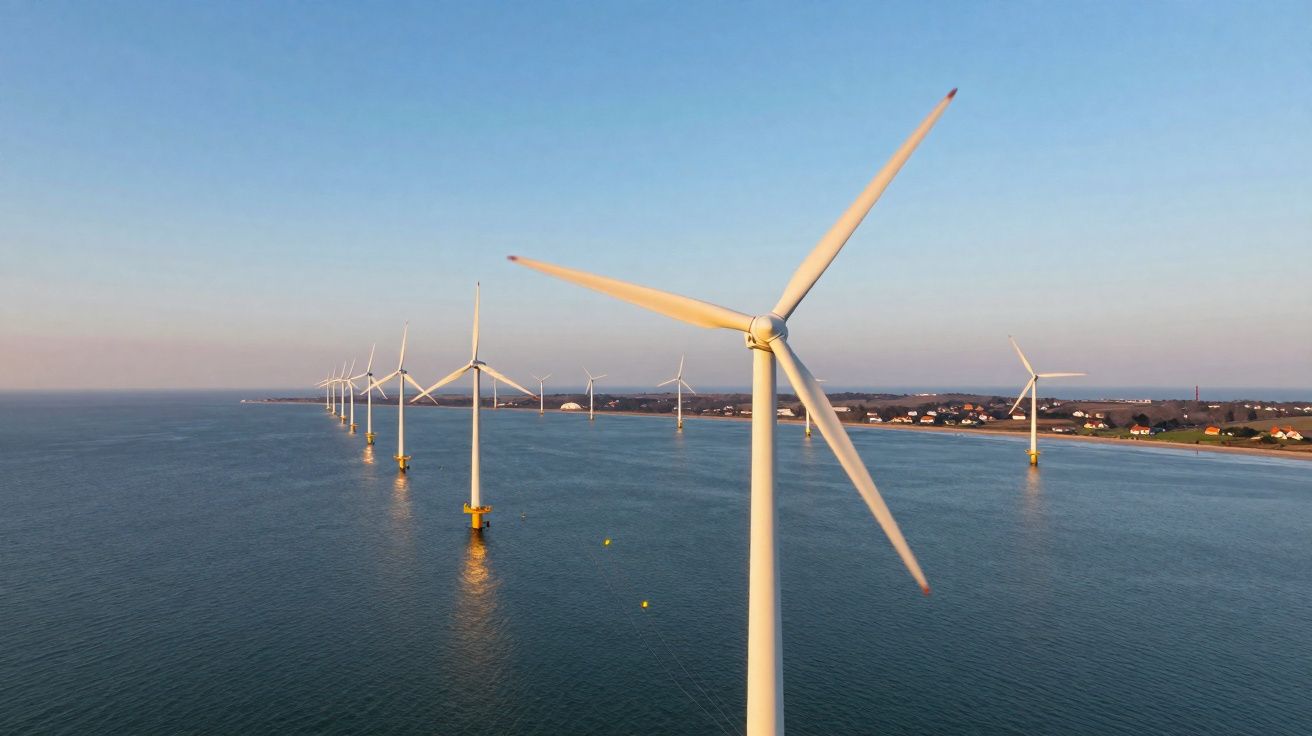
On the energy side, schemes like Tyrrhenian Link make it easier to absorb higher shares of wind and solar. By smoothing mismatches between local generation and demand, they cut renewable curtailment when networks are constrained and reduce reliance on gas-fired back-up capacity.
For households and businesses, this can mean fewer outages, steadier prices and an easier route to electrifying heating, transport and industry. For governments, it creates practical scope to trade electricity across borders, share reserve capacity and reduce dependence on single suppliers of gas or coal.
Key terms worth understanding
Two technical phrases recur in these projects:
- HVDC (high‑voltage direct current): electricity transmitted in one direction at very high voltage, reducing losses over long distances and enabling precise control of power flows between grids that may not be fully synchronised.
- Interconnector: a cable or line linking two separate power systems-often in different regions or countries-used for back-up support and cross-border electricity trade.
In practical terms, an HVDC interconnector can allow one country to export surplus wind power overnight, while importing hydroelectric or nuclear electricity back during daytime peaks-reducing stress on both grids.
Risks, opportunities and what could come next
Greater reliance on subsea infrastructure brings vulnerabilities. Cables can be struck by anchors, affected by earthquakes, or targeted during conflict. Repairs are technically complex, constrained by weather and availability of specialist vessels. That is why insurance, monitoring and redundancy are increasingly central to project design.
Yet the advantages are tangible. Cross-border links can reduce the overall cost of decarbonising electricity systems. Deep-water connections can unlock renewable resources far from major cities. Industrially, countries that lead in this niche can support high-value employment in shipbuilding, robotics, power electronics and advanced materials.
If Tyrrhenian Link delivers as intended and similar corridors multiply, Europe could develop a dense web of subsea arteries transporting both electrons and data. In that scenario, France’s much-debated industrial base looks less bleak: weaker in some areas, but still highly capable in a few that matter-quietly, thousands of metres beneath the waves.





Comments
No comments yet. Be the first to comment!
Leave a Comment