
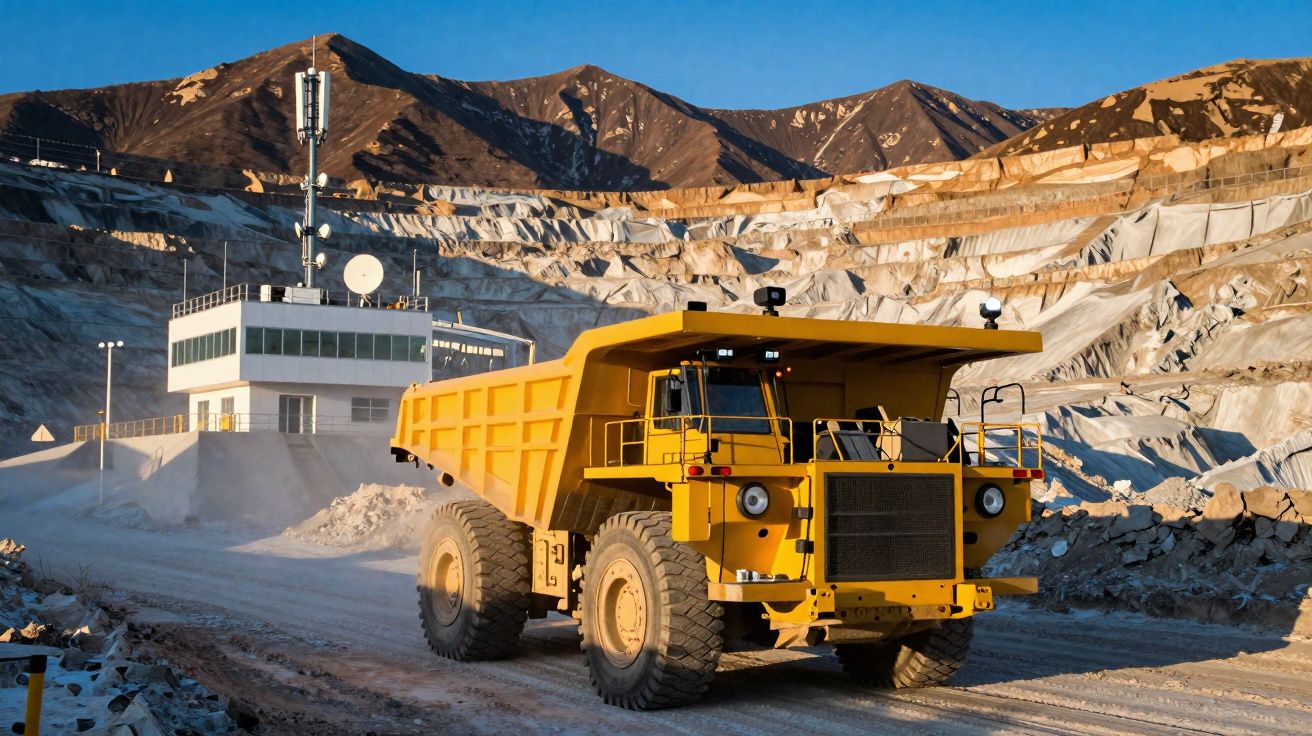
At an altitude where a gentle stroll can feel like a sprint, China is quietly carrying out an industrial-scale trial.
High above conditions most people will ever encounter, the Huoshaoyun mine is being used to find out how much mining can be done by machines when sustained human work becomes impractical. With thin air, biting cold and construction that demands sheer endurance, Beijing is placing a major wager on driverless heavy trucks to reach a vast store of metal locked beneath the rock.
The Huoshaoyun mine: a fortune hidden in air so thin it makes you light-headed
The Huoshaoyun mine lies in the Kunlun mountains, within the disputed Aksai Chin region of western China, at roughly 5,600 metres above sea level. That puts it higher than La Rinconada in Peru, the notorious high-altitude gold settlement often cited as one of the toughest places on Earth to work.
At around this elevation, even modest exertion demands extra breaths. Temperatures can fall to -20°C or lower, winds slice through insulated clothing, and the ground remains frozen for much of the year. Establishing long-lasting infrastructure is challenging; keeping a consistent human workforce is harder still.
And yet the prize is substantial. Beneath this severe landscape sits a major lead and zinc reserve. Chinese studies put the resource at more than 21 million tonnes of ore, with an estimated value of about €45 billion at current prices. Huoshaoyun is already counted among the world’s largest lead–zinc deposits, and surveys indicate surrounding peaks may contain additional, still-unexploited resources.
At 5,600 metres, Huoshaoyun blends the hazards of high-altitude mountaineering with the footprint of an industrial mining complex.
For many mining operators, the mix of cost, safety risk and logistics would make such a site borderline uneconomic. China has treated those same constraints as the rationale for aggressive automation: a mine run as far as possible by equipment that does not tire, cough or suffer frostbite.
Driverless heavy trucks built for conditions where people struggle to function
The project’s centrepiece is a fleet of autonomous mining trucks, described in Chinese reporting as the largest driverless mining convoy currently in operation. These are not ordinary road lorries with a few added sensors; they are heavy-duty industrial platforms designed around autonomy, dense with computing power and perception hardware.
How autonomous mining trucks “see” through dust, snow and ice
Each vehicle carries multiple sensing systems-cameras, radar and lidar-combined with GPS and inertial navigation to pinpoint position accurately on mountain haul roads. On-board computers fuse these streams into a continuously refreshed 3D view of the surroundings.
Using that model, the trucks detect hazards, choose safe speeds and prepare for tight bends on steep, icy routes. If a rockfall narrows a section of road, or drifting snow changes the shape of a corner, the trucks adapt their line and behaviour in real time rather than simply following a fixed script.
These machines are not merely tracking a pre-programmed route; they are constantly interpreting a landscape that can shift within hours.
The role of 5G, Huawei and remote control centres
Autonomy is only part of the design; connectivity is just as important. The trucks are linked by 5G, using equipment from Huawei according to Chinese reports. High bandwidth and low latency allow vehicles to exchange sensor information and coordinate movements, lowering the risk of incidents on narrow, high-risk mountain roads.
The same network ties the site to remote control centres hundreds of kilometres away. Operators sit at screen-lined virtual cockpits and can call up a stitched, near 360-degree view from any selected truck. When the software encounters conditions beyond its comfort zone, a human can intervene-taking over driving or precise loading actions at the press of a button.
Why altitude turns automation into a safety measure, not just a cost play
Mining companies commonly adopt autonomy to reduce labour costs and keep equipment working day and night. At Huoshaoyun, the motivation is more fundamental: reducing the number of people who must spend long shifts at 5,600 metres.
Extended work at that height brings genuine medical danger, including altitude sickness, chronic hypoxia and cold-related injury. A conventional open-pit operation would require heavy medical provision, costly accommodation and continual staff rotation to lower elevations-all of which drives up the cost per tonne of ore.
By contrast, autonomous haulage lets the mine run 24/7 with a far smaller on-site workforce. A limited group of technicians and safety staff remain at altitude, while many drivers and supervisors can work from distant urban locations.
- Reduced human exposure to altitude, cold and dust
- Fewer stoppages caused by fatigue, illness or severe weather
- More consistent haul cycles and planned maintenance windows
- Lower insurance and safety-related operating costs
Early trials cited by state-linked Chinese sources report a steadier ore flow than would be expected with human drivers, particularly through the long winter period when conditions are harshest.
Zinc, lead and the quiet contest for critical metals
The schedule behind Huoshaoyun is not accidental. Zinc and lead rarely attract the same attention as lithium or cobalt, but both remain foundational to modern industry.
Zinc is used extensively for galvanising steel, protecting bridges, buildings and vehicles from corrosion. It also features in alloys and in certain battery chemistries. Prices have hovered around €2,500 per tonne, with analysts pointing to downward pressure from expanding supply and only moderate growth in demand.
Lead, trading near €1,970 per tonne, is still central to industrial and automotive batteries-particularly in back-up power systems and conventional vehicles. Even as electric vehicles dominate headlines, lead–acid batteries continue to underpin large parts of everyday energy storage and resilience.
| Metal | Main uses | Approximate price (Dec 2025) |
|---|---|---|
| Zinc | Galvanised steel, alloys, some batteries | €2,500 / tonne |
| Lead | Industrial and automotive batteries | €1,970 / tonne |
Locking in a huge, long-duration supply of both metals strengthens China’s position across global manufacturing chains. Western economies have already watched Beijing build leverage in rare earths, battery materials and metal refining; Huoshaoyun suggests that extracting resources from extreme environments may be the next competitive edge.
Towards a fully autonomous mine at Huoshaoyun
From haulage to extraction, one system at a time
At present, the most visible milestone is the driverless truck operation. However, engineers connected to the project have signalled ambitions to push automation further upstream into extraction.
The next steps would extend remote or autonomous control to excavators and drill rigs. In principle, ore could be drilled, blasted, loaded and hauled with minimal direct human presence at the working face. Downstream, conveyors, crushers and sorting facilities could be orchestrated through integrated digital control platforms, using real-time operational data.
The aim is not only self-driving trucks, but a near-continuous, largely unmanned loop from rock face to processing plant.
Comparable ideas have been proven in more forgiving settings, such as Australian iron ore operations. Huoshaoyun is a more punishing test: if automation remains reliable in thin air and deep cold, deploying it at lower altitudes becomes considerably easier.
The hidden engineering challenge: power, maintenance and logistics at 5,600 metres
One aspect that rarely gets attention is the support system required to keep high-tech equipment running at this elevation. Sensors, compute units, communications gear and heated enclosures all depend on dependable power and robust maintenance routines. Cold affects batteries, lubricants and hydraulic systems; spare parts and specialist technicians are harder to move quickly when weather closes routes. In practice, sustaining autonomy in such a place is as much about resilient logistics and preventative maintenance as it is about algorithms.
A signal that travels well beyond one mountain
Huoshaoyun carries political weight as well as economic promise. The site is positioned in a strategically sensitive border region touching India and Tibet. Operating a high-profile, advanced industrial project there serves as a demonstration of Chinese administrative control and technical capability in contested territory.
Beyond signalling, the technology has wider implications. The same combination of remote operation, AI-assisted guidance and ruggedised vehicles could translate to other hostile settings-Arctic mines, deep desert projects and, in the longer term, even concepts such as lunar regolith extraction.
Countries with mineral deposits locked in frozen ground or steep mountain geology will be paying close attention. If China can make a high-altitude mine commercially viable through automation, deposits previously dismissed as too dangerous or too expensive may begin to look workable.
Benefits and risks of removing people from the pit
The clearest benefit is safety. Taking drivers out of heavy haul trucks reduces the probability of serious collisions. Fewer workers on exposed slopes also means lower risk from slips, avalanches and sudden weather emergencies.
There is an environmental dimension too. Autonomous fleets can manage fuel use more efficiently by keeping speed steady and reducing unnecessary idling. Over years of continuous operation, that can cut diesel burn and emissions per tonne hauled-although the overall mine footprint remains significant.
The trade-offs are substantial. Automation reshapes employment: where local communities might once have expected driving and equipment-handling roles, opportunities can shift towards software, data and specialist maintenance-often based far from the mine itself.
Technical vulnerabilities also grow. Heavy reliance on 5G links and remote operations raises cyber-security and resilience questions. A prolonged communications failure during poor weather could stop production. Errors in sensor fusion, mapping or navigation software could lead to crashes or equipment damage in a place where recovery and repairs are slow and expensive.
A further consequence is governance: a highly automated operation must demonstrate clear safety cases, auditability of decisions and robust incident response-particularly when humans supervise several machines at once from a distant control centre.
What “autonomous” really means in a mine like Huoshaoyun
For anyone thinking of self-driving taxis or delivery robots, mining autonomy works differently. The site is private, controlled and geofenced. Traffic patterns are comparatively predictable, dominated by trucks, loaders and support vehicles moving on defined routes.
That makes mining a strong proving ground for advanced robotics, but autonomy is seldom absolute. Engineers typically describe “levels” of automation, where machines handle most routine decisions and humans step in when required.
In practical terms at Huoshaoyun, “autonomous” appears to mean:
- Trucks manage routine haulage under software control
- Remote operators oversee several vehicles simultaneously
- Manual human driving is kept for complex tasks and emergencies
This hybrid approach reflects a broader industrial reality: human judgement is not eliminated-it is relocated, and spread across a larger number of machines.
What is happening on this frozen mountain is therefore about more than pulling ore from thin air. It is a live test of how far heavy industry can advance when the limits of the human body become the key constraint-and of the new constraints automation may introduce in exchange.

Comments
No comments yet. Be the first to comment!
Leave a Comment