
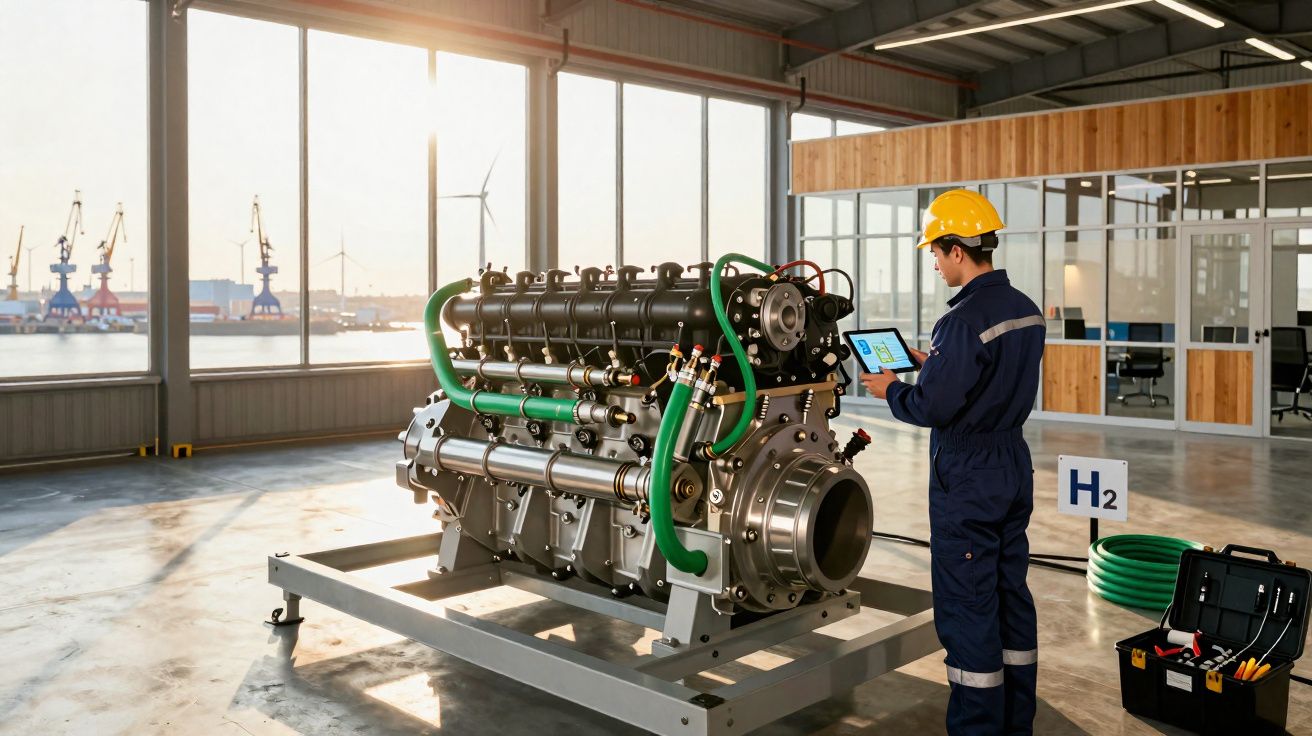
On France’s Atlantic seaboard, a long-established engine works is quietly gearing up for what could be its most intense period of activity since the post‑war boom.
The Saint-Nazaire plant-famous for manufacturing diesel engines whose mass can exceed that of a fully laden passenger aircraft-is moving into a new phase under its German owner, Everllence. A surge in demand from nuclear power and low‑carbon shipping is pushing the site into expansion mode.
Everllence Saint-Nazaire plant: from S.E.M.T. legacy to a modern heavyweight
In Saint-Nazaire, heavy industry has always been part of the scenery. The engine facility traces its origins to 1946, when S.E.M.T. (the Society for the Study of Thermal Machines) began developing and producing large diesel engines for ships and power stations.
For decades, the S.E.M.T. name became synonymous with marine propulsion and industrial engines. Even after the original company vanished in 2006, both the brand and the site endured through a series of owners and are now part of the German energy group Everllence, previously known as MAN Energy Solutions.
Around 600 people are employed at the Saint-Nazaire site today. As it approaches its 80th anniversary, the celebration is not symbolic: the plant is receiving a substantial industrial enlargement, new office space, and a rapid increase in production capacity.
Everllence intends to turn Saint-Nazaire into an industrial “war machine”, increasing output by roughly 40% by 2028.
That ambition reflects a straightforward market shift. Two sectors that do not always accelerate at the same time-nuclear energy and maritime transport-are simultaneously calling for ultra‑robust, fuel‑flexible engines.
Nuclear engines designed for worst‑case events
Within a nuclear power station, Everllence engines (alongside a small set of competitors) perform a role that is largely invisible but indispensable. They are not built to drive the main turbines or supply the grid during routine operation.
Instead, they remain on standby as a final safety layer, engineered to start when other systems have failed.
These large engines serve as:
- emergency diesel generator sets,
- backup power systems for essential safety equipment,
- autonomous electricity units if the external grid collapses.
If a plant loses its off‑site power supply, the engines must start within seconds. Once online, they deliver power to:
- reactor and spent fuel pool cooling systems,
- safety and containment pumping systems,
- instrumentation and control systems that allow operators to maintain command.
They are designed for “design‑basis accidents” and more severe scenarios: earthquakes, flooding, and grid failures where each minute is critical. Here, reliability is not a sales phrase; it is embedded in standards and proven through testing under harsh conditions.
The IAEA estimates global nuclear capacity could grow from roughly 377 GW today to nearly 1,000 GW by 2050, drawing emergency equipment suppliers such as Everllence into a multi‑decade investment cycle.
Each new reactor project, along with every life‑extension programme, needs validated backup power solutions. That directly supports a stronger, longer‑lasting order pipeline for Saint-Nazaire and explains why the site is preparing for durable expansion rather than a short-lived peak.
Maritime transition: regulation as the catalyst
Shipping is being pushed by a different set of forces-but with equally strong effect. International rules are tightening on CO₂ and pollutant emissions from vessels operating worldwide.
The International Maritime Organization (IMO) is targeting a 40% reduction in carbon intensity by 2030 and 70% by 2040, with climate neutrality as the mid‑century destination. In Europe, the EU is also drawing shipping into carbon pricing, meaning cargo ships above 5,000 tonnes will progressively pay for their emissions.
For shipowners and charterers, the financial impact is substantial:
- new low‑carbon‑ready ships can cost 30–50% more than conventional vessels,
- alternative fuels such as advanced biofuels or e‑methanol can be two to five times the price of heavy fuel oil,
- fleet renewal could require up to US$28 billion per year,
- fuel supply and infrastructure spending may reach US$90 billion per year.
Against that backdrop, scrapping large numbers of existing ships becomes an expensive route. Retrofitting engines and propulsion systems often looks like the more workable option.
Converting 320‑tonne giants to low‑carbon fuels
Everllence’s strategy is to modify its immense four‑stroke engines so they can operate on liquid biofuels and other low‑carbon fuels-rather than waiting for a fully hydrogen‑ or ammonia‑powered global fleet that may take decades to arrive.
A flagship example is the 51/60DF series: a multi‑fuel engine that, in marine form, can weigh up to about 320 tonnes per unit, rising beyond 400 tonnes in the largest power-generation versions.
Core characteristics of the MAN 51/60DF‑type engine include:
- four‑stroke architecture with very high power density,
- inline 6‑cylinder, V‑12 and V‑18 configurations,
- output up to around 20,700 kW at 500–514 rpm,
- capability to run on diesel, heavy fuel oil, natural gas, or advanced biofuels,
- direct start in gas mode using roughly 1% pilot fuel.
With a 510 mm bore and 600 mm stroke, the engine sits firmly in the “mega‑engine” class-well suited to large cargo vessels, floating power barges, and emergency power applications for critical infrastructure.
By prioritising retrofits and fuel flexibility, Everllence gives operators a route to reduce emissions without redesigning entire ships or replacing propulsion layouts. For Saint-Nazaire, that translates into sustained workload: the site is increasing output from 48 to 72 large engines per year and is adding roughly 24 additional units in 2025 alone.
The French site is positioning itself as a global centre for XXL engines that comply with tougher climate rules while making use of existing ships and infrastructure.
6,000 m² of refurbished offices and a modernised factory floor
Meeting the volume of new orders requires more than simply assembling more engines. Everllence is also reshaping how the Saint-Nazaire site operates.
On the production side, investment is focused on:
- upgraded assembly and machining lines,
- improved internal logistics and material flow across workshops,
- test facilities adapted for new fuels and hybrid configurations.
Away from the shopfloor, the white‑collar areas are also being overhauled. About 6,000 square metres of office space will be fully refurbished over a two‑year period.
This 80th‑anniversary “gift” has three specific aims:
- provide improved working conditions and more collaborative areas,
- help recruit scarce engineering and digital talent,
- enable a move towards more design work, systems integration, and innovation.
Leadership wants Saint-Nazaire to do more than assembly. The intention is for the site to host project teams focused on control systems, fuel‑conversion kits, and lifecycle services for both nuclear operators and shipowners.
Alongside the physical expansion, the ramp‑up typically brings knock‑on effects that are not always visible in headline figures: supplier capacity, machining subcontractors, and specialised testing partners must scale in parallel. In practice, keeping lead times under control often depends on deepening local and regional supply chains as much as it does on adding production bays.
A further dimension is skills. As engines become more fuel‑agnostic and more tightly integrated with digital control and monitoring, the plant’s growth increasingly hinges on training-whether through apprenticeships, mid‑career conversion programmes, or partnerships with technical colleges-so that mechanical expertise is matched by automation and data capabilities.
Saint-Nazaire’s role as an Atlantic energy gateway
Geography strengthens the plant’s industrial logic. The Everllence factory sits opposite the Greater Nantes–Saint-Nazaire Maritime Port, one of the key entry points for energy flows on France’s Atlantic coast.
In 2025 the port handled 26.4 million tonnes of cargo, including 18 million tonnes of energy products such as oil and LNG. More than 3,000 ships call each year, supporting nearly 29,000 direct jobs across 1,460 hectares.
Within this dense industrial ecosystem, the engine plant operates alongside major players such as the Atlantic shipyard, EDF, TotalEnergies and ArcelorMittal. The site also has a dedicated quay, enabling 48/60 and 51/60 engines-sometimes weighing as much as a small locomotive-to be loaded directly onto specialist ships or barges.
| Key figures for Saint-Nazaire energy hub | Value |
|---|---|
| Annual port traffic (2025) | 26.4 million tonnes |
| Energy-related traffic | 18 million tonnes |
| Ships handled per year | 3,068 |
| Direct jobs on site | ~28,700 |
| Port area | 1,460 hectares |
The surrounding area is also connected to France’s “France 2030” industrial strategy via the ZIBaC Loire Estuary programme, funded with €8.2 million to back projects involving hydrogen, CO₂ capture and biofuels. Everllence’s output aligns with that direction by providing heavy-duty equipment compatible with these emerging energy pathways.
Engines at the crossroads of energy security and climate neutrality
Behind the language of “war machines” and 320‑tonne steel assemblies lies a practical dilemma: modern economies are pursuing climate neutrality while still requiring secure, continuous access to energy.
In nuclear power, emergency engines are a last-resort safeguard. In shipping, multi‑fuel engines offer a way to reduce emissions while global trade still depends on long‑range maritime transport. Everllence operates where these two requirements overlap.
This intersection also sharpens debates about fuel strategy. Switching a large vessel from heavy fuel oil to sustainable biofuel can lower CO₂ emissions, but it also shifts attention to feedstock availability, land use, and price volatility. For nuclear backup power, moving from standard diesel to synthetic or bio‑derived fuels can reduce lifecycle emissions, yet it demands rigorous validation to ensure performance remains dependable during extreme events.
For readers unfamiliar with industry terminology, “dual‑fuel” means an engine can run either on a gaseous fuel (such as natural gas or biomethane) or on a liquid fuel (such as diesel). A very small share of liquid fuel-known as pilot fuel-ignites first and helps the gas burn more efficiently and cleanly. This approach allows operators to respond to fuel-price movements and regulatory change without replacing the engine’s fundamental architecture.
In practical terms, a vessel using a 51/60DF‑type engine might operate largely on LNG early in its service life, transition to bio‑LNG or e‑methane blends, and later undergo further retrofits as standards tighten. A nuclear facility can deploy similar technology in standby applications, with fuel flexibility becoming relevant if carbon pricing expands to backup generators or if certain fuels become politically contentious.
For Saint-Nazaire, that uncertainty is almost an advantage. As long as policy and investment continue to push towards lower‑carbon energy and tougher safety requirements, demand for large, adaptable engines is likely to remain high-meaning the plant entering its ninth decade appears set to be busier than ever.
Comments
No comments yet. Be the first to comment!
Leave a Comment