
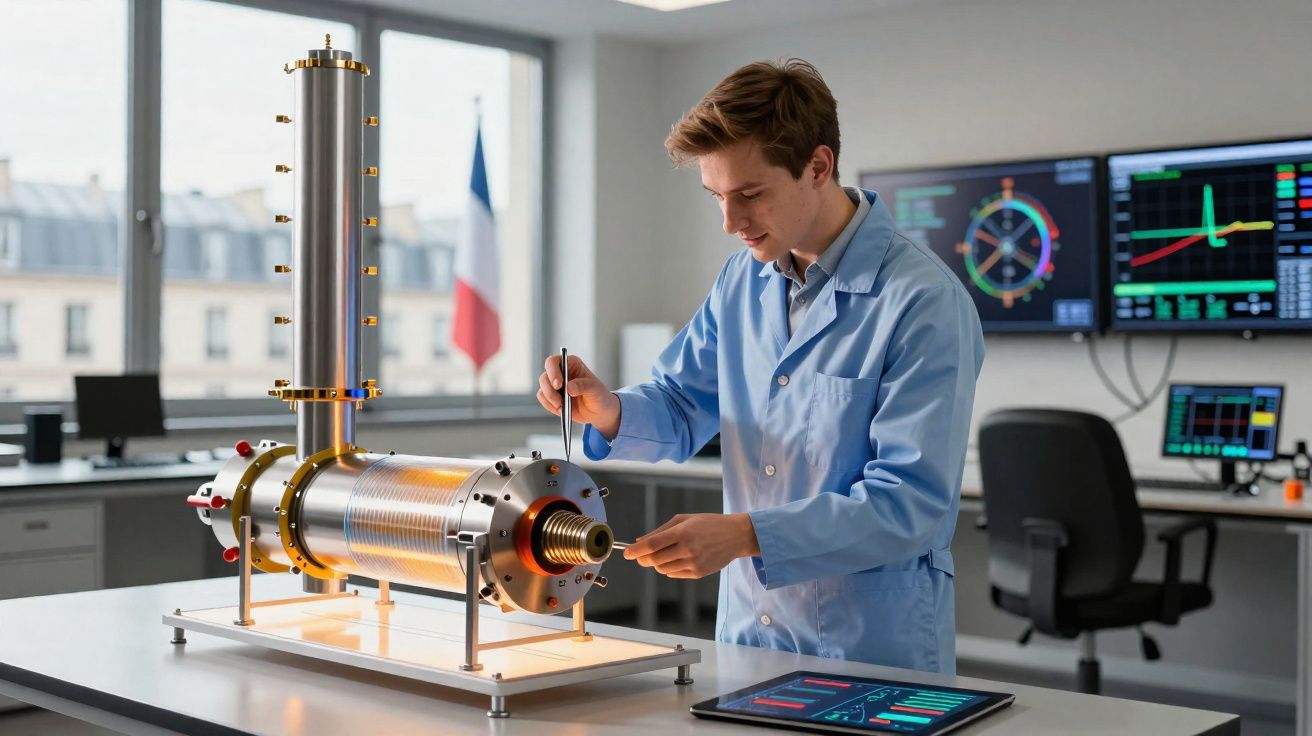
In the space of only a few months, three young firms have moved their small and advanced reactor plans from pitch decks to the desk of France’s nuclear regulator, creating an unusually clear sense of forward motion in a field that has spent much of the last decade under pressure.
Three challengers under ASNR: a new phase for French nuclear
Since the end of 2025, France’s nuclear landscape has started to change pace. Alongside the established industrial groups, newer entrants are now taking concrete regulatory steps rather than simply promoting concepts. Their technical files are being submitted to the Nuclear Safety and Radiation Protection Authority (ASNR), the national body created by combining the functions of earlier safety and radiological protection organisations.
Three names are now particularly prominent: newcleo, Stellaria and Jimmy Energy. Each is pursuing a different SMR (small modular reactor) or AMR (advanced modular reactor) pathway, with distinct target customers and schedules. What they have in common is that they are now facing direct, formal examination by one of Europe’s most demanding nuclear regulators.
The fact that three advanced reactor programmes have reached the ASNR in such a short period is the strongest indication in years that French nuclear ambitions are moving from rhetoric to engineering deliverables.
Two of the companies - Stellaria and Jimmy Energy - have already lodged a DAC (their application for construction authorisation). This is a decisive milestone: once granted, it effectively recognises the applicant as a nuclear operator, locks in the reference design and places full legal responsibility for safety on the company for the entire lifetime of the installation.
newcleo has chosen a different sequencing. Instead of immediately filing its construction authorisation application, it has submitted a detailed nuclear safety programme for its lead‑cooled fast reactor, enabling an organised technical exchange with the ASNR while parts of the design can still be refined.
newcleo lead‑cooled fast reactor: fast neutrons, recycled fuel and a French pathway
A start-up with unusually strong financing
Created in 2021 by Italian nuclear physicist and former CERN researcher Stefano Buono, newcleo is aiming to bring fast reactors back into the mainstream - but in a form compatible with twenty‑first‑century regulatory expectations and public scrutiny.
Although the business has Franco‑Italian roots, it is headquartered in Paris. Since its launch it has raised more than €500 million from private European investors - a striking level of capital for a young civil nuclear developer.
That funding underpins several efforts running in parallel: development of the LFR‑AS‑30 and the larger LFR‑AS‑200 lead‑cooled fast reactors, plans for a fuel manufacturing facility, and a sizeable experimental programme in Italy. The stated objective is to submit a DAC in France by 2027, and - subject to public consultation and regulatory approval - to have a first modular unit operating at Chinon at around 2031.
Why lead coolant and fast neutrons matter (Generation IV)
newcleo’s reactor concept sits within the Generation IV family. It uses fast neutrons in the core, and liquid lead in place of water as the coolant.
Key safety-relevant characteristics include:
- Atmospheric pressure operation, which reduces exposure to the types of failures associated with high‑pressure circuits.
- A very high boiling point, creating wide thermal margins.
- High thermal inertia, supporting passive cooling approaches if active systems are unavailable.
These characteristics underpin the safety demonstration now being reviewed. The submission explains expected behaviour during routine operation, during transients such as rapid shutdowns, and under degraded conditions. It also addresses post‑shutdown heat removal and how the core remains controllable and confined during severe and extreme scenarios.
At the centre of the newcleo proposition is a dual claim: reliable low‑carbon electricity and a route to reduce the long‑lived waste burden.
A reactor designed around advanced fuel (MOX and multi‑recycling)
newcleo’s reactor plan is closely linked to its fuel strategy. In late 2024, the company submitted a separate safety programme for a facility intended to manufacture advanced fuels, including MOX and recycled materials derived from existing spent fuel.
Part of this approach has already gained local support. In the Aube département, authorities have agreed to sell land for a MOX fuel plant estimated at about €1.8 billion, with the potential to create around 1,700 direct jobs. The intent is that this plant would supply the lead‑cooled reactors and enable multi‑recycling - treating certain high‑level waste streams as inputs for new fuel rather than consigning them solely to long‑term storage.
Crucially, the ASNR is assessing the reactor and the associated fuel approach as a connected system rather than as separate dossiers. That combined assessment will influence the safety opinion delivered to the relevant ministry before any construction authorisation is issued.
Data first: ENEA Brasimone Research Center and the PRECURSOR mock‑up
Rather than relying mainly on modelling, newcleo is emphasising experimental validation. At the ENEA Brasimone Research Center in Italy, 16 research installations are already operating or under construction to explore fluid behaviour, materials performance and thermal responses under conditions representative of the intended reactor.
In addition, the company is developing PRECURSOR, a full‑scale but non‑nuclear test installation rated at 10 MW thermal and producing roughly 3 MW of electricity. PRECURSOR contains no nuclear fuel and therefore has no fast‑neutron flux. Its role is to demonstrate, in practice, how pumps, heat exchangers, instrumentation and control functions, and the power conversion chain behave before any radioactive fuel is introduced in a commercial installation.
Evidence gathered at Brasimone and from PRECURSOR is intended to feed back into the safety case, tightening uncertainties in the models and providing the ASNR with tangible operational proof points rather than purely theoretical arguments.
A French rehearsal for wider deployment - and CNDP public debate
For Buono and his team, the French regulatory route is also a strategic proving ground. The ASNR is known for requiring detailed justification and robust evidence; achieving progress in France would give newcleo a reference framework it can adapt for regulators elsewhere in Europe and beyond.
Alongside the regulator’s technical review, France’s National Commission for Public Debate (CNDP) is scheduled to run a mandatory public consultation on the project in 2026. That process will examine not only engineering choices, but also how the developer addresses concerns about safety, waste, emergency planning and local impacts.
Stellaria and Jimmy Energy SMR/AMR approaches: two very different definitions of “small”
Three reactors, three strategies
While newcleo is pursuing fast reactors alongside fuel recycling, Stellaria and Jimmy Energy are aiming for nearer‑term or more focused industrial roles. All three sit within the SMR/AMR space, but their technologies and intended markets diverge significantly.
| Company | Reactor name | Technology | Coolant | Approximate power | Main use | Timeline |
|---|---|---|---|---|---|---|
| Stellaria | Alvin | Fast reactor | Molten salts | Dozens of MW | Electricity and industrial heat | Prototype around 2030 |
| Jimmy Energy | JIMMY | Micro‑reactor | Helium gas | Few MW thermal | Low‑carbon process heat | Progressive rollout late 2020s |
| newcleo | LFR‑AS‑30 / LFR‑AS‑200 | Fast reactor | Liquid lead | 30 MW then 200 MW | Grid power and fuel recycling | Early 2030s |
Stellaria’s Alvin uses molten salts as coolant, enabling high‑temperature operation without the challenges of high‑pressure water systems. In its safety narrative, salt chemistry is not incidental: it is presented as part of how fission products are managed and how heat is transferred under both normal and off‑normal conditions.
Jimmy Energy goes in the opposite direction, prioritising compact size and industrial heat rather than electricity. Its helium‑cooled micro‑reactor concept is intended to be deployed beside industrial facilities, displacing fossil‑fuel boilers to reduce emissions without necessarily connecting into the electricity grid.
French SMR developers are not converging on a single “universal” design; instead, they are targeting different slices of demand - from factory heat to steady grid supply.
What the supposed French “golden age” means in practice
From large standard units to diversified nuclear uses
For much of the past half‑century, “French nuclear” has largely meant large, standardised reactors supplying the national grid. The current wave is more varied: some projects still aim at electricity production, while others frame nuclear as an industrial utility - a source of high‑temperature heat for manufacturing, hydrogen production, or even maritime propulsion, a direction that the UK is also actively exploring.
That diversification reflects a wider European constraint: decarbonising electricity is not enough on its own. Heavy industry still relies heavily on gas and other fossil fuels. High‑temperature nuclear heat could, in principle, replace combustion in sectors such as chemicals, steel and cement. Small reactors placed on or close to industrial sites could provide constant heat with a smaller physical footprint than a conventional large power station.
A further dimension - not always visible in headline announcements - is the practical question of delivery capacity. If several SMR and AMR programmes advance at once, France will need sufficient specialist manufacturing, qualified welding, instrumentation and control expertise, and an appropriately sized supply chain for nuclear‑grade components. Workforce planning, training pipelines and quality assurance regimes can become schedule‑critical just as quickly as reactor physics.
There is also the issue of how these units integrate into local infrastructure. Industrial heat projects may reduce strain on electricity networks, but they can increase requirements around cooling, site security, transport logistics and emergency planning with local authorities. Even when a reactor is “small”, the surrounding enabling works can be substantial and must be accounted for early.
Risks, trade‑offs and sustained regulatory pressure
None of these programmes are without genuine technical risk. Advanced reactors depend on coolants and materials with far less operating history than conventional water‑cooled reactors. Liquid lead can drive corrosion challenges; molten salts require careful chemistry control; gas‑cooled systems must be engineered to prevent hot spots and manage heat removal robustly.
This is where the ASNR’s role is decisive: to interrogate the claims and demand proof. That includes long‑duration corrosion evidence, credible emergency cooling provisions, and coherent waste pathways - including for novel fuels. Developers must demonstrate not only safe routine operation, but also that low‑probability events remain manageable and confined.
The hazards are also financial and reputational. Schedules can slip as experimental results arrive, design choices are revised, or public opposition strengthens. A single visible failure could damage confidence in the broader SMR category among investors, policymakers and host communities.
Key concepts behind the headlines
What is a DAC and why does it matter?
In France, the DAC (application for construction authorisation) functions as the formal starting point for creating a nuclear installation. Filing requires the developer to lock the design reference, provide a complete safety demonstration, evaluate environmental effects, and set out waste management arrangements.
Once submitted, the application triggers detailed ASNR scrutiny, engagement with other public bodies and - for major projects - a structured public debate. Approval does not mean immediate construction, but it does indicate the project has crossed a major legal and technical threshold.
Fast reactors, SMRs and public perception
Labels such as “fast reactor” and “SMR” can sound unfamiliar and, for some audiences, unsettling. Put simply, a fast reactor uses higher‑energy neutrons that can fission not only conventional uranium fuel but also certain constituents found in long‑lived waste. An SMR is a smaller‑scale reactor, frequently designed with factory production and transportability in mind, whether by road or by ship.
Supporters argue that fast reactors and SMRs can reduce waste volumes, widen safety margins and lower construction risk by repeating standardised modules. Critics highlight proliferation sensitivities, lingering uncertainty over waste solutions, and the danger of overstating cost and delivery timelines.
France’s newly claimed “golden age” sits exactly at that crossroads: high expectations, a strict regulator, large sums of private and public interest, and a public that remembers previous nuclear controversies. Whatever the eventual outcome for newcleo, Stellaria and Jimmy Energy, their step into formal ASNR review marks a clear turning point in the country’s energy narrative.




Comments
No comments yet. Be the first to comment!
Leave a Comment