
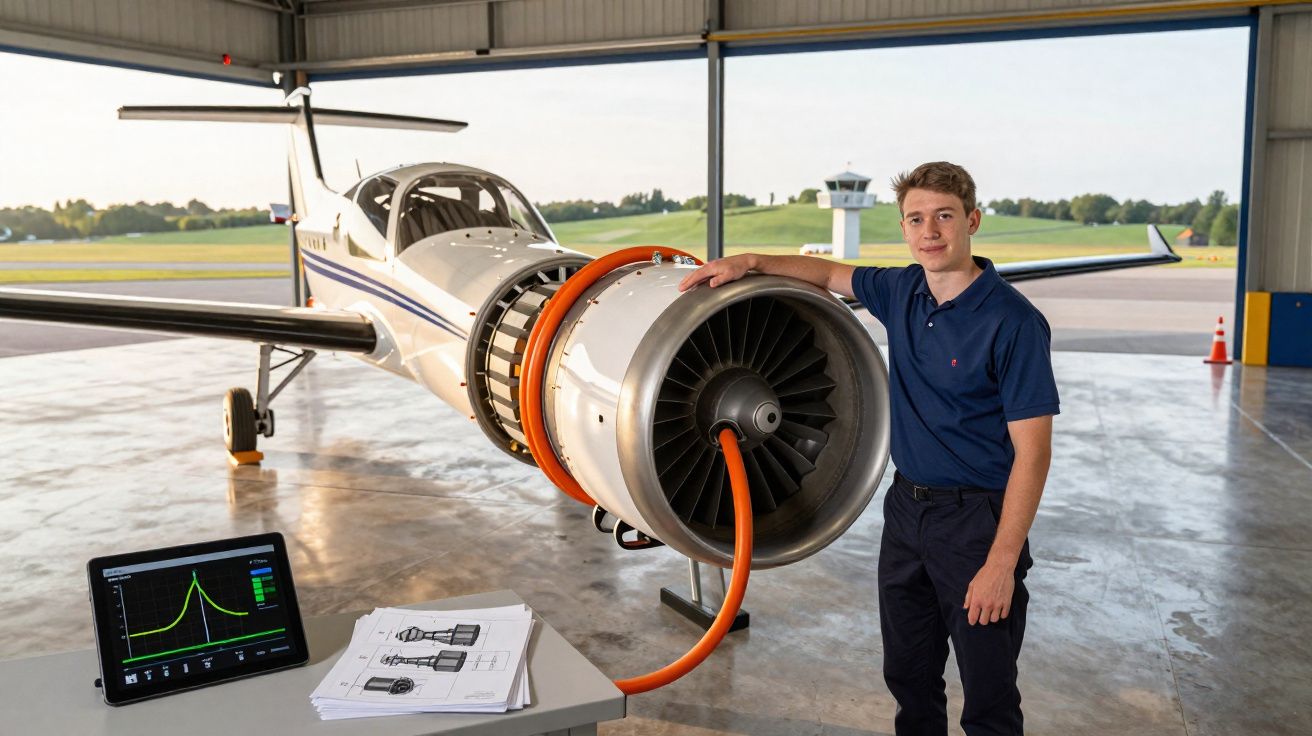
British engineers are steadily redefining how jet engines deliver thrust, borrowing ideas from hybrid cars and placing a major wager on cleaner long‑haul flying.
Across aviation laboratories in the United Kingdom, a new class of aircraft engine is being developed. Rather than depending entirely on kerosene-burning turbofans, these concepts blend established gas‑turbine power with electric systems inspired by the automotive hybrid playbook. In Westminster, the approach is framed as a way to protect the UK’s position in aerospace, reduce emissions and usher in a new phase of commercial aviation.
Hybrid engines take off after proving themselves on the road
The principle behind a hybrid aircraft engine will sound familiar to anyone who has driven a Toyota Prius or a comparable model: pair a combustion engine with an electric motor, coordinate them with intelligent power control, and deploy each energy source where it is most effective. In aviation, however, the safety and performance requirements are far higher, and the engineering challenge is unforgiving.
In an everyday hybrid car, the electric motor provides support under acceleration and recovers energy during braking. In a hybrid aircraft concept, generators, batteries and electric motors would assist-or in some cases partly substitute for-the thrust created by conventional jet engines during particular phases of flight.
Hybrid aircraft powertrains aim to keep the reliability of gas turbines while introducing electric assistance to cut fuel burn and emissions.
UK research programmes are exploring multiple layouts:
- Series hybrid, where a gas turbine turns a generator and electric motors drive the fans.
- Parallel hybrid, where electric motors support a conventional fan that is driven by a turbine.
- Turbo-electric systems, where electrical power is distributed to several smaller fans positioned across the airframe.
The objective is not to field a fully electric airliner within a year. Instead, engineers are pursuing step-by-step improvements: lower fuel consumption in take-off and climb, reduced noise around airports, and stronger overall efficiency on medium-distance routes.
Why the UK is pushing hard on hybrid aviation
The United Kingdom is home to major engine manufacturers, highly specialised suppliers and a tightly connected university base focused on aerospace. Policymakers view hybrid propulsion as a logical continuation of this ecosystem-and as a means of protecting export markets against intense competition from the United States and Europe.
There is also a clear climate-policy motivation. Aviation represents an increasing share of greenhouse gas emissions, particularly as other parts of the economy gradually decarbonise. Hybrid architectures offer two advantages at once: reduced fuel burn and compatibility with alternative fuels such as sustainable aviation fuel (SAF) and, later on, hydrogen-derived fuels.
The UK is betting that hybrid aircraft engines can bridge the gap between today’s kerosene jets and tomorrow’s fully climate-neutral aviation.
Public funding programmes, research tax incentives and joint industry initiatives are helping to speed up progress. Even where project details are not disclosed, sector analysts see a consistent direction in aerospace research calls: stronger support for electric machines, high-voltage distribution, power electronics and advanced thermal management.
An additional factor is certification readiness. As the Civil Aviation Authority and other regulators gain experience assessing electrified propulsion, early hybrid programmes can establish compliance methods, testing regimes and safety cases that later aircraft-whether hybrid, hydrogen-powered or more-electric-can build upon.
From car technology to jet engines: what transfers, what does not
Hybrid cars have made the combination of engines and electric motors familiar. Several enabling technologies carry over relatively well into aviation-though they must be significantly upgraded:
| Technology area | Automotive role | Aviation adaptation |
|---|---|---|
| Power electronics | Convert and control power between battery and motor | Scaled up to handle megawatt levels in harsh conditions |
| Battery management | Optimise charging, health and safety | Stricter safety margins and monitoring, with aviation-grade redundancy |
| Electric motors | Provide traction and regenerative braking | Drive fans or propellers, with focus on power density and reliability |
| Energy optimisation software | Switch between electric and combustion power | Manage complex flight phases, including climb, cruise and diversion |
Other elements do not scale neatly. Aircraft demand far more power than road vehicles, sustained over much longer periods, and mass is vastly more critical. A weight increase that would be acceptable in a car can destroy an aircraft’s operating economics.
The tough engineering problems still on the runway
Hybrid aviation can look compelling on paper, but several difficult constraints remain.
Battery weight and safety
Today’s batteries provide only a small fraction of the energy per kilogram available from jet fuel. That is why fully electric long-haul flying is not realistic in the near term. Hybrid systems work around this limitation by using batteries sparingly, focusing on the flight segments where electrification yields the largest benefit.
Safety is central to every design decision. High-energy batteries can overheat or ignite if damaged or mismanaged. Aerospace requirements therefore demand robust containment, continuous automated monitoring and appropriate ventilation-measures that add further mass and complexity.
Heat, voltage and reliability
Hybrid jets depend on high-voltage electrical systems operating at megawatt scale for hours. Keeping these components cool at altitude, in thin air and across extreme temperatures, stretches thermal management. Engineers are trialling new materials, compact heat exchangers and more intelligent packaging within engine nacelles.
Reliability is equally non-negotiable. Each added subsystem can introduce new failure modes. Regulators will require evidence that a hybrid configuration is at least as safe as a conventional engine, driving the need for multiple redundant pathways, fail-safe control logic and carefully engineered fault tolerance.
Any hybrid engine that reaches commercial service must meet the same rigorous reliability standards that built trust in today’s jetliners.
A practical, often overlooked issue is airport infrastructure. If airlines are to benefit from electric taxiing or ground-based charging between sectors, airports may need higher-capacity electrical connections, revised turnaround procedures and maintenance capability for high-voltage equipment-changes that must be coordinated across operators, airports and suppliers.
What hybrid aircraft operations could look like
If these concepts mature, many passengers may notice little at first. The most obvious differences are likely to be reduced noise and lower fuel burn, rather than changes to cabin layout or fares.
A plausible operating pattern for a hybrid narrow-body aircraft could be:
- Taxi and pushback: Electric power supports low-speed ground movement, reducing fuel use and local emissions.
- Take-off: Electric motors provide a short burst of additional thrust, enabling smaller gas turbines or potentially shorter runways.
- Climb: The aircraft transitions progressively towards mostly turbine power, conserving battery energy.
- Cruise: Flight is primarily fuel-powered, with electric systems used to fine-tune efficiency or act as backup.
- Descent and landing: Electric assistance helps cut noise over populated areas and supports regenerative systems that recharge batteries slightly.
For airlines, the main appeal would be lower fuel costs and a reduced carbon footprint per seat. For airports close to city centres, quieter departures and arrivals could ease noise constraints and allow more adaptable scheduling.
Risks, trade-offs and competing technologies
Hybrid engines are only one option among several decarbonisation routes. They compete with drop-in fuels such as sustainable aviation fuel (SAF) for existing engines, hydrogen propulsion, and-eventually-fully electric regional aircraft.
The UK’s approach appears to treat hybrids as a bridging technology: they retain proven gas-turbine fundamentals while pushing aircraft architecture towards higher electrification. That positioning comes with trade-offs.
On the risk side, airlines could invest heavily in an interim solution if battery technology or hydrogen systems advance faster than expected. Certification timelines could also extend beyond forecasts, leaving capital tied up in demonstrators that never reach commercial service.
On the benefit side, hybrid programmes force the supply chain to become proficient in high-voltage systems, advanced controls and new maintenance practices. Those capabilities remain valuable across many future aircraft designs, even if specific hybrid layouts evolve.
Key terms behind the hybrid aviation push (UK hybrid aircraft engines)
Several technical terms are likely to shape public discussion as these systems move from laboratory rigs to the runway:
- Power density: The amount of power a motor or battery can deliver per kilogram. Higher power density means lighter systems.
- Specific fuel consumption: A measure of how efficiently an engine turns fuel into thrust. Hybridisation is intended to reduce this figure.
- Sustainable aviation fuel (SAF): A liquid fuel made from biomass, waste streams or synthetic processes. Combined with a hybrid engine, SAF can significantly reduce lifecycle emissions.
- Distributed propulsion: Spreading thrust across several smaller electrically powered fans or propellers, rather than relying on a small number of large engines.
If UK programmes produce viable hybrid engines, the earliest deployments are likely to be on domestic services and regional European routes. Shorter sectors reduce battery requirements and can simplify certification, while still giving airlines a credible greener-flying message.
Long-haul aircraft would follow later, potentially using hybrid systems more as electrical backbones than as primary thrust sources. In that scenario, the most enduring result may not be the first generation of hybrid jets, but the electrical architecture-and the engineering mindset-that hybridisation brings into mainstream aviation.



Comments
No comments yet. Be the first to comment!
Leave a Comment