
As governments race to secure low-carbon electricity and investors hunt for the next breakthrough, one nation has quietly upped the ante.
Canada has made a notable play in nuclear fusion by supporting a domestic firm aiming to build power plants that combine pistons, liquid metal and white‑hot plasma-and it is now preparing to bankroll that ambition via the stock market.
Canada propels General Fusion into listed nuclear fusion
Vancouver’s General Fusion is poised to become the first publicly traded “pure‑play” nuclear fusion company by merging with Spring Valley Acquisition Corp, a US‑listed SPAC. In doing so, Canada becomes the first country to shepherd a dedicated fusion developer onto public markets, rather than keeping fusion confined to government laboratories and private venture capital.
General Fusion’s move towards a listing suggests nuclear fusion is edging away from being only a long-horizon research endeavour and towards a commercial wager that investors can actually buy.
Under the transaction, General Fusion would carry a pro forma valuation of about $1 billion (approximately €850 million). The overall funding package combines two main streams:
- roughly $110 million from an oversubscribed private financing round
- up to around $240 million from the SPAC’s cash pile, assuming investor redemptions remain limited
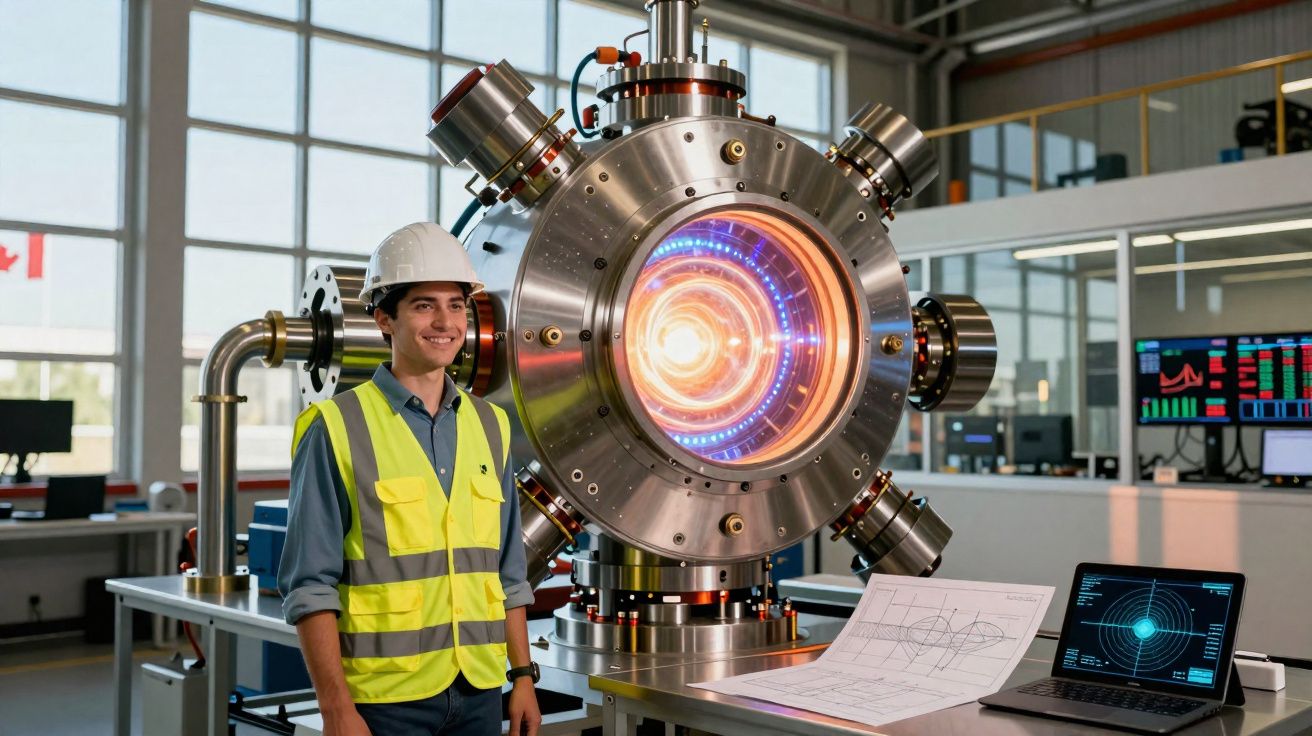
Most of that capital is intended for a single centrepiece: a full‑scale demonstrator called Lawson Machine 26 (LM26), which underpins the company’s industrial plan.
A demonstrator designed to resemble a real power station
Lawson Machine 26 (LM26) targets net fusion energy
LM26 has already been built and is operating as General Fusion’s lead test platform. It represents the firm’s first large‑scale demonstration of magnetised target fusion (MTF)-a hybrid method that combines magnetic effects with mechanical compression.
The development path is organised around three concrete temperature-and-performance milestones, each bringing the system closer to the point where fusion reactions could yield more energy than they consume:
- 1 keV (around 10 million °C): stabilise the plasma and demonstrate fundamental controllability
- 10 keV (about 100 million °C): reach a regime where fusion reactions become meaningfully efficient
- Lawson criterion: meet the required blend of temperature, density and confinement time that makes net energy output credible
Unlike many laboratory-scale set‑ups, LM26 is substantial in size. Its diameter is already approaching half the diameter of a future commercial fusion module, which matters because it allows teams to trial not only plasma behaviour but also the pipework, materials choices and maintenance routines that an operational plant would demand.
By constructing hardware that is close to commercial scale, General Fusion is essentially rehearsing a power station design, not merely running a physics experiment.
Pistons and liquid metal, rather than gigantic magnets
Most nuclear fusion programmes tend to sit in one of two categories: vast magnetic machines such as ITER in France, or laser‑driven inertial fusion systems like the National Ignition Facility in California. General Fusion’s architecture is deliberately more mechanical.
In its reactor concept, multiple pistons arranged around a spherical chamber drive inward almost simultaneously. Their motion compresses a cavity of swirling liquid lithium, which then squeezes a small, pre‑heated, magnetised plasma at the centre.
Liquid lithium serves two purposes at once. First, it protects the solid structure from the punishing neutron bombardment produced by fusion. Second, it captures the neutrons’ energy as heat-heat that would then power a conventional turbine, much like a standard electricity station.
Because the inner surface is liquid and continually replenished, the design aims to avoid a persistent problem for large tokamaks: solid wall materials that become embrittled and degraded after years of exposure to fast neutron damage.
Fusion engineered with a heavy‑machinery mindset
General Fusion’s management often frames the system as akin to a robust diesel engine adapted for the grid. Instead of running continuously at the limits of plasma physics, the concept focuses on simple, repeatable pulses-approximately one compression each second.
The underlying approach is straightforward: minimise exotic components, reduce dependence on extreme precision, and rely where possible on established mechanical engineering. If successful, that could enable smaller, lower‑cost plants that might be sited near industrial facilities or data centres, rather than only in remote locations.
Sceptics argue that coordinating dozens of fast pistons, controlling a churning bath of hot liquid metal and sustaining fragile plasma conditions at the core is far from trivial. General Fusion counters that these are demanding but familiar engineering domains-hydraulics, metallurgy and high‑speed control systems-rather than wholly new scientific territory.
A grid increasingly desperate for firm, clean electricity
Why fusion has returned to the energy conversation
The International Energy Agency forecasts that global electricity use could increase by 40–50% by 2035. Expanding data centres, electrified transport, wider deployment of heat pumps and more power‑hungry industry are all contributing to the upward pressure on demand.
Wind and solar capacity are rising rapidly, yet their output varies with weather and daylight. System operators still require firm capacity that can be dispatched when needed, especially through calm, dark periods. Gas power stations provide much of that flexibility today, but they emit CO₂ and leave countries exposed to fuel‑price volatility.
A compact, dispatchable, low‑carbon power source is near the top of the priority list for energy planners from Texas to Tokyo.
Fusion is often described as offering that combination: high power density, no fossil fuel supply chain, and no long‑lived radioactive waste on the scale associated with today’s nuclear fission. Until recently it was widely treated as a technology for the latter half of the century, but a surge of private funding is trying to bring the timetable forward.
Investors are piling into fusion-and Canada is changing the route to capital
In recent years, private funding for fusion businesses has climbed into the billions. Well‑known supporters-from technology entrepreneurs to hedge funds-see echoes of early commercial spaceflight: extremely risky, but potentially world‑changing if it works.
The US firm Helion Energy, for instance, has raised about $400 million, including backing from OpenAI’s Sam Altman, to pursue pulsed fusion systems designed to convert fusion energy directly into electricity using electromagnetic coils. General Fusion, by contrast, is pursuing a heat‑based pathway that would feed standard turbines.
| Company | Core approach | Funding model |
|---|---|---|
| General Fusion (Canada) | Magnetised target fusion with pistons and liquid lithium | SPAC listing, strategic investors, government support |
| Helion Energy (US) | Pulsed magnetic fusion with direct electricity conversion | Private rounds backed by tech investors |
| ITER (international) | Gigantic tokamak, continuous magnetic confinement | Government-funded international consortium |
What stands out is the diversity of physics and engineering strategies. Some developers focus on compact units aimed at industrial heat, while others are pursuing large, grid‑scale stations. For public markets, this breadth signals that nuclear fusion is no longer framed as a single mega‑project, making it easier for investors to diversify across multiple concepts.
A further implication of the SPAC route is speed and visibility: a merger with a listed shell company can provide a faster path to trading than a traditional IPO, while also imposing the disclosure and quarterly scrutiny that comes with being public-factors that can materially shape how a long‑cycle engineering programme is financed and judged.
How magnetised target fusion compares with other confinement approaches
Every confinement method is trying to solve the same central challenge: keep ultra‑hot plasma sufficiently dense, for long enough, to allow nuclei to fuse efficiently. General Fusion’s magnetised target fusion sits alongside several rival concepts, each with distinct compromises.
- Tokamaks rely on powerful magnetic fields to confine a doughnut‑shaped plasma and typically aim for steady operation.
- Stellarators use more intricate magnetic geometries that can improve inherent stability, though they are harder to manufacture.
- Inertial fusion employs extremely powerful lasers to crush tiny fuel pellets, producing brief but intense fusion bursts.
- Hybrid and magneto‑inertial concepts attempt to blend magnetic confinement with pulsed compression.
MTF aims for a middle position: the plasma is magnetised to help maintain coherence, while the final compression is delivered by rapid mechanical pressure rather than magnets or lasers alone. That dual dependency is exactly why LM26 matters-its job is to prove that both the magnetic and mechanical elements can operate together under realistic, power‑plant‑like conditions.
Risks, schedules and the ways this could fail
Despite the enthusiasm, nuclear fusion remains a high‑stakes proposition. Achieving the Lawson criterion in hardware that resembles a commercial reactor is still not a settled problem. LM26 must demonstrate performance that is not only extreme in temperature, but also repeatable and reliable, using equipment capable of surviving thousands of cycles without constant replacement.
Several failure points are easy to imagine: piston timing errors that ruin compression symmetry, unforeseen turbulence patterns in the liquid lithium, or materials complications for components exposed to both hot metal and strong magnetic fields. Any of these could slow progress or force expensive redesigns.
Regulation is another moving piece. Fusion does not present the same meltdown risk as fission, yet it still involves tritium handling and high neutron fluxes. Licensing pathways, safety rules and public acceptance will strongly influence how quickly any commercial plant can be approved and constructed-particularly as regulators adapt frameworks that were largely built around nuclear fission.
What it could mean for everyday energy users
If General Fusion and its competitors deliver on their promises, tomorrow’s electricity systems could look markedly different. A mid‑sized city might be powered by clusters of fusion modules roughly the size of small industrial buildings, operating close to continuously while supporting variable renewables. Heavy industry could place fusion units on‑site to produce high‑temperature steam without relying on gas or coal.
The largest uncertainty is cost. Advocates argue that once the physics and engineering are proven, manufacturers could mass‑produce identical fusion modules, reducing prices in the way gas turbines and wind turbines have historically become cheaper through repetition and scale. Doubters respond that the inherent complexity of fusion equipment may keep it expensive and specialised relative to solar, batteries and advanced nuclear fission.
For the moment, Canada’s backing of a publicly traded fusion contender gives both retail and institutional investors a direct way to participate in that argument. The next few years of results from Lawson Machine 26 (LM26) will indicate whether this combination of pistons, liquid lithium and magnetised plasma warrants the leap from laboratory promise to market reality.
Comments
No comments yet. Be the first to comment!
Leave a Comment