
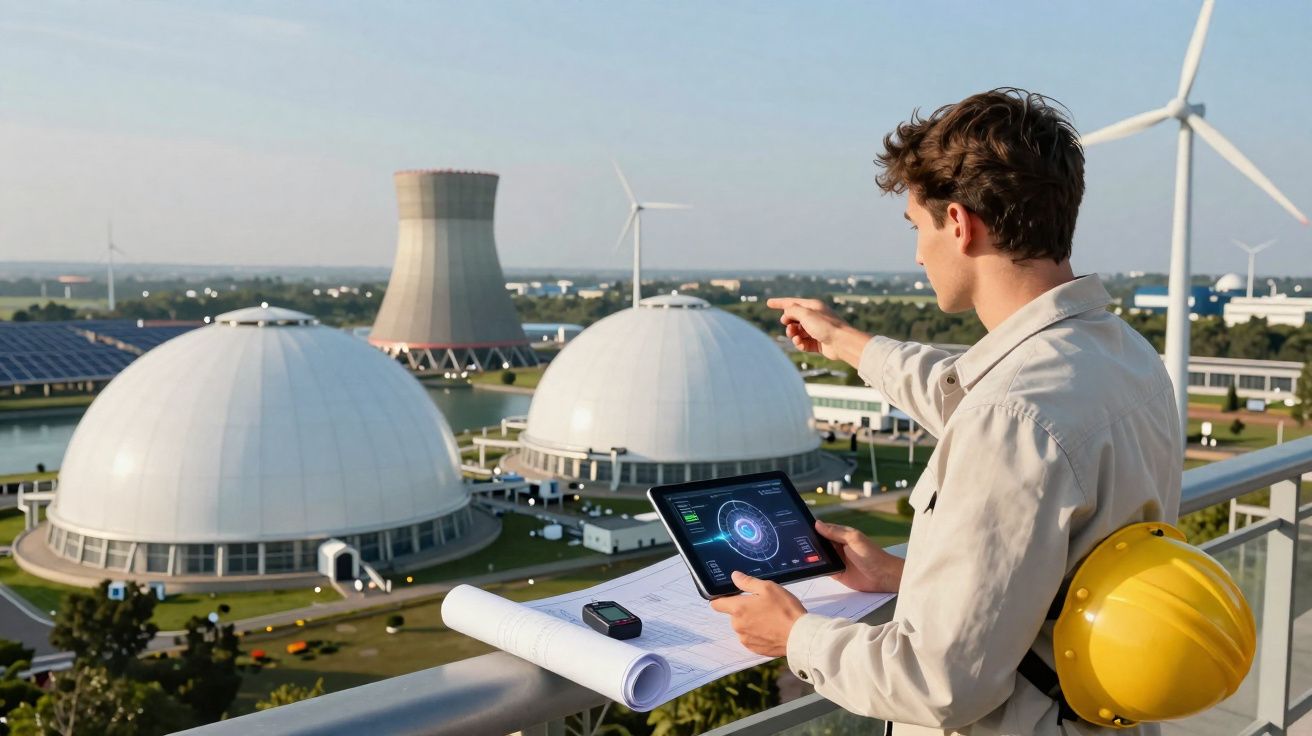
Across Europe and further afield, governments are discreetly committing billions to a technology that many people still link mainly with historic disasters.
Even as wind turbines and solar farms spread across coastlines, skylines and farmland, nuclear reactors continue to generate roughly a tenth of the world’s electricity. That leaves an unavoidable question: is nuclear power a climate lifeline, a high-stakes industrial wager, or a fading legacy propped up by momentum?
Nuclear’s place in the global electricity mix
For all the attention on renewables, nuclear power still provides a material slice of low-carbon electricity worldwide. In 2023, reactors produced about 2,600 terawatt-hours (TWh), roughly 9–10% of global generation.
| Energy source | Output (TWh, 2023) | Approx. global share |
|---|---|---|
| Coal | ~10,000 | ~36% |
| Gas | ~6,500 | ~23% |
| Hydro | ~4,300 | ~15% |
| Nuclear | ~2,600 | 9–10% |
| Wind | ~2,200 | ~8% |
| Solar | ~1,600 | ~6% |
The United States remains the biggest producer of nuclear electricity, with China next. France is the standout in terms of dependence: reactors supply over 60% of French electricity, helping deliver one of the lowest-carbon grids among major economies.
How a pressurised water reactor (PWR) actually works
The majority of operating nuclear stations today use pressurised water reactors (PWRs). The headline purpose is straightforward-convert nuclear heat into rotating turbines-but the mechanism is intricate.
At the heart of the reactor, fuel rods filled with uranium‑235 pellets sit inside a steel reactor vessel. When a neutron strikes a U‑235 nucleus, it splits. This fission event produces additional neutrons and releases a large amount of energy in the form of heat.
To keep the process controlled, control rods-made from neutron‑absorbing materials-move in and out of the core. Their job is to manage the chain reaction so it stays stable rather than running away.
A sealed primary loop circulates water through the core at very high pressure, typically about 155 bar. Under these conditions, the water can exceed 300°C without boiling. This same water serves two roles at once: it removes heat (coolant) and slows neutrons down (moderator), which helps maintain efficient fission.
That extremely hot, pressurised primary water then flows through steam generators. There, it hands over heat to a second, separate water circuit running at lower pressure. In this secondary circuit, water boils into steam, which drives a turbine coupled to an alternator.
The PWR’s defining feature is that the radioactive primary circuit is kept separate from the turbine circuit, so most radioactivity remains behind thick steel and reinforced concrete.
After expanding through the turbine, the steam is cooled back into liquid in large condenser and cooling systems-often using seawater or river water-and then sent around the loop again.
Overall thermal efficiency is typically about 33%. In other words, around a third of the heat becomes electricity, while the remainder leaves as waste heat. Newer designs aim to lift efficiency by running at higher temperatures or switching to alternative coolants.
Safety by design: the “defence in depth” approach
Nuclear engineering starts from a sceptical premise: failures will happen. The response is to build multiple layers of protection so that a problem in one layer does not escalate into a severe accident.
This philosophy-defence in depth-begins with strong fundamentals: thick reactor vessels, robust pipework and conservative design margins. On top of that, it adds several independent safety provisions.
- Active systems: pumps and valves capable of injecting cooling water into the core.
- Passive systems: gravity-fed tanks, natural circulation and heat exchangers designed to function without external electrical power.
- Physical barriers: fuel cladding, the steel reactor vessel, the primary circuit and the reinforced concrete containment structure.
Following the major incidents at Three Mile Island, Chernobyl and Fukushima, regulators across the sector tightened requirements. Modern plants are expected to handle extended station blackouts, as well as major earthquakes and flooding.
Generation III reactors are generally expected to protect the core for at least 72 hours without external power, relying largely on passive cooling.
PWRs also have an inherently stabilising characteristic called a negative temperature coefficient of reactivity. As core temperature rises, the nuclear reaction naturally eases off: the physics of the fuel and coolant push the reactor towards a less reactive, safer condition.
Costs, intermittency and the nuclear–renewables clash
If you look only at headline cost per megawatt-hour, new nuclear build appears expensive. Recent estimates place advanced reactors at around $110/MWh (roughly £85–£90/MWh, depending on exchange rates). By comparison, modern onshore wind is often near $40/MWh (around £30–£35/MWh), while utility-scale solar has fallen sharply, with contracts in some regions trending towards $25–30/MWh (roughly £20–£25/MWh).
However, those simple figures overlook a central issue with weather-dependent generation. Solar output drops when the sun sets or cloud cover increases; wind generation falls when the air is still. Their capacity factor-the proportion of time a plant produces at its rated output-can fall to single digits for solar on some grids, while wind commonly sits around 40%.
Once a grid becomes heavily supplied by wind and solar, each additional percentage point typically requires backup: batteries, flexible gas plant, storage or long-distance transmission.
Those balancing measures have real costs, often estimated at $25–40/MWh when variable renewables reach high shares. Nuclear stations, in contrast, usually run close to continuously, with capacity factors above 80%. That firm output can underpin the system through cold snaps, heatwaves and prolonged wind lulls.
This reliability is one reason many climate and energy system models keep nuclear power in the portfolio-not as an alternative to renewables, but as a stabilising anchor that can reduce the overall cost of achieving a carbon-neutral grid.
What happens to spent fuel and nuclear waste?
Debates about nuclear power repeatedly return to waste, and the raw numbers can sound alarming until they are broken down.
Consider France, one of the most nuclear-intensive countries. Across all categories, France recorded around 1.85 million cubic metres of radioactive waste in 2023. Over half of that total is classed as very low level, largely contaminated rubble and equipment arising from decommissioning.
The high-level portion-highly radioactive material largely originating from spent fuel-amounts to only a few thousand cubic metres, roughly comparable to the volume of a couple of Olympic-size swimming pools. That relatively small volume is also where the longest-term technical and political difficulty sits.
Most national strategies converge on deep geological repositories: engineered tunnel networks several hundred metres underground in stable rock, designed to isolate waste while it cools and decays over very long timescales. Finland has already licensed such a repository, and Sweden and France are progressing along similar routes.
Alongside disposal, researchers continue to develop fast reactors and advanced fuel cycles intended to consume part of today’s waste as fuel. The aim is to reduce long-term radiotoxicity and compress the hazard timeframe from hundreds of thousands of years to thousands-or tens of thousands-of years.
Decommissioning and skills: the less visible side of nuclear power
Another cost and capability question sits beyond electricity generation itself: decommissioning. Retiring a reactor is a multi-decade programme involving dismantling, decontamination, packaging of materials into appropriate waste categories, and long-term site management. This work can be planned and funded over many years, but it depends on maintaining specialist skills, regulatory oversight and a supply chain that can meet demanding quality requirements.
The same workforce and industrial base also influence the economics of new build. Where a country has an experienced nuclear regulator, trained welders, quality-assured component manufacturing and a stable project pipeline, delivery risks can fall. Where those capabilities have lapsed, projects can become slower and more expensive to execute.
EPRs: Europe’s large-scale bet on generation III+
Among large reactors currently offered, the European Pressurised Reactor (EPR) has become emblematic of both high ambition and painful delivery challenges.
A single EPR unit is rated at around 1,650 MWe. The design includes double concrete containment, four independent safety trains and strong passive cooling capability. On paper, this translates into very low predicted accident probabilities and resilience against severe external hazards.
On site, the record has been more troubled. At Flamanville in Normandy, the first French EPR achieved initial criticality only in 2024, after 17 years of construction and cost escalation now estimated at about €13.2 billion.
Advocates argue the EPR is paying a “first-of-a-kind” penalty, and that subsequent builds should be faster and cheaper once the supply chain and workforce have gained experience.
Finland’s Olkiluoto 3 has been supplying electricity since 2023 and has reported capacity factors above 90%, indicating that performance can be strong once a unit is commissioned. In the UK, Hinkley Point C, based on the EPR design, has become one of Europe’s largest construction efforts, including the delivery of massive forged components from France.
SMRs and nuclear power: small reactors, big expectations
While mega-project reactors dominate headlines, a parallel race is gathering momentum around small modular reactors (SMRs). These are generally designed to produce between 50 and 300 MWe, far below the output of traditional gigawatt-scale stations.
The SMR pitch is industrial rather than bespoke: build a large share of the plant in factories, then transport modules to the site for assembly. In theory, this could shorten schedules and reduce the civil engineering complexity that has plagued many large nuclear builds.
Governments and utilities see several potential roles: supplying electricity to remote areas, firming up renewables on constrained grids, or delivering both power and industrial heat for steelmaking, chemicals or hydrogen production.
- Lower upfront capital per unit, potentially easing financing.
- Greater flexibility over siting, including redevelopment of former coal plant locations.
- The prospect of standardised fleets, reducing maintenance and training costs.
Sceptics counter that the economics only work if hundreds of units are manufactured, unlocking genuine factory-scale efficiencies. A small number of demonstration plants is unlikely to deliver low-cost electricity. There are also concerns about security and safeguards if many smaller reactors are deployed across a larger number of sites and countries.
From generation II to IV: what changes under the bonnet
The sector commonly categorises reactor designs into “generations”. Most of today’s large PWRs are generation II, while generation III and III+ designs are now entering service. Generation IV remains largely in the demonstrator and research phase, targeting higher efficiency and alternative fuel cycles.
| Generation | Typical period | Key features | Status |
|---|---|---|---|
| I | 1950s–60s | Early prototypes, basic safety | Shut down or decommissioned |
| II | 1970s–90s | Standard PWRs and BWRs, active safety | Majority of the current global fleet |
| III / III+ | 1990s–2025 | More passive systems, stronger containment | Under construction and in service |
| IV | 2030–2050 | Fast neutrons, closed fuel cycles | Demonstrators and R&D |
Generation IV concepts include sodium-cooled fast reactors, molten salt reactors and high-temperature gas-cooled reactors. Many are designed to extract more energy from fuel, reduce waste, and operate at temperatures better suited to industrial heat applications.
Key terms that shape the nuclear debate
Three ideas recur in policy discussions and are frequently misunderstood.
Capacity factor. This measures what a plant actually generates relative to what it would produce if it ran at full power all year. A nuclear station running at an 85% capacity factor will deliver far more electricity than a solar plant at 15%, even when both have the same nameplate capacity.
LCOE (levelised cost of electricity). This combines build costs, fuel, operation and decommissioning into a single cost per megawatt-hour over the lifetime of the plant. It does not readily include wider system costs, such as balancing variable renewables or reinforcing and extending electricity networks.
Baseload vs flexibility. Traditional planning assumed nuclear would run flat-out while gas and hydro would ramp up and down. Some modern reactors-particularly in France-already load follow, adjusting output day to day to match demand and variations in wind generation.
Scenarios for 2050: nuclear in a net zero grid
Energy modellers describe multiple routes to a net zero electricity system by mid-century. One family of scenarios relies on very large overbuilds of renewables combined with storage, with nuclear shrinking as existing stations retire. Another maintains or expands nuclear capacity, reducing the scale of storage and backup required.
In reality, decisions will differ by country. Nations with ageing fleets face costly choices between life extension and replacement. Others-such as Poland and some Gulf states-see nuclear as a way to cut coal dependence while retaining firm, dispatchable power.
The eventual balance between PWRs, EPR-scale projects and future SMRs is likely to depend less on physics than on public confidence, financing conditions and political tolerance for delays.
For households, the result will be visible not only in bills but also in the physical environment. Offshore wind arrays, large solar developments, long transmission corridors and nuclear sites each demand space-on land, at sea or in communities. Whatever mix is chosen, the trade-offs extend well beyond the perimeter fence of any reactor.


Comments
No comments yet. Be the first to comment!
Leave a Comment