
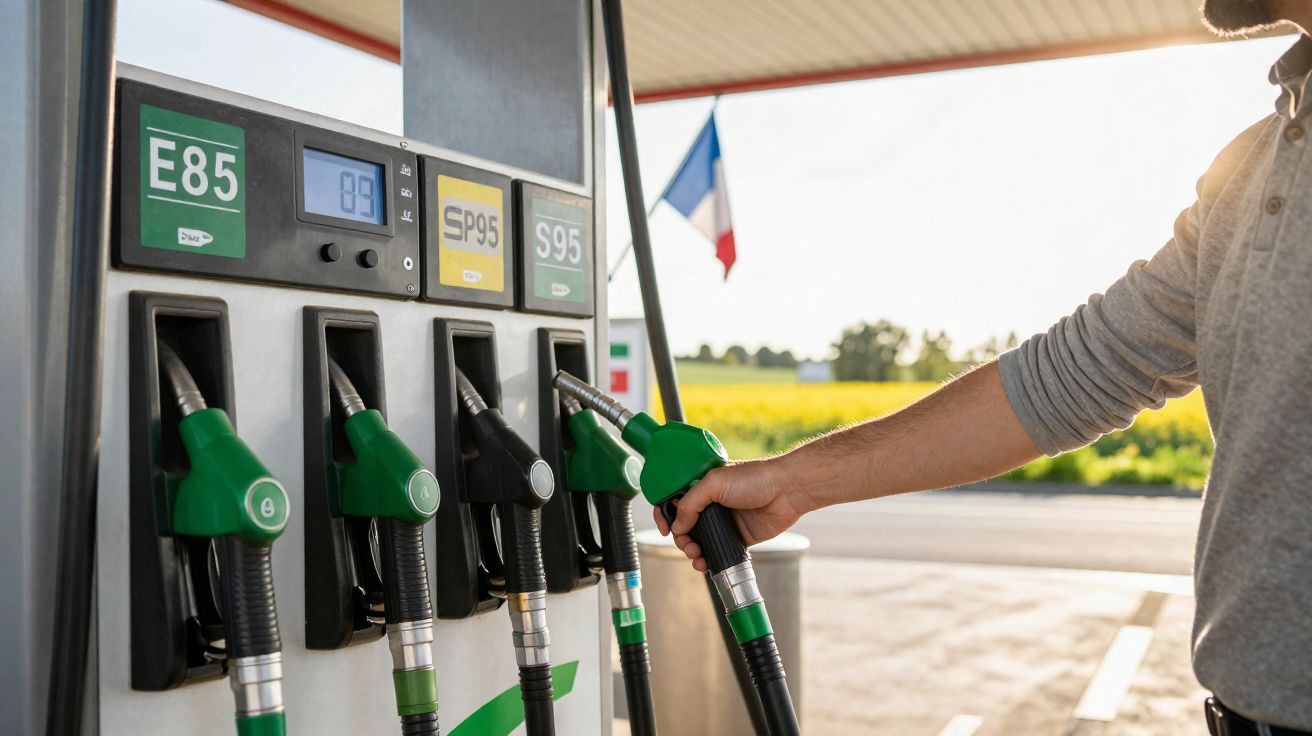
French motorists, caught between rising fuel costs and shifting policy signals, are increasingly choosing an option that used to be overlooked on the forecourt.
Across France, Superethanol‑E85-a petrol–ethanol blend once seen as a niche curiosity-has become a mainstream choice. Its rise is reshaping the fuel market and reviving arguments about what a “clean” car could realistically be in the 2030s.
Why French motorists are flocking to Superethanol‑E85
Price wins the argument at the pump
For many drivers, the appeal starts and ends with the price tag. In 2025, Superethanol‑E85 averaged about €0.73 per litre, while SP95‑E10 (the most common petrol grade) sat at roughly €1.69 per litre. Even allowing for higher fuel use per mile on E85, the difference remains substantial.
Industry modelling illustrates the annual impact:
- At 13,000 km per year, using E85 instead of SP95‑E10 saved about €705, assuming 25% extra fuel consumption.
- At 20,000 km per year, the saving increased to around €1,085 under the same assumption.
If the real-world consumption uplift is nearer 20%, the estimated savings rise to about €739 at 13,000 km and €1,137 at 20,000 km.
For many households, Superethanol‑E85 can leave several hundred euros a year in the family budget, even after accounting for higher consumption.
These sums help explain why roughly 418,000 motorists have taken up Superethanol‑E85 since its launch in 2006. About 62% are driving petrol cars upgraded with an approved flex‑fuel conversion kit, while 38% are in factory-built flex‑fuel vehicles.
From rare curiosity to near-standard option
Availability used to be E85’s weak spot. That objection is rapidly disappearing. By 2025, more than 4,000 service stations in France were offering Superethanol‑E85, representing about 42% of all stations.
Coverage is now such that 93% of motorists live within 10 km of an E85 pump. In many areas it sits alongside diesel and conventional petrol on the same forecourt, rather than requiring a special trip.
What to check before you switch
Moving to Superethanol‑E85 is usually straightforward, but drivers still need to do basic due diligence. The key steps are confirming that the vehicle is genuinely flex‑fuel from the factory or, if not, that it can be legally and mechanically adapted with an approved flex‑fuel conversion kit installed by an authorised professional. This matters for reliability, warranty protection, and peace of mind.
It is also sensible to plan for day-to-day realities: cold-start behaviour in winter, how regularly you use motorways, and whether E85 is consistently available on your usual long-distance routes.
A 15% jump that changes the conversation
In 2025, French bioethanol consumption climbed by about 15%, reaching more than 19 million hectolitres, according to industry figures. Superethanol‑E85 accounted for roughly one third of that total-meaning about one in three litres of ethanol used nationally ended up in an E85 tank.
Superethanol‑E85 has shifted from a niche choice to a serious contender, growing 15% in 2025 and expanding to more than 4,000 fuel stations across France.
This momentum has arrived in a curious context: fierce political disagreement over climate policy, repeatedly adjusted EU CO₂ rules for cars, and constant headlines for battery-electric models. Yet many households are reducing both fuel bills and emissions through a very familiar object-the petrol pump-without changing how they drive.
Climate gains, without pretending to be perfect
A smaller footprint than fossil fuels
The French sector is clear that bioethanol is not automatically carbon-neutral. Emissions occur when crops are grown, processed and transported. Even so, the overall life-cycle balance is generally better than for purely fossil fuels.
In 2025, bioethanol used on French roads displaced around 1 million tonnes of oil equivalent, avoiding an estimated 2.7 million tonnes of CO₂. Analysts liken that to the annual tailpipe emissions of about 1.3 to 1.4 million cars.
The underlying logic is the carbon cycle: the CO₂ released at the exhaust was previously absorbed from the atmosphere by plants. The loop is not perfectly closed-machinery burns diesel and factories require energy-but life-cycle emissions remain markedly lower than those of conventional petrol.
A modest but growing slice of the fuel pie
Even with rapid growth, E85 remains only one part of a much larger fuel landscape. Total road-fuel consumption in France was around 47.5 million m³ in 2025. Diesel still dominated at roughly 32 million m³-just over two thirds of the total-while petrol products reached 15.6 million m³, up 5.7% year on year.
| Fuel type | 2025 volume (million m³) | Share of road fuels |
|---|---|---|
| Diesel | 32.0 | 67.3% |
| Petrol (all grades) | 15.6 | 32.7% |
| Bioethanol (all uses) | 1.9 | ~4.0% |
With about 1.9 million m³, bioethanol represents just under 4% of road fuels. The trend line is widening, but the wider system is still heavily shaped by diesel, even as its share gradually declines.
A very concrete French supply chain
From fields to fuel tank
Every litre of E85 sits on top of a largely domestic French supply chain. Farmers supply the feedstocks-particularly sugar beet and cereals-providing a supplementary outlet for around 55,000 farm holdings. In an environment of volatile commodity prices, that additional demand can help steady incomes.
On the industrial side, the bioethanol sector supports about 9,000 full‑time equivalent jobs. Sugar refineries and starch plants convert crops into ethanol and also valorise co-products and residues that might otherwise deliver lower returns. In practice, E85 contributes value not only to the main product but also to side streams, improving overall use of each harvested tonne.
In France, bioethanol is not just an abstract “green” concept; it underpins tens of thousands of farms and close to 9,000 industrial jobs.
Sustainability questions that still matter
Debates about land use and “food versus fuel” have not vanished. Supporters argue that improved yields, tighter sustainability criteria, and better use of co-products strengthen the case for bioethanol. Critics remain concerned about indirect impacts and the need for clear, enforceable standards. Either way, the discussion is increasingly focused on measurable outcomes-traceability, farming practices, and verified life-cycle CO₂ performance-rather than slogans.
What drivers actually want
High awareness, lingering doubts
An IFOP survey of 1,000 French people, carried out for the national bioethanol collective, shows that internal combustion remains central to consumer preferences, whether alone or combined with electrification. About 76% of respondents favour some form of combustion engine: petrol leads at 52%, while diesel remains preferred by 24%.
By contrast, only 10% say their next car would be fully electric-well short of the trajectory envisaged in EU legislation. Among future petrol buyers, around 17% are considering vehicles able to run on E85, in hybrid or purely combustion form, implying notable headroom for flex‑fuel growth.
Information gap in front of a full forecourt
Recognition is no longer the problem. The same IFOP polling indicates 76% of French people have already heard of Superethanol‑E85, and 58% view it as a credible alternative to fossil fuels, alongside battery-electric cars.
However, the friction is often psychological rather than technical:
- About 30% cite insufficient knowledge as the main barrier.
- Another 30% say there are too few service stations-despite most living within 10 km of an E85 pump.
The pumps exist and the price gap is clear, yet many drivers still assume E85 is rare or complicated.
This mismatch highlights a communications challenge for industry and public bodies alike. Many motorists are cost-conscious but cautious about engine health and warranty implications. Clearer, more visible guidance on eligible models and certified flex‑fuel conversion kit routes would likely reduce hesitation.
Brussels reopens the door for cleaner combustion
Post‑2035: not just batteries
On 16 December 2025, the European Commission proposed revisiting the CO₂ rules for light vehicles. The draft would allow sales of combustion-engine cars after 2035, provided they run on fuels meeting strict climate criteria-including fuels that blend bioethanol.
The Commission explicitly positions sustainable biofuels as a complementary tool alongside electrification. For France’s Superethanol‑E85 ecosystem, that brings fresh legitimacy. It also strengthens the case for plug‑in hybrids designed to operate primarily on E85: electricity for routine journeys, and low-carbon liquid fuel for longer trips.
Towards fully renewable E85
From low‑carbon to near‑neutral fuel
The next step being pursued by the French industry goes beyond crop-based ethanol. Work is in progress on an E85 blend that would be 100% renewable, anchored in a strict definition of “CO₂‑neutral” fuels. Under this approach, all carbon in the fuel would come from the atmosphere-captured by plants or taken from industrial flue gases-and could also be used to create synthetic e‑fuels.
Technical standards are now under discussion at the European Committee for Standardization, with the aim of updating the E85 specification to accommodate these new components. If successful, future flex‑fuel plug‑in hybrids could operate without fossil petrol at all, while achieving life-cycle emissions comparable to-and in some cases lower than-those of a battery-electric car, depending on the electricity mix.
How E85 compares in real life
A practical scenario for a French commuter
Consider a commuter covering 18,000 km per year in a small petrol hatchback. Using SP95‑E10 at €1.69 per litre, with average consumption of 6.5 l/100 km, annual fuel spend works out at roughly €1,980. Switching to Superethanol‑E85 at €0.73 per litre, with 25% higher consumption, brings the yearly bill down to about €1,100.
Even after paying for an approved flex‑fuel conversion kit-typically €700 to €1,400 fitted-the payback period can often land around two to three years.
This is not without caveats. Some older engines will not be compatible; fitting non‑certified hardware may void warranties or risk mechanical damage; cold starts in winter can be more demanding; and motorway availability can still influence convenience. Even so, for a sizeable share of the petrol fleet-particularly newer cars-the numbers have become hard to ignore.
Key terms that keep coming up
- Superethanol‑E85: a fuel containing 65% to 85% ethanol, blended with petrol, for compatible flex‑fuel engines.
- SP95‑E10: standard unleaded petrol with up to 10% ethanol by volume, approved for most modern petrol engines.
- Flex‑fuel vehicle: a car designed so the engine and fuel system can run on any mix of E85 and conventional petrol.
- Flex‑fuel conversion kit: an added electronic module that adjusts injection and engine settings so certain petrol cars can operate safely on E85.
Battery-electric cars continue to gain ground-reaching about 24% of new car sales in France in December 2025-but France’s E85 story suggests motorists are not converging on a single pathway. Increasingly, they are hedging: combining charging cables with fuel pumps, and choosing whatever best supports both the household budget and a downward CO₂ trajectory.




Comments
No comments yet. Be the first to comment!
Leave a Comment