
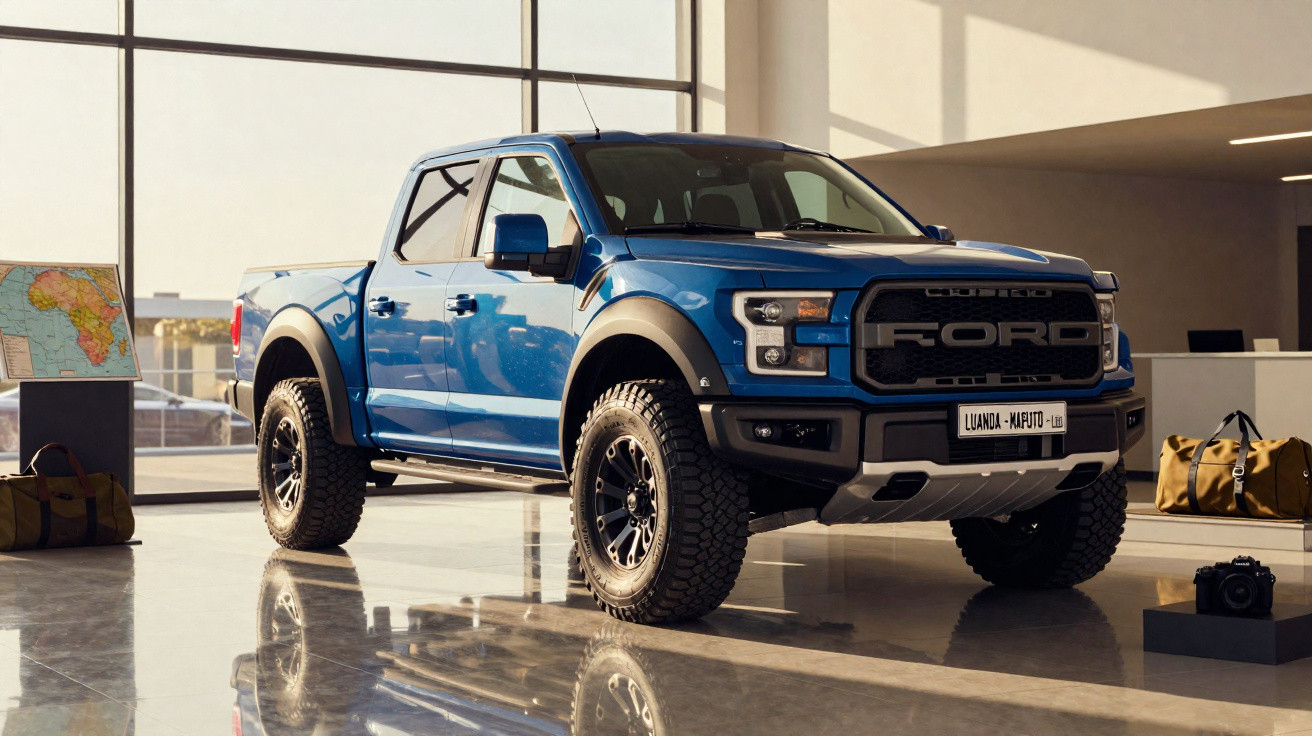
A father and a daughter; almost 36,000 kilometres; more than 700 hours behind the wheel; well over a hundred turns of the Earth; 27 countries; and 5,000 litres of petrol swallowed up. Carlos and Ana Oliveira drew their own pink map and set out to retrace the route of the Discoveries in reverse: from Luanda to Maputo, and from Maputo to Leiria. This is the story of a dream lived on four wheels.
A pink map, and the itch to go further
Being past 70 was never going to be the detail that slowed down a former amateur off-road driver. A mechanical engineer by training and an export professional by career, with years of life and adventure in Guinea-Bissau and a reputation as a relentless traveller, Carlos had long since ticked off some of the world’s most iconic rallies - including the legendary Dakar. And not only as a driver: he had first known those events as a reporter and team leader.
Even so, something still felt unfinished for Carlos Oliveira, a businessman from Leiria whose appetite for adventure seemed immune to age. He still had his biggest ambition to fulfil: “To do a big circuit around Africa, something like a replica of the expeditions of Roberto Ivens, Hermenegildo Capelo and Serpa Pinto” (1877–1880) and of the “pink map” that came from them - and to drive “the route of the Discoveries the other way round, from Maputo to Portugal”.
Preparing the expedition: three legs, one Ford Raptor, and a motto
Carlos dug into history books and maps, realised the GPS was able to plot a route, and then threw down the challenge to his daughter Ana - a marketing professional who had been living in Mozambique for 12 years and who is, in her father’s words, “a bit crazy like her dad”.
Ana, in turn, is devoted to Africa: to its unpredictability and to off-road adventure. From her parents she inherited a love of travel of every kind. She had travelled with them to Guinea-Bissau, where they met, and she had been to the Dakar as a reporter, as well as to Portuguese rally events as a navigator. During one foray into the south of the continent (she loves it so much that what was meant to be a six-month stay in Mozambique became years, still without a return date), Carlos put the dream on the table - and Ana pushed “for him to get it off paper sooner rather than later”.
Together, they designed the journey in three stages, so they could split the adventure and still return to Portugal in between - in part so Carlos could kiss his mother, “already very old”. Life would take her away during the interval.
The vehicle was also decided: a Ford Raptor pick-up, chosen for its “toughness” and “comfort”. And the mantra was set: “The GPS says it works.” If it says so, Ana wrote on Instagram (@azeitonasonthe_road) before they set off, “then we believe it. Even without knowing whether it (the GPS) has ever tried to drive from Maputo to Leiria”...
Their hopes were sky-high. “We’re going to cross roads, borders, landscapes and languages. We’re going to meet people, cultures and ways of life. We’re going to collect stories that will enrich us. We don’t know what we’ll find along the way, but if the GPS insists it works... then we’re going! Because sometimes, to leave where you are, you only need that: a starting point, company that matters, and a destination that calls you,” she wrote. Six months later, father and daughter could confirm every word.
Stage 1 - Luanda to Maputo (28 days, 9,380 km)
First, they had to get the Raptor - the “home” for the months ahead - to Luanda. It went by ship. Then, on 6 June, they set off.
The plan would be adjusted as they went - because in Africa, relying on certainty is pointless - with stops to rest both the travellers and the pick-up, a flight over the Okavango Delta, time in the Moremi and Chobe parks and encounters with those who rule them, the true owners of the bush. There was also a spray-soaked visit to Victoria Falls, and a deep dive into Lake Malawi.
Reaching Mozambique felt like coming home, back to the Portuguese language. The first stage ended after 28 days and 9,380 kilometres across seven countries. It was time to give the Raptor a break: it stayed parked in Maputo while Carlos flew back to Leiria for a month.
Stage 2 - Maputo to Cape Town to Angola (32 days, 11,715 km)
The second leg began on 1 August, turning back through African history and following the footsteps of Portuguese navigators - but in reverse. From Maputo they headed to Cape Town and the Cape of Good Hope, and from there on to Angola.
Along the way there were days in the Kruger, once again in the company of the “lords of the bush”, plus time in Hlane, in Eswatini. They also climbed to what they called “the highest pub in Africa”, up in snowy Lesotho, before dropping down again towards Cape Town and its plateau.
Pointing north once more, the Oliveiras - the “Olives” - plunged into South Africa’s rural landscapes, Namibia’s desert straightaways, the eerie mining ghost town of Kolmanskop, and the lifeless pan of Deadvlei. They faced the harshness of Sossusvlei and the spell of Walvis Bay, in a route of seals and welwitschias that led into another unmissable park, Etosha, and on to the Himba people.
Then Angola arrived, heavy with secrets: the Tundavala Gap and the Leba Mountains; Soba Beach and South Kwanza; the Moon Viewpoint and Luanda’s gleaming seafront. Behind them were 32 days and 11,715 kilometres through six countries. Ahead was a forced pause: time to handle visas, give the Raptor a check-up, and brace themselves for the hardest stage - the one aimed at Leiria.
Stage 3 - From Angola to Leiria (16 September to 3 November)
Carlos knew it would be “far more demanding and challenging”, and that they needed their “stomachs much better prepared”, on top of the added malaria risks. They started out on 16 September for what became a true endurance test, packed with stories that would never leave them.
One of them was a stretch of road the GPS claimed would take four hours - and which took 15 (because, as they discovered, the GPS has its quirks). “We got bogged down, we used the winch several times, the car was close to tipping sideways in a muddy patch. I lost my waist bag, with passport, money, cards. A lad on a motorbike turned up at one in the morning and helped us - we had planned never to travel at night, but there was nothing but the track. We set off and after 20 km, we heard a noise in front of the car and that’s when I went looking for the bag and didn’t have it. I went into shock: the trip would die there. We decided to go back, to the place where we’d been stuck, head torch on, pitch black. And we found the bag. We made it to the end with the fuel almost finished.”
It was worth it to cross the Mayombe, described as the world’s second-largest forest after the Amazon, from Cabinda onwards, and then the Congos: tropical rainforest, friendly police and dreadful roads, and the chaos of Brazzaville. And, of course, spotting gorillas at Abio.
In Yaoundé, Cameroon, they needed another longer stop - again for visas - along with another plunge into a genuine African traffic maze. It was the perfect moment for one more return to nature before Nigeria: complicated, and, as they put it, “a difficult journey, of red mud and stone”. Ana says it was there, at the border crossing, that she lived the most memorable day of the entire expedition. “Alone in the middle of nowhere, on difficult ground, we did 150 kilometres in 15 hours. And we were scared. Everyone frightened us - be careful, you’ll be kidnapped, and so on. And it was nothing like that; it was the opposite. The border guard even asked me where I wanted him to put the stamp in my passport and offered us a place to sleep if we needed it.”
They carried on until a blow punctured the fuel tank and left them with a broken window. “A man in a Land Rover more than 50 years old, carrying bananas, stopped and lay down under the Ford and solved the problem with soap,” Carlos recalls. He even offered them shelter. “The next day we followed him, in his Land Rover about 50 years old loaded with bananas, several times almost rolling over...,” Ana remembers, smiling.
“Despite the risk warnings, Nigeria is absolutely fantastic from a human point of view - everyone, including the police - but it has very difficult tracks,” Carlos says. He concedes: “It was a bit reckless to set off on an adventure with just one car,” yet what father and daughter gained was bigger than anything they lost. “Everything went very well,” he says - apart from Ana’s regret that fear got into her head and she didn’t stop more often to connect with villagers and photograph them.
In Benin, they passed religious heritage influenced by Brazil, built by descendants of enslaved people who returned, and Portuguese heritage at the Fort St John the Baptist of Ouidah. After narrow Togo, they saw Ghana - its organised cities, its paradise beaches, and its heavy legacy of the slave trade. They then took in rain, palms and a modern capital in Ivory Coast, and met Liberia, born from the hope of formerly enslaved people and home to what they found to be the most chaotic capital of all. There was Sierra Leone, a name of Portuguese origin, and then Guinea-Conakry, with its “unbelievable tracks” of constant red earth, before the beautiful entry into beloved Guinea-Bissau - part of Carlos’s own past.
It was time to slow down: to return to Bafatá, where Ana had once volunteered; to take a detour to the Saltinho on the Corubal river; and to savour the charm of old Bissau.
There was still Senegal to enjoy, and a quick crossing of landlocked Gambia so they could stop at the historic island of Saint-Louis, before pressing on towards the desert, between Mauritania, Western Sahara and Morocco.
One of the episodes Carlos recalls with a grin happened at the Moroccan border. “We had maps of the estimated route on the car doors, taken from Google Maps, and they included Western Sahara. They asked us to remove them. We did - we tore them off. And they confiscated our drone. We’d had dinner in Nouadhibou and kept the restaurant lad’s Instagram contact; he was Spanish, and he went to the border to collect the drone and bring it back to Galicia...”
On 3 November, with almost 36,000 kilometres on the clock, Carlos and Ana parked the Raptor in Leiria, hearts full of adventure and souls made richer. They even completed the geography: they crossed the Tropic of Capricorn, the Equator and the Tropic of Cancer. “I always drink my glass of wine. And never without a toast. And I always toast to luck. And luck, thankfully, was always there.” Carlos admits he will not repeat the journey - not least because there is so much road still left to travel on the planet. But he isn’t exhausted. “I can only be tired when I have access to rest. And hungry when I have access to food.” Simple.
“The beauty of the journey is moving forward in Africa. Looking back and realising: we crossed a continent!” Ana says, certain she will repeat this style of travel. With her father, perhaps. Because the route brought them even closer than they already were, in a life experience few fathers and daughters will ever share. Yes, there were tense moments: “On such a long trip, you get to know the good things and the bad things about each other better,” but the point was to move past disagreements - sometimes with the co-driver’s silence, the “guest” inside the dream.
That story is told through striking images on Instagram at @azeitonasonthe_road.




Comments
No comments yet. Be the first to comment!
Leave a Comment