
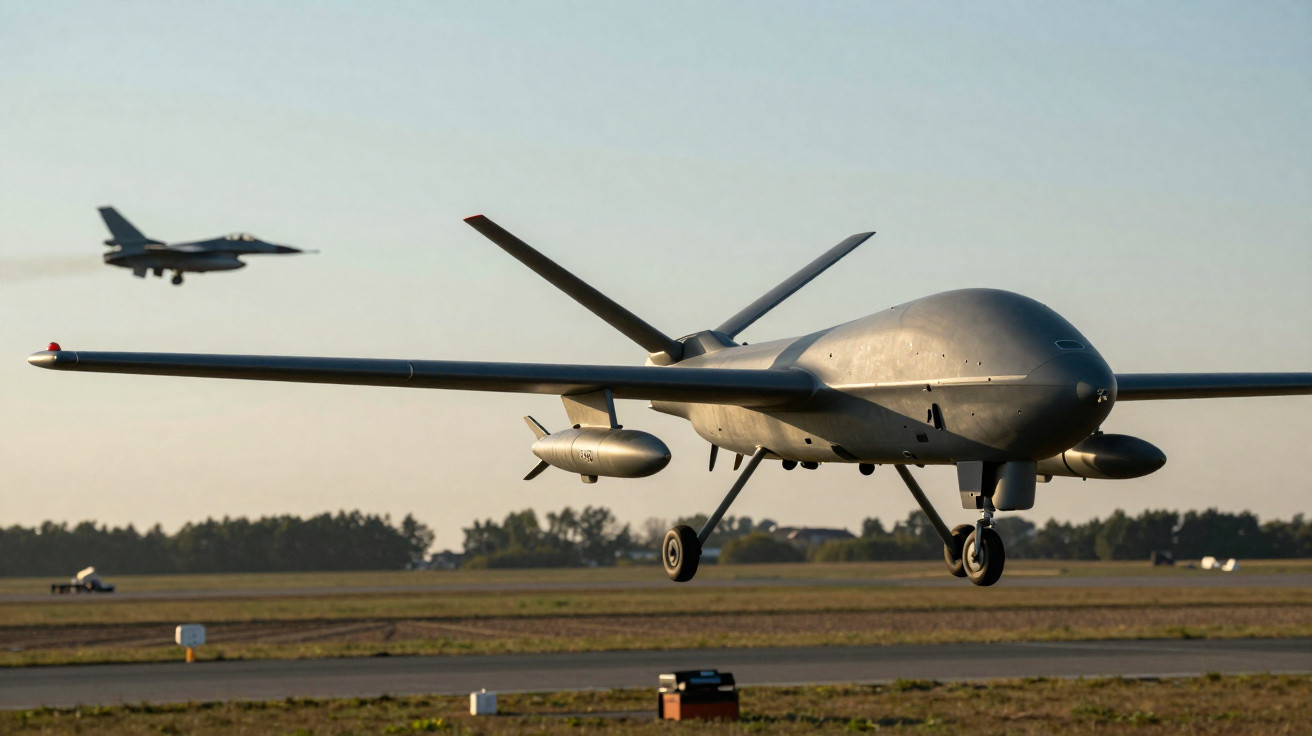
Ukraine’s Air Force F-16 and Mirage 2000 fighters are now exposed to a fresh danger after Russia’s Armed Forces began fitting Shahed/Geran-2 drones with short-range air-to-air missiles. The change was uncovered when Ukrainian teams examined the debris from Russian unmanned aerial vehicles that had been destroyed by Ukrainian interceptors.
Evidence from Shahed/Geran-2 shootdowns by Ukraine’s Unmanned Systems Forces
Footage released by the Darknode Battalion of the 412th Nemesis Brigade-part of Ukraine’s Unmanned Systems Forces-provided the first visuals of altered Russian Shahed/Geran-2 drones carrying an R-60 air-to-air missile, designated by NATO as the AA-8 “Aphid.”
Those drones were brought down by Sting interceptors, unmanned aerial vehicles designed and manufactured by the Ukrainian company Wild Hornets. After the engagements, a review of the wreckage corroborated what the interceptors’ FPV cameras had shown: Russia is fielding Shahed/Geran drones able to carry air-to-air missiles. That represents an added risk for Ukraine’s F-16 and Mirage 2000 fighters, and also for helicopters tasked with hunting Russian drones.
How Russia adapted the Shahed/Geran-2 to carry the R-60 (AA-8 “Aphid”)
The shootdown videos indicate the drones had been altered with a launch rail installed along the top of the airframe, enabling them to mount a short-range, infrared-guided R-60 missile. First introduced in the 1970s, the R-60 gained a reputation for high manoeuvrability and for being able to strike targets at extremely short distances (200 to 300 metres). Capable of speeds above Mach 2.0, it carries a 3 kg explosive warhead-sufficient to bring down a helicopter or a fighter aircraft.
Background on Drones Armed with Air-to-Air Missiles
At present, no additional specifics have been reported about the alterations to the Russian drones beyond the launch rail. Examination of recovered fragments may clarify whether the missile can genuinely be launched, or whether this is a Russian measure designed to influence the way Ukraine employs its manned interceptors.
While this appears to be the first known case in the war of a drone equipped with an air-to-air missile, Ukraine’s Armed Forces have previously demonstrated the concept with their own systems.
In that earlier example, Ukraine’s Magura naval drones were fitted with-and successfully used-R-73 and AIM-9 Sidewinder missiles. Verified shootdowns include at least two Mi-8 helicopters and two Su-30 fighters belonging to the Russian Aerospace Forces, all downed over the waters of the Black Sea.
Drones’ expanding roles across the Ukraine war
The emergence of Russian drones carrying R-60 missiles marks another step in the rapid evolution of unmanned systems in the Ukraine war. For months, drones have been among the main tools on both sides, undertaking a wide range of missions, including aerial and naval strike, reconnaissance, logistical support, relay duties, interceptor roles, and more.
Both Russia and Ukraine also use drones beyond the front line to hit strategic targets on land and at sea, with Ukraine retaining an advantage in maritime strikes.
Cover image via Nemesis Brigade.
You may also like: Ukraine’s Air Force Successfully Uses Legacy Magic 2 Missiles from Its Mirage 2000-5 Jets to Shoot Down Russian Drones





Comments
No comments yet. Be the first to comment!
Leave a Comment