
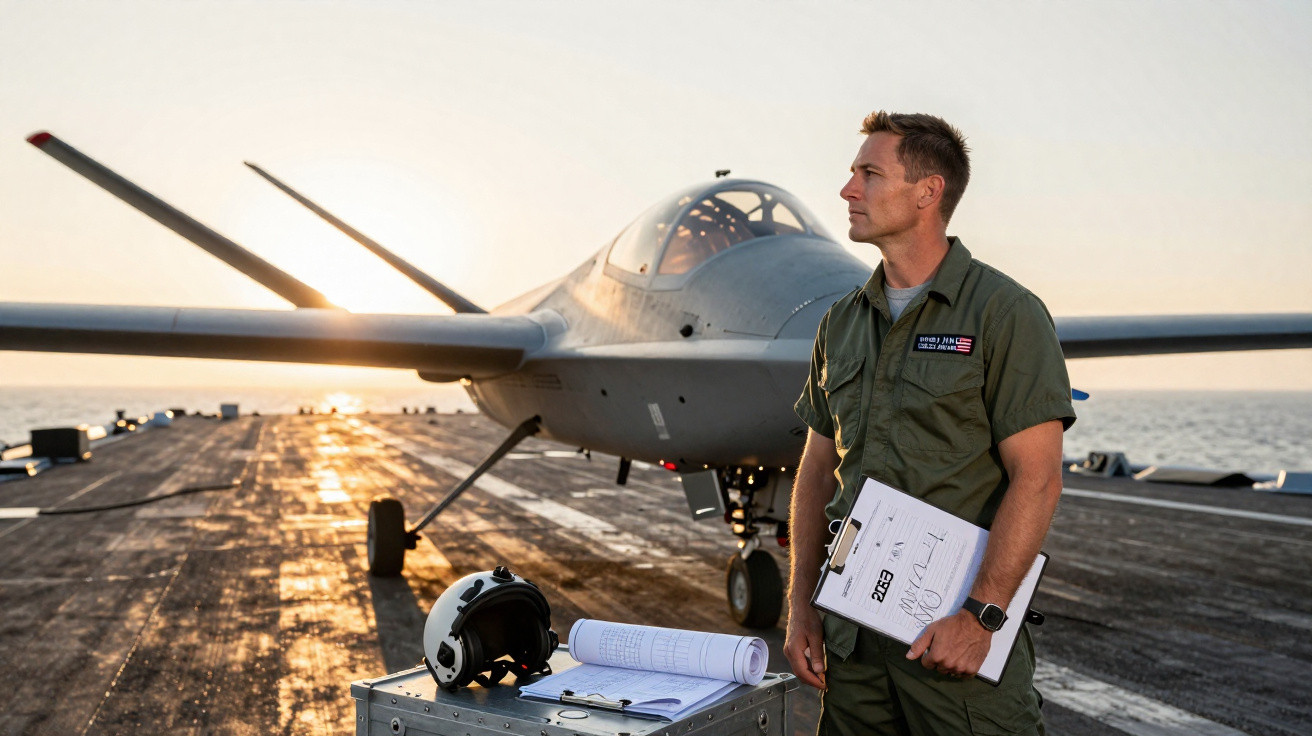
The U.S. Navy has confirmed a further schedule slip for the MQ-25 Stingray carrier-based refuelling drone: under current plans, the aircraft will not fly at any point during the remainder of 2025, with the first flight now pushed into early next year. This update runs counter to previously stated expectations-voiced by both Boeing representatives and Navy personnel-that flights would take place next year, enabling development to move ahead more quickly.
U.S. Navy update on MQ-25 Stingray testing and certification
Drawing on excerpts from the U.S. Navy’s official statement:
“Over the last several months, the team completed structural testing of the MQ-25A Stingray on a static aircraft, conducted initial engine tests, completed its certified flight software, and commanded the vehicle from the Unmanned Carrier Aviation Mission Control System (UMCS). The team is finalizing systems testing and flight clearance, and the first flight is expected once certification is complete and weather permits.”
Boeing and Lockheed Martin work still outstanding
Building on the steps described by the U.S. Navy, Boeing said in its own release that the certified software has already been installed and that engine tests have been carried out, but that the programme is still waiting for Lockheed Martin to complete the command programming.
Separately, U.S. analysts have pointed to disruption from the government shutdown in recent weeks, as well as a strike at Boeing facilities in the state of Illinois, as factors that affected multiple programmes-although neither issue was cited officially in relation to the MQ-25.
MQ-25 Stingray programme delays since 2018
This is not the first setback to affect the MQ-25 Stingray programme, with development of the unmanned platform having been under way since 2018. Looking back over the timeline, 2021 marked the most notable period of progress, including trials from the deck of the aircraft carrier USS George W. Bush. By contrast, 2022 and 2023 brought relatively little public indication of major advances, leaving the original objective of reaching Initial Operational Capability in early 2025 looking unrealistic.
Why the MQ-25 matters for U.S. Navy carrier operations
Even with repeated delays, the drone remains central to the U.S. Navy’s future plans, with earlier reporting indicating an ambition to field at least 76 aircraft. The key feature is its ability to operate from aircraft carriers to provide an aerial refuelling capability that is currently delivered by F/A-18 Super Hornet fighters fitted with external fuel tanks-a mission they were not designed to perform. With the MQ-25 in service, those aircraft could be returned to their primary roles while also easing the wear placed upon them.
Images used for illustrative purposes
You may also like: Construction has begun on the future USS Barb, the 31st Virginia-class nuclear submarine of the U.S. Navy





Comments
No comments yet. Be the first to comment!
Leave a Comment