
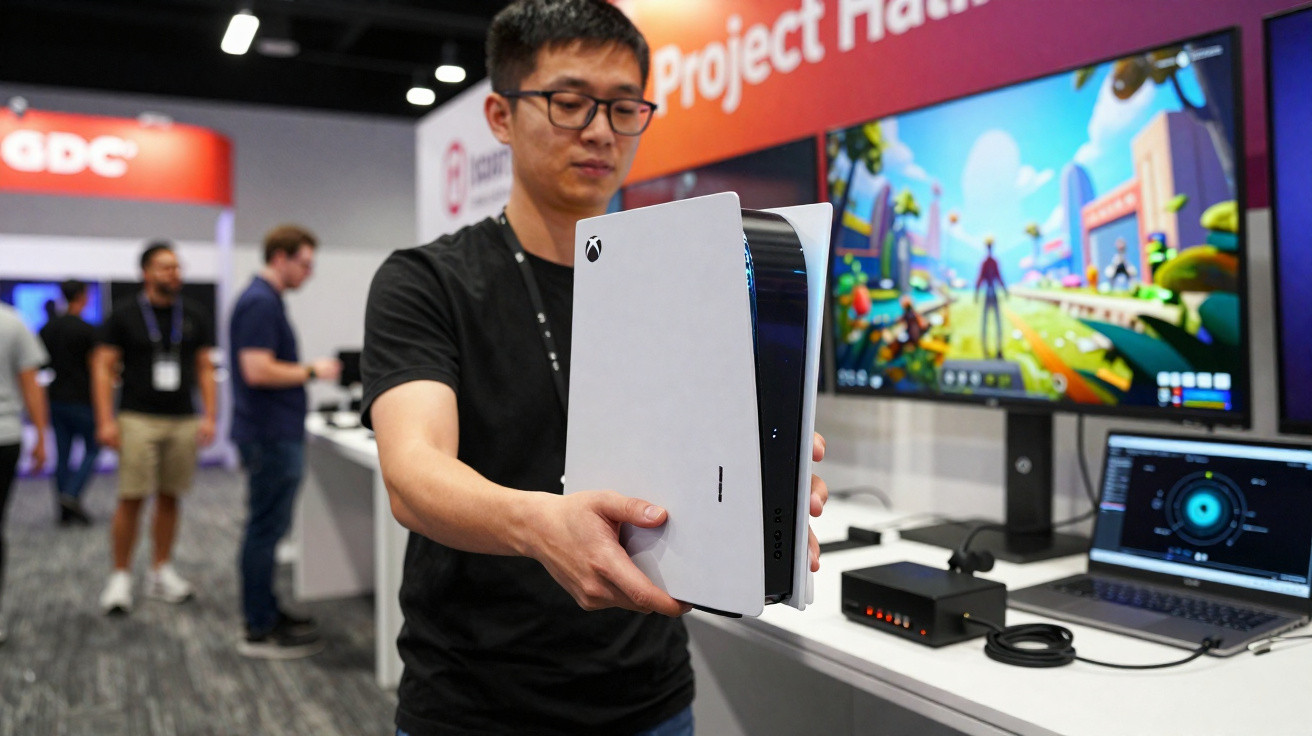
Microsoft has unexpectedly shared images of a new developer device at the Game Developers Conference. Officially, the company is only calling it hardware intended for studios, but plenty suggests we could be looking at an early Project Helix prototype - the next Xbox concept that aims to bring console and PC closer together than ever.
What Microsoft actually showed at GDC
The photos were posted via the official “Microsoft Game Dev” account and depict a black-and-white unit clearly labelled as an Xbox Development Kit (XDK). Hardware like this typically appears in developers’ offices long before any consumer console reaches the shops.
In the shots, the casing looks familiar to seasoned watchers. Its silhouette strongly echoes previous dev kits - including the one associated with Project Scorpio, which later became the Xbox One X. That resemblance is exactly what has reignited speculation.
The first images suggest a developer prototype that is more than just recycled hardware - Project Helix could already be running at full tilt behind the scenes.
Microsoft has not addressed the rumours directly. Still, the timing - released during GDC, in full view of thousands of developers - hardly feels accidental.
How much Project Helix is inside this prototype?
No-one is officially naming the device, yet the codename Project Helix has been surfacing more and more over recent weeks. Asha Sharma, Microsoft’s new head of gaming, has already referenced the term in both internal communications and public statements.
The core idea is straightforward: Helix is expected to be a hybrid console between a traditional Xbox and a PC. That does not mean placing a full Windows desktop machine in the living room, but it could mean the line between console and desktop gaming becomes far less distinct.
- An architecture shaped more like modern gaming PCs
- Improved compatibility with existing PC games
- Deeper integration with Xbox Game Pass and cloud services
From a developer perspective, that would be a meaningful shift. Teams that currently optimise separately for PC and Xbox could, in future, work much closer to a single, unified platform. For players, the best-case outcome is clear: more games, faster ports, and fewer technical compromises.
Recycling old cases or genuinely new hardware?
The biggest question raised by the leak is how new the underlying system really is. One detail has puzzled fans and hardware observers alike: the device’s casing appears heavily inspired by already-known dev-kit designs.
That opens up several plausible scenarios:
- Microsoft is reusing older dev-kit enclosures while fitting them with entirely new internals.
- This is an early transitional phase, and the real Helix outer shell simply is not finished yet.
- The prototype uses a modular approach, allowing different internal configurations during development.
One point remains consistent: XDK units usually only reach a small circle of approved studios and partners. If Microsoft is willing to show one publicly, it is doing so with intent - particularly to those planning their next slate of games and signing off budgets.
The message between the lines: “The next Xbox generation is being built - those who get in early will have an advantage later.”
Why GDC was the perfect moment for the leak
The Game Developers Conference (GDC) in San Francisco is the industry’s meeting point for technology, engines, and tooling. The audience is not made up of fans in branded T-shirts, but programmers, producers, and studio leaders.
That is exactly who Microsoft is speaking to with these dev-kit images. Rather than staging a big consumer spectacle, the company is opting for a technical whisper behind closed doors: “Something new is coming - get ready.”
Microsoft has leaned on this playbook for years. Long before any official console reveal, dev kits appear in studios, tech demos circulate at internal events, and developers receive documentation and roadmaps. The newly published photos feel like the starting signal for the next phase of the Xbox ecosystem.
Xbox in transition: why Helix matters so much
Microsoft’s gaming division is currently navigating a period filled with uncertainty. The company is investing heavily in acquisitions and Game Pass, while fans simultaneously push back when exclusives slip or studios are closed.
On top of that, there have been leadership changes within Xbox management. When familiar figures step away, pressure increases on what comes next - and that is where Project Helix moves to centre stage. The platform is expected to indicate where Xbox is heading over the coming years.
| Aspect | Current Xbox generation | Possible Helix direction |
|---|---|---|
| Hardware focus | Console with PC connectivity | PC-like hybrid platform |
| Ecosystem | Combination of console, PC, cloud | More unified environment |
| Game Pass | Subscription as an add-on offering | Central hub and cornerstone |
| Development | Parallel PC and console builds | More tightly integrated development processes |
What a hybrid Xbox could mean for players
The practical question is what a hybrid console would feel like day to day. In theory, it could bring several advantages:
- Faster ports: PC games could arrive on the new Xbox with fewer changes.
- Better backwards compatibility: A more PC-like architecture can make supporting older titles easier.
- More flexibility: Cloud streaming, local play, and potentially PC-style features could work together more closely.
At the same time, there are risks. If the system becomes too open, the classic console promise - plug in, press start, it just works - could be weakened. Too many hardware options and modes could confuse less technical users.
Microsoft therefore has a narrow path to walk: enough PC DNA to excite developers and core players, while keeping the experience simple enough that the new Xbox still feels like an easy living-room device.
Why dev kits are so crucial to the future of games
If you are only waiting for a new console as a player, it is easy to miss how early the real work starts. Dev kits sit at the heart of that early phase. They do not just provide hardware; they also deliver tools, debug menus, telemetry, and extensive documentation.
Studios use them to trial new rendering techniques, fine-tune memory access, measure loading times, and stress-test simulations. The earlier teams get access, the more effectively they can adjust their roadmaps. That is why Microsoft is keen to send a clear signal: “The next step is ready - plan your projects for it.”
Terms such as XDK may sound dry, but for developers they are invaluable. They indicate the platform is concrete enough for serious work, even if certain details still change. For big productions with development cycles of five years or more, that certainty is essential.
What could happen next with Project Helix
There are no official dates for a full reveal. A realistic roll-out would be gradual: more technical details at developer events, followed by a major Xbox showcase focused on games, and finally a traditional console presentation covering design, price, and release timing.
Anyone who has followed the industry for a while knows leaks like these photos are rarely pure chance. Microsoft can gauge how the community and media respond, how strong the interest is, and which questions keep surfacing. That feedback shapes not only messaging, but sometimes even hardware and software planning.
For players, it is worth paying closer attention now to terms like Project Helix, XDK, and hybrid architecture. Behind these labels sits a strategic shift that could influence where and how we play games in the long run - on the sofa, at a desk, or streamed to almost any device in the home.






Comments
No comments yet. Be the first to comment!
Leave a Comment