
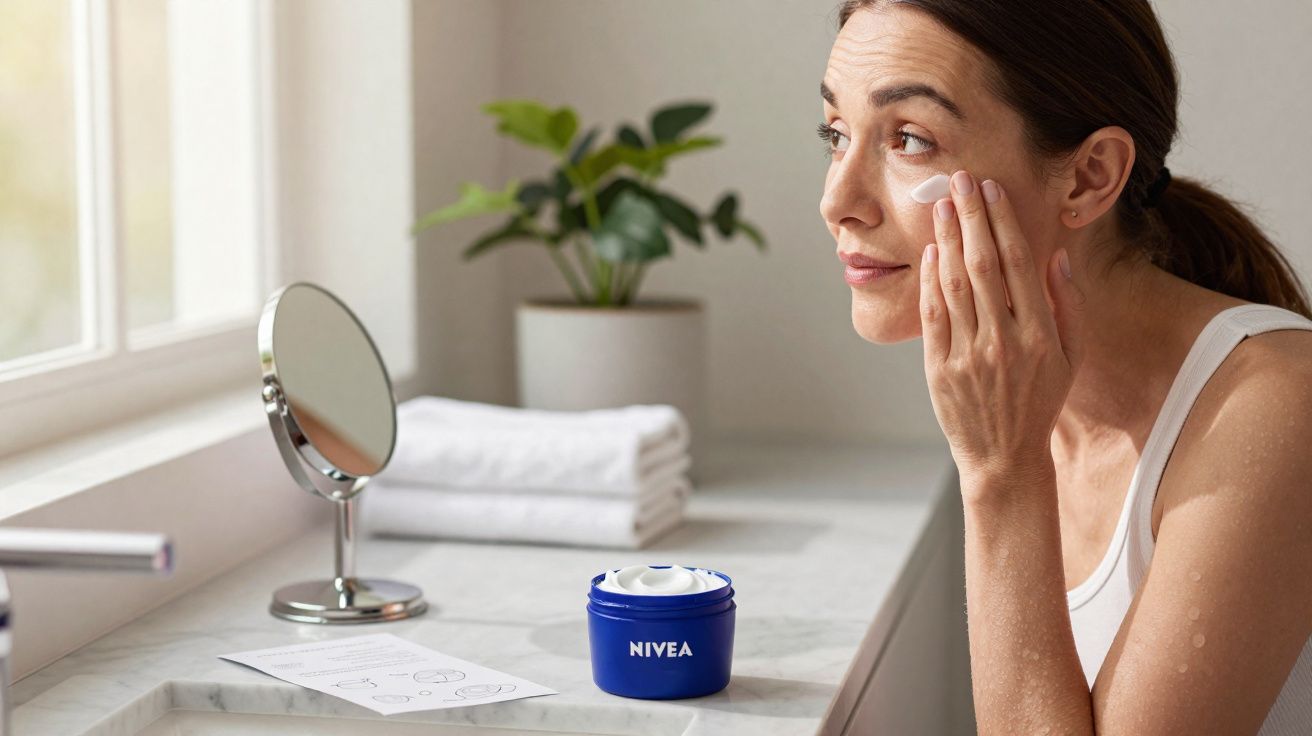
Some people smooth it on like a hush-hush trick. When wrinkles show up, they turn to a very traditional approach.
When lines feel more obvious and foundation starts clinging or creasing, many reach for Nivea cream. The logic is straightforward: flood the skin with moisture, refine the surface feel, and make creases appear less noticeable. That can deliver a visible improvement, at least temporarily. However, what you see depends on your skin type, the specific product formula, and everything else in your routine.
What actually happens on your skin
The original Nivea Creme is thick and highly occlusive. It helps retain water by leaving a light film over the skin, which reduces transepidermal water loss. Ingredients such as glycerin and panthenol attract and hold onto moisture, while lanolin alcohol and waxes help seal it in. As the skin takes on water it swells slightly, so fine lines can look a bit less pronounced for several hours.
Nivea’s Q10 ranges include ubiquinone, an antioxidant intended to help counter free radicals. That matters because oxidative stress can accelerate collagen breakdown. Any visible effect tends to be slow and subtle. Often, skin feels smoother before any meaningful shift in the look of line depth.
"Moisture plumps. Occlusives hold that moisture in place. Together they blur fine lines, but they don’t rebuild collagen."
Hydration, plumping and the wrinkle illusion
When skin is dry, it tends to crease more sharply. Boosting hydration in the upper layers makes the surface less rigid, which can soften the appearance of crow’s feet and smile lines. Make-up typically applies more evenly over a cushioned, well-hydrated base. That’s why some people use Nivea as an affordable primer alternative.
More established wrinkles behave differently. They develop as collagen becomes thinner and elastin loses resilience. A rich moisturiser can’t truly fill those deeper channels; it can only make the edges look less stark. For longer-term, structural improvement over months rather than hours, retinoids, peptides and daily sunscreen are the tools that do most of the work.
"Expect smoothness and glow within minutes; expect change in wrinkle depth only with a full routine over time."
Where this cream shines
- Cold weather and central heating: helps protect against dryness and that tight, uncomfortable feeling.
- After a gentle acid or retinoid night: can ease flaking and lower the chance of irritation.
- Under make-up on normal to dry skin: improves slip and can create a soft-focus finish.
- As a hand, neck and chest seal: keeps more delicate areas feeling comfortable.
Where it can fall short
If your skin is oily or prone to acne, the richness may feel too much. Occlusive products can trap oil and sweat, which may trigger congestion for some people, particularly across the T‑zone. Several Nivea formulas contain fragrance, which can be a problem for sensitive, reactive or rosacea-prone skin. Used around the eyes, a heavy cream may also contribute to milia in those who are susceptible.
"If your skin breaks out or stings with fragrance, choose a fragrance-free moisturiser with glycerin, squalane or ceramides instead."
What you may notice and when
| Effect | Why it happens | Typical timeframe |
|---|---|---|
| Softer feel and surface glow | Humectants draw water; occlusives reflect light | Minutes to hours |
| Fine-line blurring | Epidermal hydration swells corneocytes | Within a day, while skin stays hydrated |
| Improved tolerance to active skincare | Barrier support reduces dryness and flaking | Days to weeks |
| Slight boost in skin firmness (Q10 ranges) | Antioxidant support against oxidative stress | Weeks, with consistent use |
How to use it without drama
Apply for maximum hydration
Apply it to slightly damp skin after cleansing. For the face, use roughly a pea- to almond-sized amount. Rub it between your fingers to warm it up, then press in and smooth over. If the neck and upper chest feel tight, include those areas too. In the evening, use it as the final step to lock everything in.
Pair it with line-fighting actives
In the morning, finish with SPF 30 or higher as your last layer. Protecting against UV helps stop new lines forming. At night, apply Nivea after a retinoid or a peptide serum. This “sandwich” approach can reduce dryness and support the skin barrier while your actives do their work.
- Morning: gentle cleanse, antioxidant serum, Nivea (a thin layer if needed), sunscreen.
- Evening: cleanse, retinoid or peptide serum, Nivea to seal.
Who should patch-test first
If you’re prone to fragrance allergy, test it along the jawline for two nights. If you break out easily, begin by applying it to the cheeks only. Should you notice closed comedones, limit use to drier areas. For eyelids, opt for a lighter eye gel rather than a heavy occlusive if you tend to get milia.
The cost angle and what to choose
A big draw is the price and how easy it is to buy. The classic tin lasts a long time and is handy for travel. For daytime, a lighter Nivea Q10 day cream with SPF may suit normal skin. For night-time, the richer Creme or a Q10 night version can help offset moisture loss while you sleep.
Label clues to check
- Prioritise formulas listing glycerin and panthenol near the top for hydration.
- Check for fragrance if your skin is easily irritated.
- For daytime, look for SPF; the blue tin contains none.
"No moisturiser removes etched wrinkles. It can reduce the look, improve comfort, and help other actives work with less irritation."
Extra context that helps
Wrinkle care builds over time. Think in layers: sunscreen every day to protect collagen, retinoids to support turnover, antioxidants to help limit oxidative stress, then an occlusive such as Nivea to trap hydration. Used together, this can lead to smoother-looking texture and a more even, steady tone. In that line-up, the cream acts as the seal rather than the headline act.
Make-up performance is often about texture. If your foundation starts to pill, use less product and give it ten minutes to settle. Lightly press on powder rather than buffing. If you have a beard or stubble, apply with the direction of hair growth to reduce clumping. During flights or train journeys where the air is dry, a small dab part-way through can keep skin supple and help avoid that tight, shiny look when you arrive.
Risks, advantages and a simple trial plan
The upsides are straightforward: reduced water loss, softer-looking lines at a glance, and improved tolerance of active products. The downsides can include breakouts on oilier skin, reactions to fragrance, and milia around the eyes. A seven‑day trial usually gives a clear answer. Use it each night on damp skin, steer clear of the T‑zone if you clog easily, and note how your make-up sits the next morning.
If you’re after a bigger change in wrinkle depth, introduce a retinoid or a peptide complex. Keep Nivea as your comfort layer. That way you get the immediate plumping you can see, while evidence-based actives work on the underlying structure you can’t see yet.






Comments
No comments yet. Be the first to comment!
Leave a Comment