
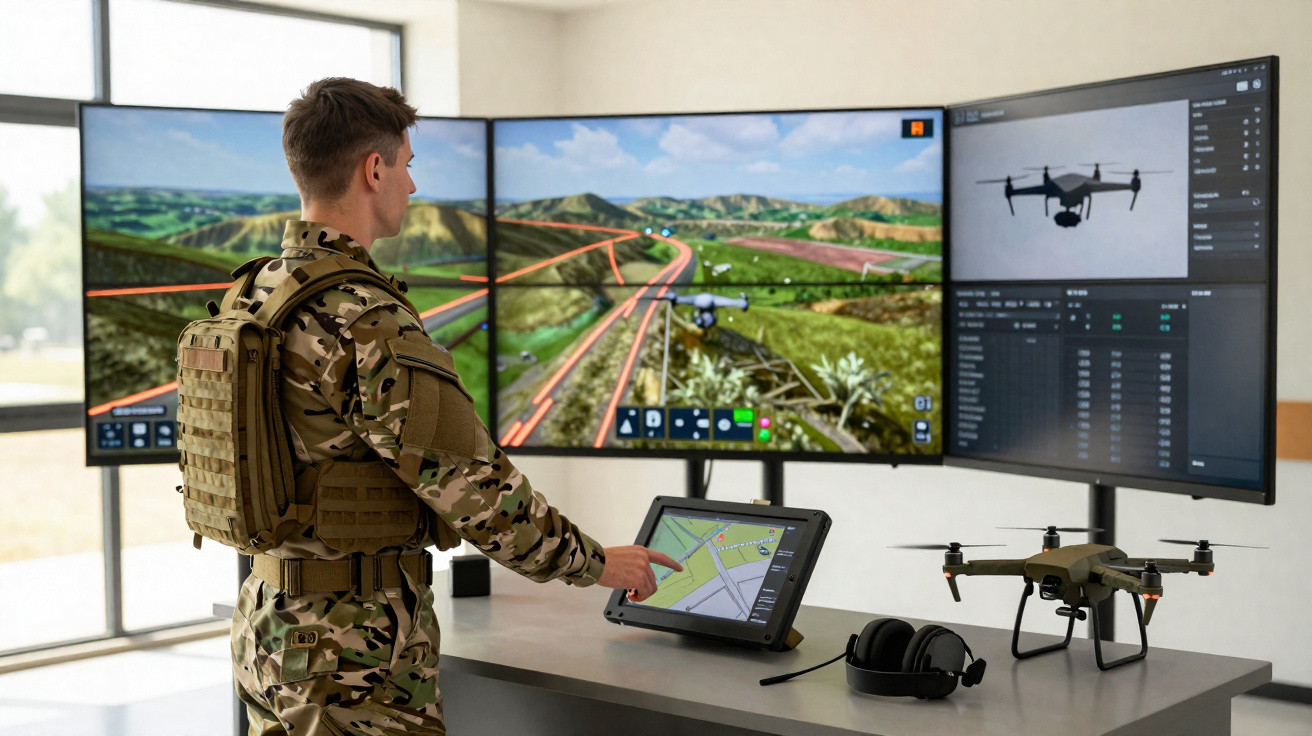
Thales has unveiled an updated version of its Land Live Training (LLT) simulator. The more advanced release brings a key upgrade: drones can now be integrated into the simulator to strengthen training delivery and oversight. Zona Militar spoke with Bruno Delacourte, Thales’ Director of Strategy, Marketing and Product Policy, about the new system.
Thales Land Live Training (LLT) now integrates drones
Delacourte said the drone addition is “compatible with all our [training] solutions” produced by Thales. That matters because the company builds several live-training simulators. In Thales’ portfolio, the Land Live Training system is known as Gladiator, while its “next-generation” tactical engagement simulation system is called Cerbere.
How the LLT system operates: EMS and TAN
Thales’ latest work is a comprehensive live land-training setup that brings together “soldiers, vehicles and drones in a fully instrumented real environment, enabling exercises at any scale, from small-unit training to multinational operations”. Delacourte also noted that “at the heart of the LLT system” sits its Exercise Management System (EMS), described as “a powerful platform that enables commanders and instructors to plan scenarios, control the conduct of live exercises and carry out detailed post-action assessments”.
Alongside the EMS is LLT’s Training Area Network (TAN), Delacourte told ZM, which links soldiers, vehicles and drones to an Exercise Control Centre, allowing real-time monitoring.
Drone kit and pilot module for live missions
In the newest LLT version, operators are able to fly their own drones during training missions. The enhanced Land Live Training solution is drone-type agnostic. Thales told ZM the system includes a dedicated drone kit with its own hardware and software, integrating sensors, indicators and telemetry.
A Drone Pilot Add-On Module-also with its own hardware and software-equips drone pilots with specialist tools tailored to live-training missions.
Drone use cases: “friendly” and “enemy” scenarios
The company explained in a press release dated 1 December that the new system “covers multiple drone use cases”, including scenarios involving both “friendly” and “enemy” drones. For instance, drones can be fitted with transmitters to replicate loitering munitions or armed drones. In addition, sensors and indicators can be installed “to simulate the effects of drone neutralisation and provide real-time feedback on the drone’s status during training exercises”.
Relevance for Latin American armies and varied terrain
ZM asked Delacourte why Latin American militaries should pay attention to drone-enhanced training systems such as Gladiator-particularly given regional geography, where forces train for and operate in both jungle warfare and mountain warfare. “As the solution is geo-referenced by radio and uses laser for anti-drone attacks, it is also usable in training for jungle and mountain warfare,” Delacourte explained.
Thales provided further detail on how the simulator can be applied in Latin America, taking account of the region’s distinctive environments. Delacourte said that “for jungle environments, such as the Amazon”, adding drones to live training “enables realistic scenarios for aerial reconnaissance, river monitoring, patrol coordination and defence against hostile drones, all essential skills given both military threats and internal security challenges in the region”.
On mountain warfare, Thales stated that “in mountain environments” such as the Andes, “drones help extend observation range, support rescue simulations and improve coordination between mountain units and air support”. Delacourte added that “innovative training adapts to altitude and aerodynamics, reflecting regional realities”.
The company also noted that the drone-enabled simulator can support preparation for desert warfare, such as in Peru’s deserts or Chile’s Atacama Desert. “Drones are especially valuable [in desert environments] for long-range reconnaissance and logistics, with training focused on overcoming challenges such as dust and high temperatures”.
Another potential draw for Latin American armed forces is that “the LLT scales without difficulty”, because its “architecture allows exercises involving thousands of participants, all integrated into a single control framework”. Thales told ZM that an entire battalion-or even a brigade-can use the drone-enhanced LLT for training.
Latin American militaries are already familiar with simulators as a way to raise training standards. Chile’s state defence firm FAMAE has built virtual shooting simulators for the Chilean Army; these are well suited to learning how to operate the Galil ACE rifle. Colombia’s CODALTEC has also developed a shooting simulator. Thales’ LLT solutions go beyond marksmanship training: they also support the effective management of full field exercises and give commanders greater situational awareness of how troops, vehicles and drones are performing.
The improved, drone-enabled version of Thales’ Land Live Training simulators was recently shown at the I/ITSEC exhibition in Orlando, Florida. ZM asked Thales whether there are customers or users for the new drone-enhanced live-training simulator. “Many customers have provided us with very positive feedback on our drone-type-agnostic solution and have already expressed a high level of interest,” the defence company said, without giving details on potential orders or negotiations.



Comments
No comments yet. Be the first to comment!
Leave a Comment