
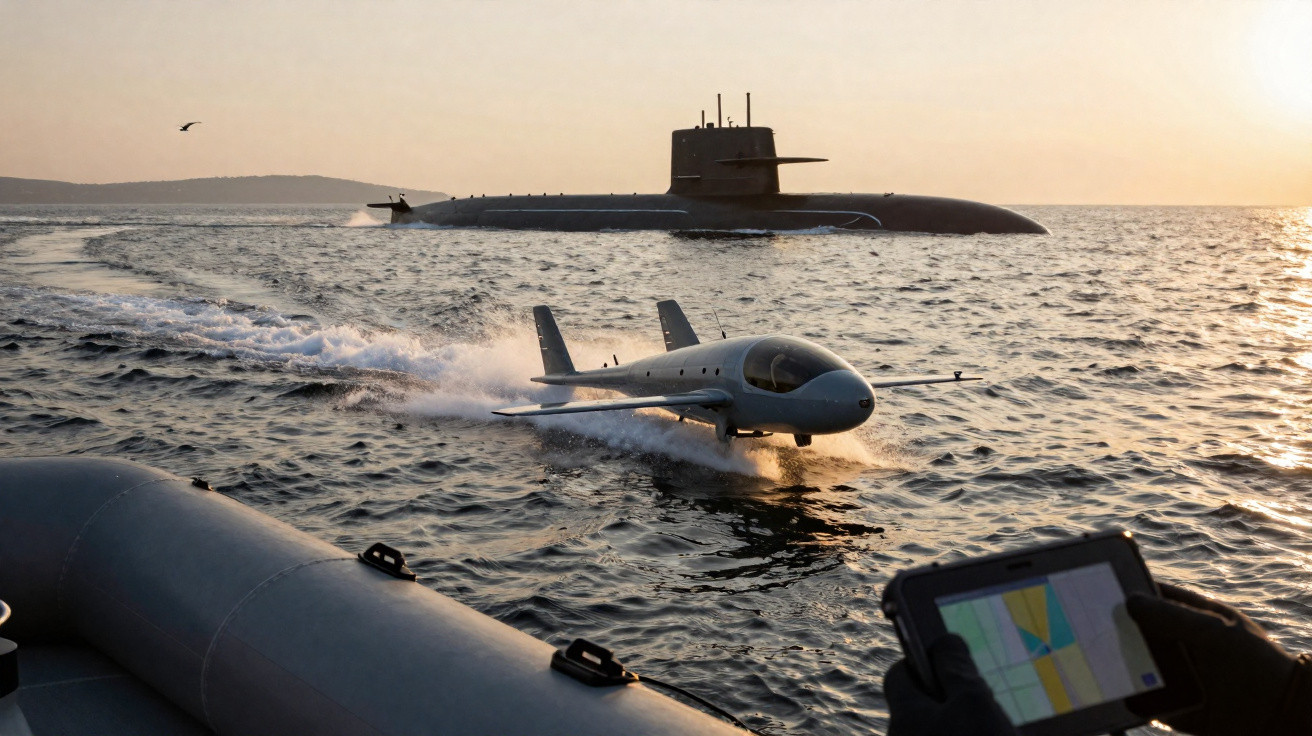
In a short video posted on its YouTube channel, the Security Service of Ukraine (SBU) announced that it had attacked one of the submarines deployed by the Russian Navy in the Black Sea, using one of its new “Sub Sea Baby” naval drones. The SBU identified the target as a Project 636.3-class submarine (also known as Kilo II or improved Kilo) that was at the naval base in Novorossiysk. Planning and execution of the operation were attributed to the Ukrainian Navy working alongside the SBU’s 13th Main Directorate of Military Counterintelligence.
Claimed SBU strike on a Project 636.3 (Kilo II) submarine in Novorossiysk
Expanding on details released by the SBU, it said the blast rendered the submarine completely unusable, including its Kalibr missile launchers, which are used in attacks against Ukrainian territory. This was presented as a key reason for selecting the submarine as the aimpoint within a base hosting a range of different assets.
As shown in the above-mentioned video, the explosion is said to have occurred at the submarine’s stern, reportedly causing damage to its propulsion system and hull significant enough to put it out of service. Kyiv further stressed that the strike represented a loss of 400 million dollars for the Russian Navy-an amount it argued would be even higher in practice given the sanctions affecting Moscow’s ability to build a replacement.
The “Sub Sea Baby” naval drone: what is known from early reports
Regarding the “Sub Sea Baby” drone allegedly used in the attack, the SBU did not provide additional technical details. However, early analyst reporting suggests it may be derived from the Sea Baby system previously used by the Ukrainian Navy against surface ships, with the distinguishing feature being an ability to attack while remaining submerged.
In that vein, it has been suggested it could be a type of autonomous torpedo equipped with guidance systems that would have enabled it to manoeuvre within the naval base to reach the Russian submarine-something that, given the layout of the facilities, would have required tight turns.
Russian Ministry of Defence denial and competing narratives
It is worth noting, however, that the Russian Ministry of Defence has denied that the strike publicised by the SBU achieved its intended effect. Moreover, a separate short video has been released claiming that the Kilo II-class submarine remains moored at the quay with no visible damage; it even shows crew members walking on the deck without apparent difficulty.
At present, it is not fully clear whether this is the same submarine, nor whether the footage may have been recorded earlier and edited later. That uncertainty points to another instance of Moscow and Kyiv attempting to shape the narrative around events in the conflict.
Some background on Ukrainian attacks in the Black Sea
Against the backdrop of uncertainty over this latest claim, it should be noted that-if confirmed-it would not be the first Russian submarine neutralised by Ukrainian strikes while in port. More specifically, in September 2023, a set of images was published indicating severe damage to the submarine “Rostov del Don” while it was alongside a berth in Sevastopol, reportedly caused by drones and Storm Shadow cruise missiles. In the same incident, damage was also verified to the Project 775-class landing ship “Minsk”, including major fires affecting its superstructure and internal compartments.
Separately, it is also necessary to note that the attack announced by the SBU came at a time when operations in the Black Sea appear to be increasing, particularly Ukrainian actions against Russian targets in Crimea and Novorossiysk. Clear examples cited include recent strikes on the oil tankers Virat and Kiaros in late November, as well as the use of Sea Baby drones against the ship Dashan a little under a week ago. All were reportedly bound for that same destination.
Broadening the view to Ukraine’s strike strategy in the region, the Kerch Bridge cannot be overlooked as a strategic target, serving as the link between occupied Crimea and Russian territory. It has been a frequent objective of Ukrainian operations, including SBU attempts to use underwater explosives to destroy its supports and bring it down in June-an effort that has not yet achieved that aim. Earlier, for example in October 2022 and July 2023, similar attempts were made using drones that likewise sought to bring down the bridge’s support pillars; on both occasions significant damage was caused, but not the outcome Kyiv was seeking.
Cover image: SBU






Comments
No comments yet. Be the first to comment!
Leave a Comment