
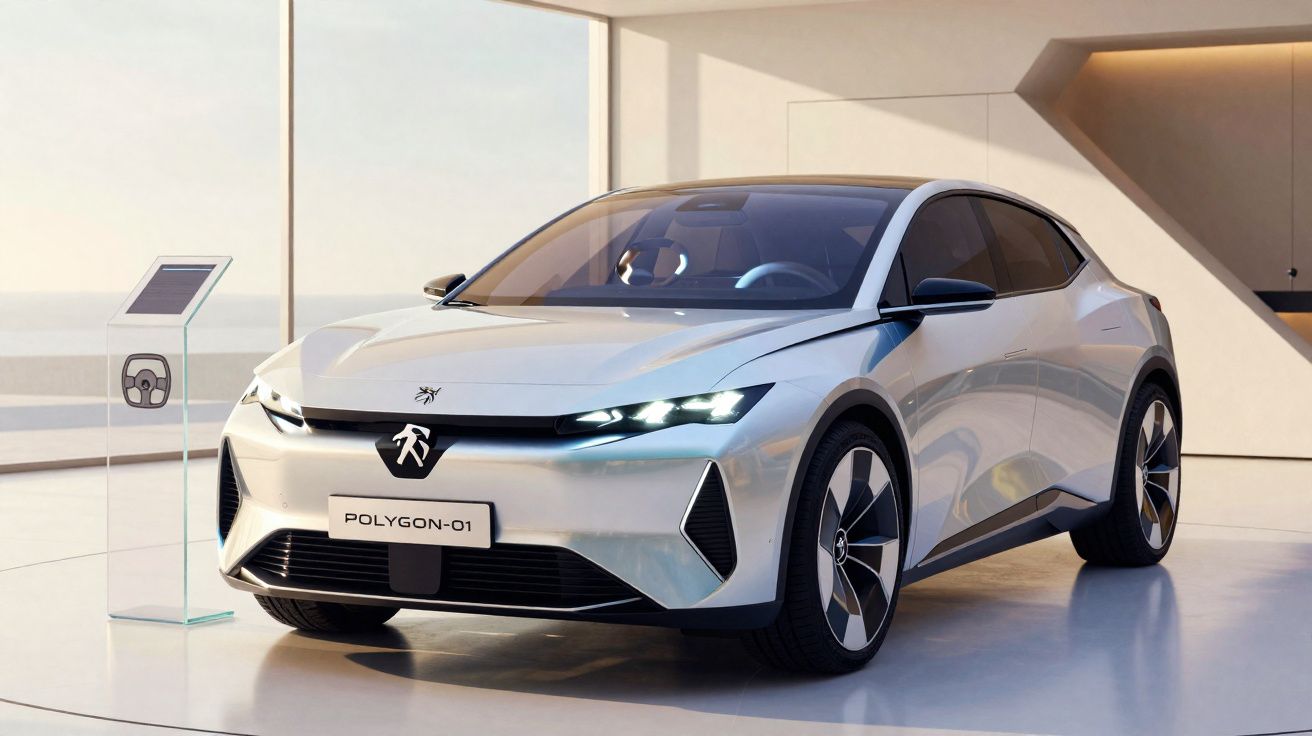
No-one has seen a Peugeot like this before: it is called the Polygon Concept, and it offers a first look at the design of the next-generation 208, due to be unveiled over the coming year.
Its extreme styling leaves little room for interpretation. The Polygon Concept sets out to be disruptive inside and out - to the point where Peugeot appears to have reinvented the wheel. Or, more precisely, the steering wheel.
The intention is unmistakable: draw a line under the past and focus solely on what comes next. On paper, that sounds like a big claim, but we spent time with this prototype in Portugal and were genuinely surprised by what it brings to the table. Take a look:
Reinventing the wheel
Far more than a show car with unconventional looks, the Polygon Concept was conceived as a rolling laboratory - a working prototype designed to trial technologies that will start appearing in Peugeot production models from 2027 onwards.
One of those technologies has forced a rethink of one of the car’s most traditional components: the steering wheel. That is because Peugeot wants to introduce Steer-by-Wire to more mainstream segments, removing the mechanical connection between the steering wheel and the road wheels.
First introduced by Infiniti in 2013 on the Q50 - and later explored by both Mercedes-Benz and Saab - Steer-by-Wire is currently found only on the Tesla Cybertruck, the Lexus RZ and the NIO ET9. Peugeot is now testing it, and it is expected to appear, for the first time, on the next 208, paired with a new rectangular Hypersquare control that replaces the conventional steering wheel.
Beyond its unusual shape, the Hypersquare also integrates four touch-sensitive pods (no, they are not cup holders…), which will be used to operate various functions while driving.
Returning to Steer-by-Wire, it is worth noting that Lexus, working with an external supplier, took 10 years to bring this system to a production car - a clear indicator of how complex the technology is.
During the Polygon Concept presentation in Portugal, we asked a Peugeot engineer how long this solution took to develop. He did not give a specific figure, but he did confirm it was far less than the 10 years required by the Japanese manufacturer, even though the same supplier that worked with Lexus has also collaborated closely with the lion brand.
What changes in the Polygon’s steering?
With no physical link between the steering control and the wheels, Peugeot says the driving experience becomes more immediate and engaging - something it claims is only possible thanks to removing the friction and latency found in conventional systems.
Any feedback is delivered electronically, but tuned to retain a sense of the road while filtering out unwanted vibrations. At least, that is Peugeot’s promise.
The system also makes it possible to tailor how the steering behaves (or the steering “style”) to each scenario: on a motorway, for instance, you typically want a slower, less direct set-up that prioritises stability; on a tighter, twistier road you want faster responses and greater angles at the front axle.
In theory, this is the future of steering. But will it feel that way in practice? In two years’ time, when we try this system in a production car from the French brand, we will revisit the discussion.
Polygon Concept: built for the future
Personalisation is another key pillar of the Peugeot Polygon, as almost everything can be configured to suit individual tastes - from interior trims to the ambient colours on board, without overlooking the wheels and even the Hypersquare control itself.
Everything has been designed around modular parts that can be slotted in and swapped out in just a few minutes. Even the tyres - developed by Goodyear - are part of this rethink: they use laser engraving on the sidewalls, allowing different patterns and colours to be combined depending on the driving mode.
There is more. With the Polygon Concept, Peugeot also signals a commitment to sustainability and circularity in its future models. As a result, both the structure and the cabin of this prototype make extensive use of recycled materials.
The cabin floor and panels are finished in forged textiles made from the seats of older Peugeot models; the seats are 3D-printed using recycled plastic (R-PET); and the interior paint uses pigments derived from end-of-life tyres.
More than a radical styling exercise, the Polygon Concept is a manifesto for what Peugeot believes the car of the future should be. Only time will tell whether the French manufacturer is proved right. For now, one thing is certain: it is impossible to feel indifferent towards this prototype.




Comments
No comments yet. Be the first to comment!
Leave a Comment