
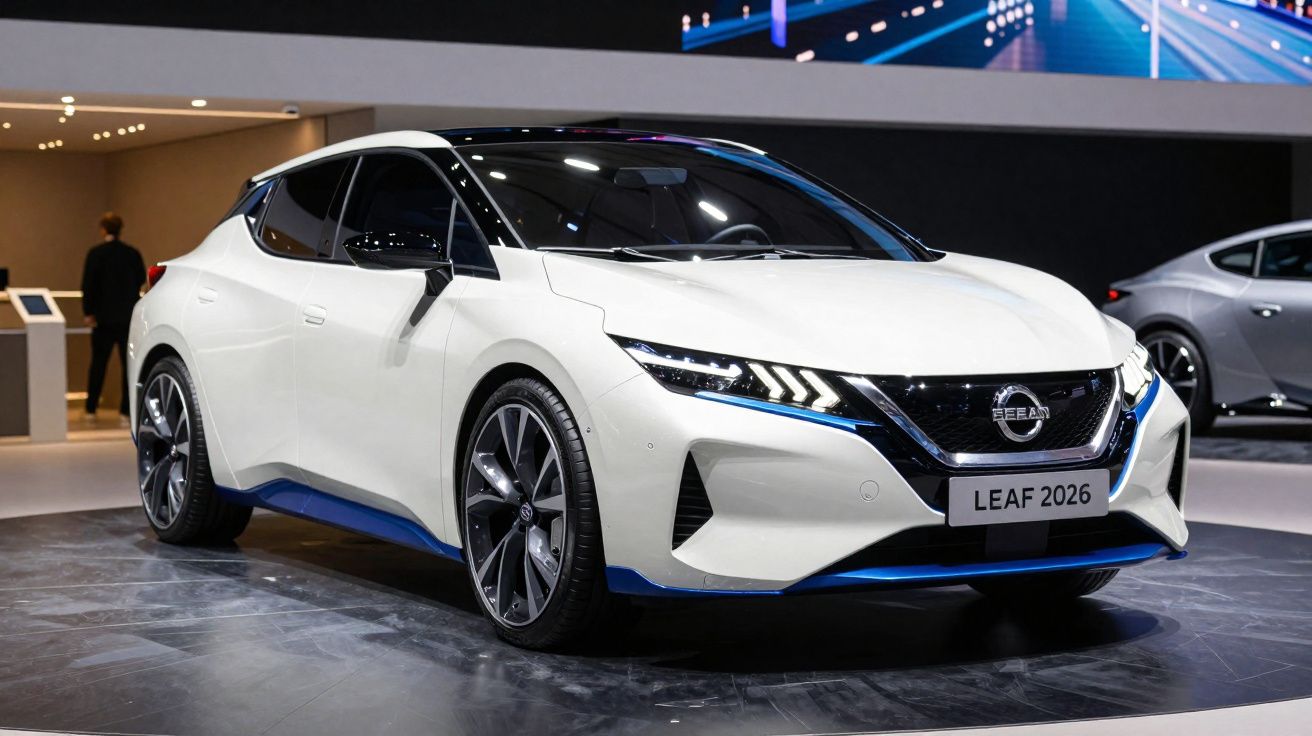
First launched in 2010, the Nissan LEAF is, for many, the “father” of electric mobility. For several years it was the world’s best-selling EV, and to this day it has notched up more than 700,000 units sold.
Over time, however, that success faded - and not even the second generation managed to reverse the slide. Now the model has undergone the biggest overhaul in its history: it is roomier, more high-tech, more powerful and it claims a WLTP driving range of over 600 km.
Ahead of its arrival in Portugal - still expected in the first quarter of 2026 - the new Nissan LEAF made a brief appearance at the Brussels Motor Show 2026, which opened its doors today. Here is our first encounter with the model.
Revolution in every sense
In terms of styling, the car leaves behind the slightly quirky, less appealing shapes of earlier generations. In their place is a sturdier look with better-balanced proportions, in line with today’s SUV-coupé trend.
It is also more aerodynamic, with a drag coefficient (Cx) of just 0.25. The new LEAF’s profile is more attractive too, especially at the rear, where the lighting signature stands out within a black surround.
And while many new generations grow in size, that is not quite the case here. Interestingly, the latest LEAF is 13 cm shorter (4.35 m), 1 cm taller and 2 cm wider than before. Inside, though, it offers more space than ever, thanks to a dedicated platform.
In the cabin, the LEAF feels years newer. If the previous versions were beginning to show their age, this one marks a clear break: there are now two 14.3" screens mounted side by side, handling the instrumentation and the dashboard interface.
LEAF with record range in the segment
Under its bodywork, the new Nissan LEAF sits on the CMF-EV platform - the same one used by the Nissan Ariya and the Renault Megane E-Tech - and it comes with two different battery options: a 52 kWh pack, delivering up to 436 km of range (WLTP), and a larger 75 kWh unit, which claims up to 622 km between charges.
When it comes to charging - and perhaps one of the less exciting aspects of this EV - the LEAF does not support the very highest charging rates seen in some rivals. On direct current (DC), the Japanese SUV charges at up to 105 kW (smaller battery) or 150 kW (larger battery).
On alternating current (AC), the Nissan LEAF can charge at speeds of up to 7.4 kW or, optionally, 11 kW.
How much will it cost?
The new Nissan LEAF is due to reach Portugal in the first quarter of 2026. For now, prices for the Portuguese market have not yet been announced. Even so, the Japanese brand says it will be highly competitive.






Comments
No comments yet. Be the first to comment!
Leave a Comment