
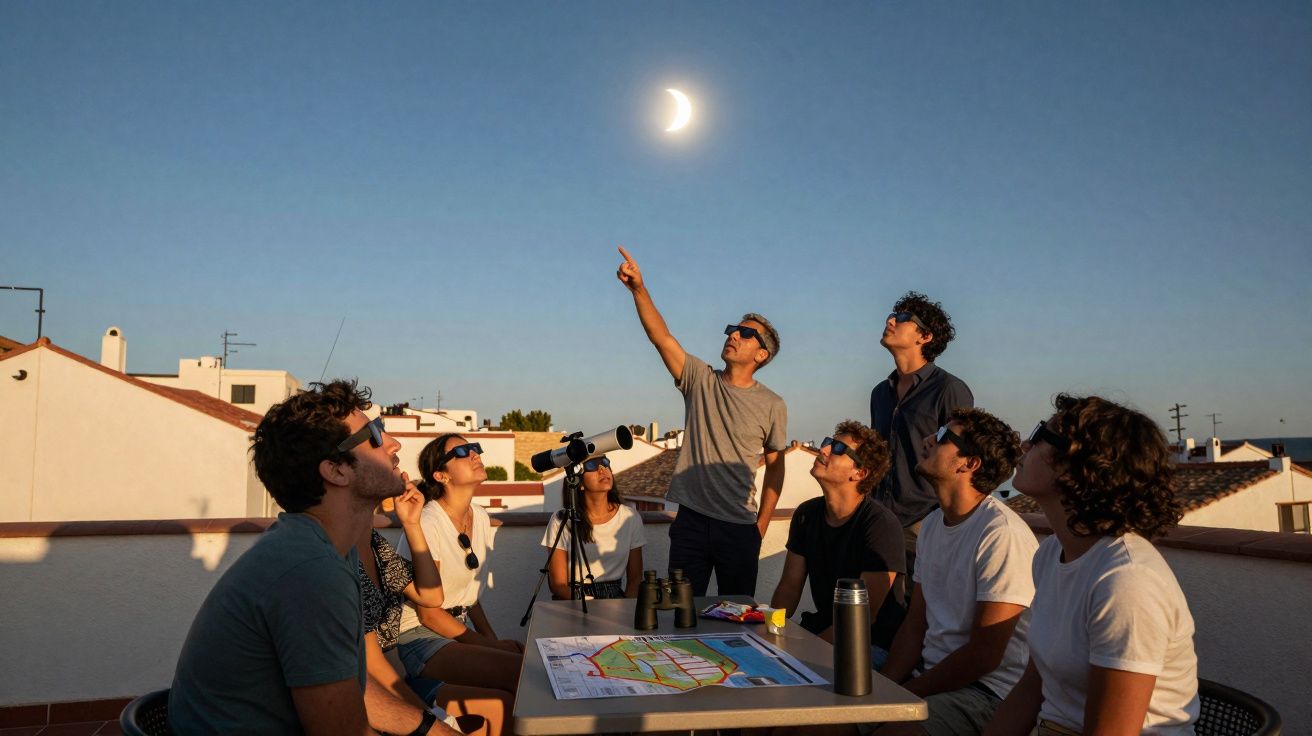
In the middle of the holiday season-when many people are relaxing on a terrace or stretched out on the beach-the sky above Europe turns into the stage for an exceptionally rare event: a solar eclipse sweeping from the Arctic Ocean down towards the Mediterranean. Across parts of Western Europe, daylight noticeably fades; in some areas it will dim almost as much as at sunset-only hours too early.
Europe set for one of the most striking solar eclipses since 1999
On 12 August 2026, the Moon will move between Earth and the Sun, creating a spectacle Europe has not seen in a comparable form since the summer of 1999. Back then, people across half the continent crowded onto fields and car parks with cardboard viewing glasses and homemade pinhole cameras. Since then, skywatchers have been waiting-now the next major date is approaching.
The eclipse track runs from the Arctic Ocean via Iceland and Spain to the Mediterranean coast-a line across the sky cutting right through Europe.
Along this track, some places will experience a total solar eclipse, where the Sun disappears completely behind the Moon for a short time. Bright daytime light collapses into an eerie twilight; stars and bright planets become visible.
Outside the zone of totality, the Sun will only be partially covered-yet that, too, can feel dramatic, particularly with coverage well above 90 per cent, which is expected in parts of Western Europe.
Near-total dimming in south-west Europe
Current calculations put one area especially under the spotlight: the continent’s south-western coastline. There, the Moon is expected to cover 90 to 95 per cent of the Sun’s disc. The eclipse begins in the early evening at around 19.30 Central European Summer Time (CEST), building to a peak roughly an hour later-just before natural sunset.
That combination is precisely why the effect can feel so intense. The Sun is already low in the sky, and the Moon then removes almost all remaining light. The landscape takes on an unreal bluish-grey cast. Colours look flatter, shadows lengthen and soften, birds fall quiet, and some animals behave as if the day has suddenly ended.
From an astronomical point of view, this is a so-called syzygy: the Sun, Moon and Earth are aligned almost perfectly. The term may sound technical, but it captures a rare moment when cosmic geometry becomes a direct, everyday experience-suddenly, anyone sitting in a garden chair can sense that these bodies are not just points on a chart, but are truly in motion.
Spain in the spotlight: holidays under the shadow
Spain will be affected most strongly. A large part of the country lies within the zone of totality-meaning the Sun will vanish entirely for a few minutes. And it is happening right in the August peak travel period.
As a result, the authorities are already making long-range preparations. Several ministries are working together to coordinate traffic flows, security and infrastructure. In tourist areas, excessive price hikes are to be curbed. Local rural tourism providers, guesthouses and holiday farms are expecting full bookings and are putting together special programmes for visitors travelling specifically for the skywatching.
- High demand for hotels and holiday lets along the eclipse corridor
- Special programmes in rural areas and on the coast
- Plans for public viewing sites with safety measures
- Increased rail and road traffic around 12 August
Spanish seaside resorts could present an unusual scene that day: beaches packed with people not watching the water, but staring upwards at the darkening sky-ideally with certified eclipse glasses, and not with the naked eye.
Iceland’s hotels fully booked, cruise ships head for the shadow
Farther north, the situation is even tighter. Iceland also lies within the zone of totality. Popular areas such as Reykjavik, the Reykjanes Peninsula and Snæfellsnes have reported accommodation fully booked well ahead of the event. Room rates are rising sharply, with some reports of prices doubling.
Cruise operators are also sensing an opportunity. Expedition ships are plotting routes between Iceland and the fjords of eastern Greenland to give guests as clear a view as possible of the ring-shaped shadow track. Other cruise lines are shifting itineraries to waters off the Spanish coast or towards the Balearic Islands, so passengers can watch the darkened sky directly from the deck.
Anyone hoping to pair the eclipse with a trip needs to plan early-many places to stay are booked years in advance.
A cosmic double event: solar eclipse meets meteor night
As if a solar eclipse were not enough on its own, the date falls during a period that stargazers mark in bold anyway: the peak of the Perseids, a well-known meteor shower. Normally these “shooting stars” are most visible later in the evening and overnight. With the sudden early-evening dimming, the chances increase of spotting especially bright meteors much earlier than usual.
Other objects in the sky add to the scene. Bright planets such as Venus and Jupiter sit near the darkened Sun. The open star cluster of the Pleiades may also stand out. With a clear view, you may see a patch of sky that feels more like early night-only it is happening in the middle of a summer evening.
What observers can realistically see
Depending on where you are, you may be able to make out:
- A crescent-shaped remainder of the Sun’s disc-or complete darkness at the centre
- A strongly dimmed sky with visible planetary light
- Bright meteors from the Perseids region
- A noticeable drop in air temperature as the eclipse progresses
How to protect your eyes properly
However mesmerising the view, looking directly at the Sun remains dangerous. Ordinary sunglasses are not enough. To watch safely, you need dedicated eclipse glasses with certified filters. Only these block harmful radiation sufficiently.
Telescopes and binoculars must never be used without appropriate filters. Concentrated sunlight can burn the retina in a fraction of a second. The safest option is to join public observing events run by observatories or local astronomy groups, where equipment is properly filtered and expert guidance is available.
Why eclipses like this are so rare
Eclipses occur when the orbits of the Moon and Earth line up so that the Moon passes directly in front of the Sun. It sounds like a straightforward alignment problem, but in reality it only happens in this level of precision infrequently. The Moon’s orbit is slightly tilted relative to Earth’s, its distance varies, and Earth is moving around the Sun at the same time.
When these factors coincide, a syzygy occurs. More often, the line is offset by a small amount; the Moon’s shadow misses the globe altogether or only brushes polar regions. That is why comparable events are separated by long gaps for central Europe. Anyone who experienced 1999 consciously and looks up again in 2026 belongs to a relatively small group of people lucky enough to witness two such eclipses in one lifetime at close range.
Practical tips for an unforgettable eclipse day
If you want to experience the spectacle deliberately, it pays to plan early. A few simple steps improve the odds of a clear view:
- Choose a location: Areas with statistically high sunshine in August have the advantage-especially in southern Europe.
- Arrive early: If you are travelling to high-demand spots, book your hotel or holiday let well before 2026.
- Buy protective glasses: Purchase certified eclipse glasses in good time, rather than relying on last-minute leftovers.
- Keep an eye on the weather: In the short term, it is worth checking forecasts so you can shift your viewing spot slightly a few hours beforehand if needed.
- Prepare your camera: Get lens filters, test your kit, bring a tripod-and despite the technology, remember to spend some time simply watching the sky (with glasses) without a lens.
Terms and context: what is happening when you look up
Many specialist terms can sound off-putting at first, but they are easy to place. Syzygy means the near-perfect alignment of the Sun, Moon and Earth. Totality refers to the area where the Sun is completely covered. Outside that zone, it is a partial eclipse: part of the Sun remains visible, light levels fall, but it does not become fully dark.
The Perseids are an annually recurring meteor shower. Earth crosses a stream of comet debris, so tiny dust particles enter the atmosphere at high speed and burn up. They create the familiar streaks of light many people know as a “wish star”.
For many, the day will blend a natural spectacle with a holiday memory. Anyone sitting on a beach on a summer evening in 2026, watching the sky slowly fade, seeing planets, meteors and the Moon’s shadow at the same time, will probably never forget the time on the clock. Moments like this pull astronomical terms out of textbooks and into everyday life-and, for a brief interval, make the cosmos feel close.






Comments
No comments yet. Be the first to comment!
Leave a Comment