
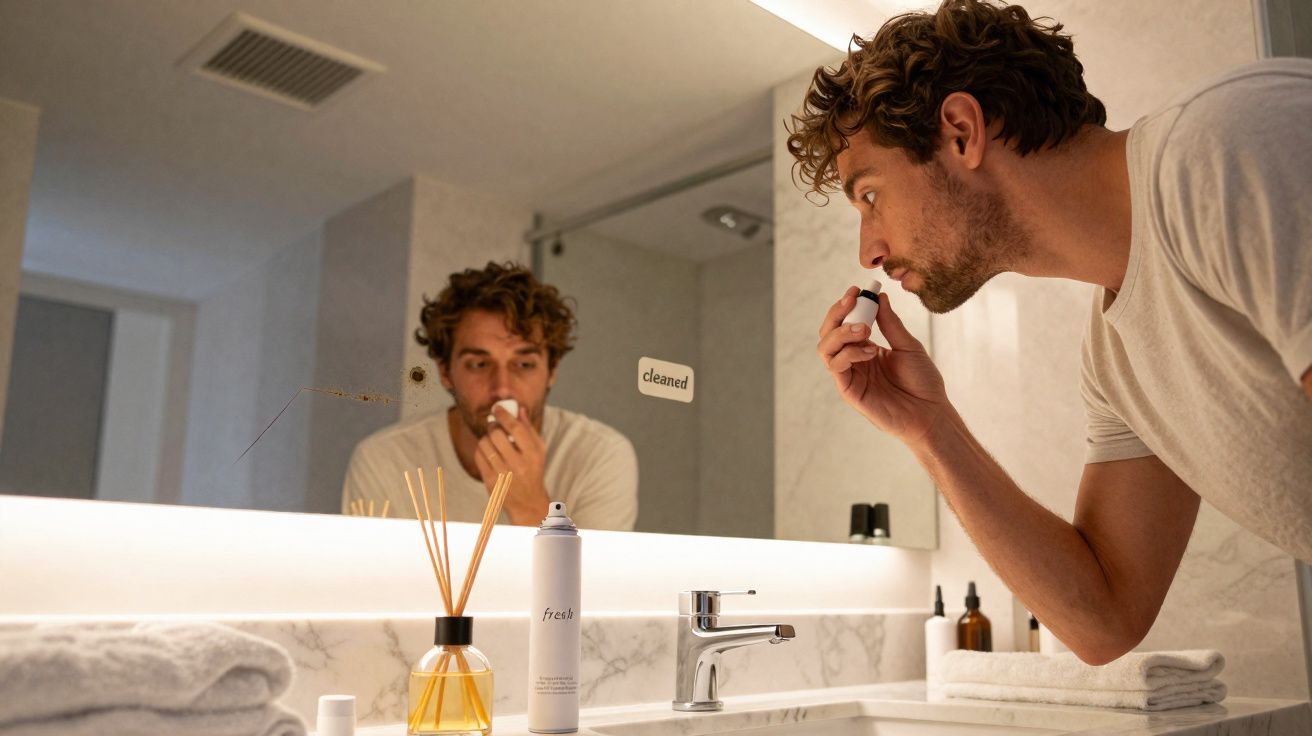
The bathroom door clicks shut with that muted, hotel-style hush, and for a moment it feels as if you’ve walked onto a set. Thick white towels, gleaming chrome taps, and a mirror that somehow makes you look more rested than you are. Then there’s the scent: clean, “fresh”, almost sea-like, laced with a floral note you can’t quite place. You loosen up. If it smells this good, it must be spotless… right?
You sling your bag onto the hook and inhale again. The fragrance sits in the air, catches on the shower curtain, even follows onto your clothes. Somewhere between the tiles and the mini soaps, your brain quietly translates “perfume” into “hygiene”. No need to inspect. No need to ask what’s hiding beneath the shine.
That’s precisely where the trick starts.
The comforting lie of the “fresh” hotel bathroom
Step into most mid-range or higher-end hotels and the bathroom is presented as a little refuge. The air feels crisp, like linens dried in a mountain breeze, with a touch of citrus or something “marine”. You start relaxing before your suitcase has even hit the carpet. That reaction isn’t accidental; it’s engineered.
In marketing, it’s called scent branding. Hotel groups invest heavily in developing a signature aroma designed to communicate calm and cleanliness the instant you arrive. Your nose receives the signal before your eyes have taken anything in, and your brain obligingly fills in the rest. You’re not only smelling lemon; you’re smelling “this place is safe”.
That’s the illusion many hotels quietly rely on.
A receptionist in Lisbon once told me, half-joking, that their hotel’s “biggest cleaning tool is an aerosol can”. She meant the bathroom spray they unleash between guests. The room I was in did smell immaculate. The grout lines, not so much.
Everything looked glossy at first glance. But around the base of the tap there was a ring of hardened limescale. In the shower, a faint shadow of old mould sat behind the hem of the curtain. The air, though, was filled with that comforting “just cleaned” haze. My instinct was to believe the scent and overlook the details.
We’ve all had that moment: the nose overrules the eyes and we decide not to look too closely.
A small psychological misfire is doing the heavy lifting here: we instinctively link a pleasant smell with cleanliness, even when the two have nothing to do with each other. Hotels understand this and often lean on strong fragrance to compensate for what a truly thorough scrub didn’t have time to cover. Tight room turnaround times, underpaid housekeeping teams and constant pressure to keep occupancy high all encourage the shortcut.
So you get a bathroom that feels disinfected but may only have been deodorised. The drain might be half blocked, the showerhead could be coated in biofilm, and yet an ocean-breeze spray wipes away your doubts. A fresh scent is cheaper than an extra fifteen minutes of detailed cleaning.
That’s the quiet economy behind your “wow, it smells so clean” moment.
What hotels really do to your bathroom air
Watch a housekeeping team on a busy check-out morning and the pace can be brutal. Bedding stripped, bins emptied, surfaces wiped at something close to Formula 1 speed. Bathrooms get their own routine: cleaner sprayed on the obvious areas, a quick scrub, one or two swipes over the mirror, and then the crucial move-spray. Plenty of it.
Air freshener isn’t merely a final flourish; it functions as equipment. One long hiss into the shower, another near the toilet, and a last mist by the door. The cloud lingers, primed to meet the next guest with “reassuring cleanliness” as soon as they step in.
You’re not smelling hygiene. You’re smelling strategy.
Luxury properties don’t tend to showcase this on Instagram, but former housekeeping staff frequently describe the same approach. In anonymous online forums, cleaners say they’re instructed to “focus on what guests see and smell first”. That usually means the mirror, the sink, the toilet seat-followed by a generous application of the hotel’s signature fragrance.
One ex-housekeeper from a London four-star hotel said that on fully booked days they were given under 15 minutes per room, bathroom included. Deep-cleaning shower tiles or taking apart a drain simply didn’t fit the timetable. What did fit? A powerful scent diffuser in the corridor and a concentrated spray bottle for bathrooms.
The outcome is predictable: camera-ready shine, instant olfactory reassurance, and neglected corners quietly ageing out of sight.
There’s also been a drift from neutral “clean” towards heavy perfume. Instead of a mild trace of soap, some hotel bathrooms now smell like the fragrance hall of a department store. That’s not an innocent over-spritz; it’s deliberate. Strong scents lodge in memory and become part of the brand: the detail you mention later on the train home-“Their rooms smelled so fresh.”
The blunt truth is that a bathroom can smell like a spa while still harbouring invisible bacteria on the shower curtain, or hair and residue in the drain. Your nose can’t detect hygiene; it detects molecules. Those molecules might be from bleach. Or they might come from a synthetic “ocean rain” blend pumped out by a hidden diffuser.
Cleanliness is about what’s removed; scent is about what’s added. Some hotels reduce the first and overuse the second.
How to see past the perfume and protect yourself
Next time you enter a hotel bathroom and that familiar surge of “freshness” hits, give it ten seconds before you sink into relief. Pause. Let the fragrance settle, then start looking properly-not the tired, travel-weary glance most of us do.
Scan the grout between tiles. Check the silicone seals around the bath or shower. Slide a tissue beneath the base of the tap and see whether it comes away grey or clean. Look down to the shower curtain hem, the floor corners behind the toilet, and the grille of the extractor vent.
That isn’t paranoia; it’s simply separating scent from hygiene.
Many of us feel uncomfortable doing this, as though we’re making a personal accusation. We don’t want to be “that” guest-the fussy one. So we breathe in the citrus mist, assume everything’s fine, and set a toothbrush down beside a tap that hasn’t been properly de-gunked in months.
Be realistic: nobody disinfects every hotel surface they touch, every day, without fail. But you can adopt a few easy habits. Don’t leave your toothbrush directly on the sink-use a glass, or keep it in a travel case. If you have a sanitising wipe (or even just a tissue), give the flush button and door handle a quick once-over.
And if the smell is intensely strong-borderline choking-that’s not evidence of extra care. It’s your signal to be more, not less, attentive.
A veteran hotel cleaner once told me, “If you want to know how serious a place is about hygiene, ignore the smell and check the places we don’t have time for-the corners, the hinges, the underside of things.”
- Look at the shower curtain hem: yellowing or mould spots tell you more than any “fresh linen” scent.
- Glance at the drains: visible build-up or hair is a sign the edges are being skipped.
- Check the air vent: a thick layer of dust suggests deep cleaning isn’t a priority.
- Use your own small toiletries rather than open hotel bottles that may be refilled.
- Trust your body: if the fragrance gives you a headache, open a window or ask for a room without scent diffusers.
Behind the good smell: what kind of “clean” do you really want?
Once you clock how heavily hotels use scent to signal cleanliness, it’s difficult to stop noticing it. The bathroom spray. The discreet diffuser in the corridor. The same “signature aroma” you catch again in the lobby and, strangely, in the lift as well. Together they build a single message: this place is fresh, safe, hygienic.
But real hygiene is mostly invisible, and it doesn’t necessarily smell like a Pinterest board. A truly clean bathroom may have a faint hint of chlorine-or almost no smell at all. It doesn’t require a thick perfume layer to persuade you; the details do the convincing instead. Clear grout. Dry corners with no mould. A shower curtain that looks properly washed, not merely freshly sprayed.
Next time you’re about to equate “smells great” with “must be clean”, stop and mention it to whoever you’re travelling with. Compare the tricks you’ve noticed and the quick checks you now do. That brief moment of awareness changes how you move through hotel rooms from then on.
Maybe the real luxury isn’t a bathroom that smells like a spa, but one that doesn’t need perfume to prove it’s truly clean.
| Key point | Detail | Value for the reader |
|---|---|---|
| Smell ≠ hygiene | Hotels use strong fragrances and scent branding to create a “clean” feeling even when deep cleaning is rushed | Helps you stop trusting perfume as proof of sanitation |
| Check hidden zones | Grout, shower curtain hems, drains, and vents reveal if cleaning is superficial or serious | Gives you quick ways to assess real cleanliness in seconds |
| Simple protective habits | Elevate toothbrush, wipe key touch points, question overpowering scents | Reduces health risks without turning your trip into a military operation |
FAQ:
- Do hotel air fresheners kill germs or just mask smells? Most hotel air fresheners only mask odors; they don’t disinfect surfaces or kill bacteria in any meaningful way.
- Is a strong perfume smell in the bathroom a red flag? It can be: an overpowering scent often means the hotel is covering odors instead of solving their root causes through deep cleaning.
- What should I quickly check first in a hotel bathroom? Look at the shower curtain hem, grout lines, drain area, and corners behind the toilet-these spots reveal the real cleaning effort.
- Are hotel toiletries safe to use? Sealed single-use products are generally safer; refillable or open bottles can sometimes be topped up without proper sanitizing.
- Can these fragrances be bad for my health? Yes, some synthetic scents can trigger headaches, allergies, or asthma; if you feel unwell, ask the front desk for a room with less or no fragrance.



Comments
No comments yet. Be the first to comment!
Leave a Comment