
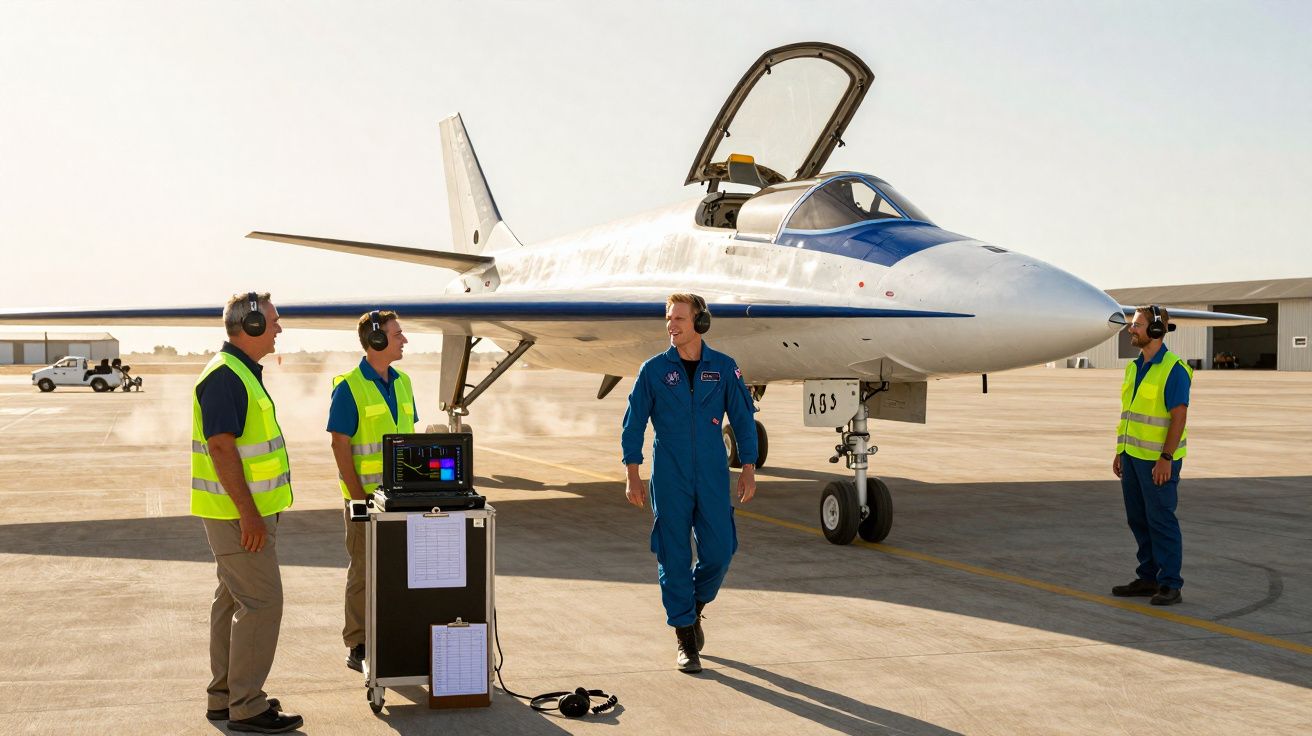
QueSST programme continues testing quiet supersonic technology
NASA has completed a second successful test flight of its experimental X-59 QueSST (Quiet SuperSonic Technology) aircraft. The sortie took place at Armstrong Flight Research Center in California as part of the agency’s effort to develop technologies for quieter supersonic flight.
X-59 QueSST design and purpose
The X-59 is a single-engine aircraft with an unconventional aerodynamic shape, engineered to reduce the loudness of the sonic boom when crossing the sound barrier. During this second flight, the team evaluated flight-control systems, aerodynamic performance, and the operation of the main onboard systems.
Second flight timeline and technical issue
Although the flight was cut short because of a technical problem, the team was still able to collect information that will be used in future tests. The aircraft took off at 10:54 a.m. Pacific Time from Edwards Air Force Base and landed at 11:03 a.m. after a warning indicated a malfunction in an onboard system.
Data collection and next steps for NASA
NASA engineers are continuing to gather data for detailed analysis and to prepare for the next phases of the programme. The central aim of the X-59 project is to prove that supersonic passenger aircraft can be built without producing loud shock waves. A later stage will involve a series of flights over US cities to assess how residents perceive the noise.






Comments
No comments yet. Be the first to comment!
Leave a Comment