
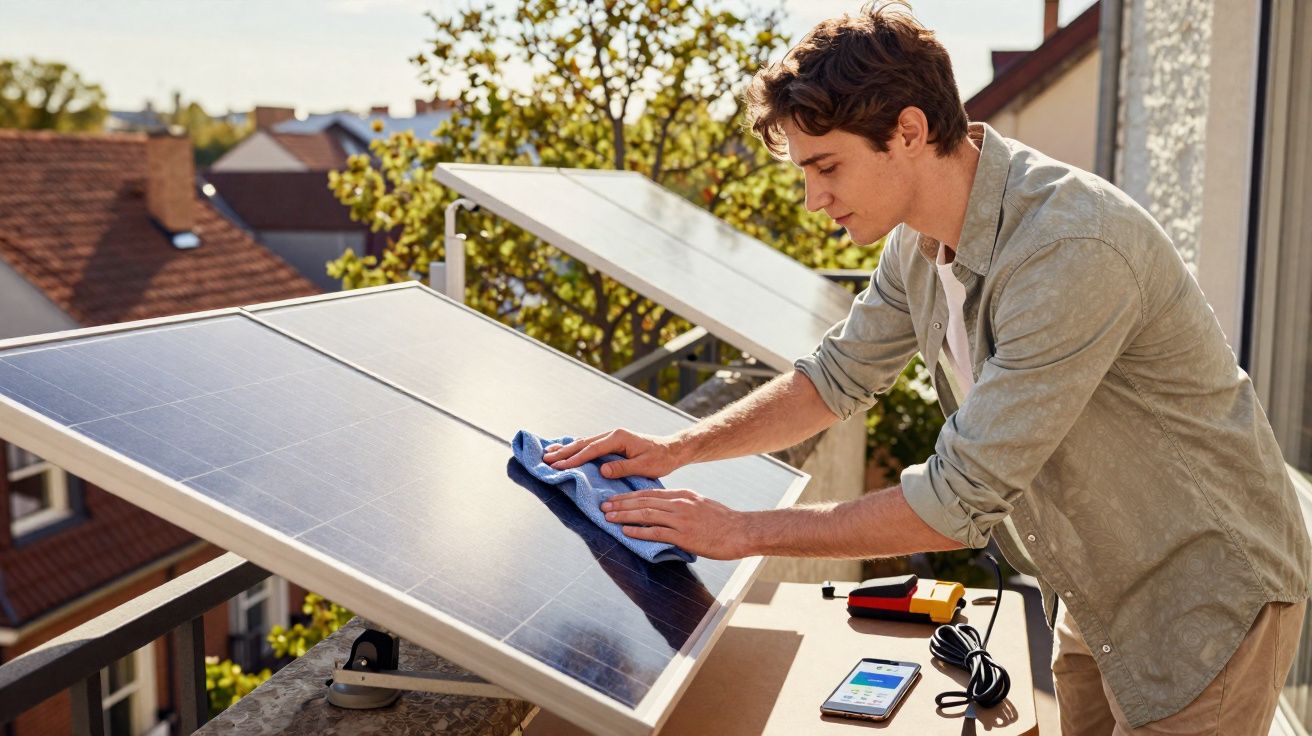
With the first properly mild days, the real season for balcony solar power stations begins. Many systems come through winter without complaint, yet still generate far less than they could-simply because nobody has looked after them. Plan a few targeted checks now and you can noticeably boost output from your modules while also extending the life of the equipment.
Why spring is so critical for balcony solar power stations
In spring the days lengthen, the sun climbs higher, and the panels receive more direct irradiation. From March onwards, a well-positioned balcony solar power station can produce noticeably more electricity than it did in the depths of winter. Plenty of people underestimate this-and keep running their setup with dirty modules, loose connectors, or an angle that is far from ideal.
On top of that, the surge in mini solar installations continues. In Germany, well over a million systems are now thought to be in use-on balconies, mounted to façades, on garages, or on small flat roofs. That makes it even more important to run these countless small generators in a way that is both technically sound and compliant.
"Anyone who gives their balcony solar power station a thorough check in spring secures maximum yield for the sunny months-and reduces the risk of damage and downtime at the same time."
1. Safety check after frost, wind and snow
Winter can be hard on even sturdy panels. The cells themselves are rarely the weak point; the trouble usually lies in what supports and connects everything: frames, cables and plugs.
Check brackets and fixings
- Make sure screws and clamps are tightened and secure
- Inspect metal parts for rust, cracks, or bending
- Take a critical look at how the system is fixed to the balcony railing or façade railing
High winds can loosen mounts slightly without it being obvious at first. Once a module starts to wobble, it becomes a genuine hazard-for pedestrians, for parked vehicles, and of course for the system itself.
Examine cables and connectors closely
Moisture is one of the biggest enemies of electrical components. Go through every cable connection, especially where plugs meet sockets:
- Are there green deposits or signs of corrosion on the contacts?
- Is the rubber seal on plug connections still supple and undamaged?
- Have cable insulations split or become brittle?
Cables routed through window or door frames are particularly risky. They can be crushed when sashes or frames are regularly shut. A flat, purpose-made cable can help; standard extension leads are not suitable here.
2. Check alignment and shading
Many balconies feel unobstructed in winter-but spring changes everything. Trees leaf out, hedges thicken, awnings and parasols return, and new outdoor furniture appears in the wrong place. Any of these can cast partial shade on the panels.
"Even a narrow band of shade-say from a railing or a neighbour’s parasol-can significantly reduce a module’s output."
Identify new sources of shade
Deliberately check your balcony solar power station at the times when sunlight is strongest-typically between 11:00 and 15:00. Look for the following:
- Do tree canopies, branches or shrubs fall across the panels?
- Do awnings, parasols or window boxes cast sharp shadow lines over individual cells?
- Do railing bars create stripe-like shadows across the panel surface?
Depending on the type of module, even slight shading can wipe out a large share of generation because cells are often wired in series. Sometimes changing the tilt or shifting the panel slightly is enough.
Adjust tilt to match the sun’s position
In winter the sun sits low; in summer it is much higher. During the spring transition, a flatter tilt angle is often worthwhile. If you use an adjustable mounting frame, it makes sense to re-set it at least once a year.
As a rough guide, an angle between 20 and 35 degrees is a good compromise for many locations in Germany, depending on orientation and mounting height. If a panel hangs vertically on a balcony, additional angled brackets often deliver a few per cent more yield.
3. Gentle cleaning for better performance
Rain does not remove everything. Over winter, dust, soot, residues from de-icing salt, or bird droppings build up-and in spring, pollen adds another layer. If a film forms on the glass surface, less light gets through and electricity production drops.
"Even a thin film of pollen or grime can noticeably cut yield-so gentle cleaning really is hands-on ‘energy transition’ work."
How to clean properly
- Work only with the inverter switched off and, if possible, out of direct sun
- Use lukewarm water with a soft cloth or sponge
- Avoid abrasives, harsh cleaning agents, and anything with sharp edges
For heavy soiling such as bird droppings, it is better to soak briefly rather than scrubbing with force. A telescopic pole can help you reach higher-mounted modules without climbing onto the balcony edge.
What you should avoid at all costs
- Pressure washers: the jet can damage seals or force water into the module
- Stiff brushes or abrasive scourers: they can scratch the glass surface
- Solvent-based glass cleaners: they may attack seals and coatings
4. Check settings in the app
Many modern balcony solar power stations can be controlled-or at least monitored-through an app. This is where data on generation, self-consumption and, in some cases, export is brought together. After firmware updates or changes to your electricity tariff, it is worth reviewing the settings.
Update software to maximise yield
Check whether the manufacturer has released new firmware builds or app versions. These often improve:
- Inverter efficiency and stability
- Fault detection and safety functions
- Statistics for daily and monthly production
An up-to-date system is usually more dependable when the grid voltage fluctuates and tends to use the modules more efficiently.
Set power limits and storage sensibly
Many owners never revisit configuration after the initial installation-and end up leaving performance on the table. If you use a small home battery, spring is a good time to confirm the control strategy still makes sense:
- Match output power and export limits to the legal requirements
- Prioritise self-consumption if someone is at home during the day
- Control the battery so it does not fill up before midday and waste the lunchtime solar peak
"Anyone who watches app data over a longer period quickly sees typical patterns in their own consumption-and can tune the balcony solar power station specifically towards the washing machine, dishwasher or home office."
5. Keep regulatory requirements in view
The legal framework for balcony solar power stations is constantly evolving. Permitted export limits are increasing and registration duties are being simplified, while certain rules remain mandatory.
Check registration and power limits
If you have made changes to your system-such as swapping modules or installing a different inverter-you should review the details in the Market Master Data Register. Is the recorded capacity still correct? Have you added a battery?
As soon as mini solar installations move towards 800 watts of export capacity, additional requirements apply-for example regarding the type of feed-in plug/socket or direct instructions from the network operator. Keeping everything in order helps you avoid problems if there are disturbances in the home electrical system.
Why being transparent with the network operator helps
Many network operators are now far more cooperative with balcony solar owners than they were a few years ago. Registering the system properly makes it easier to:
- plan local grid loading
- organise a meter exchange without hassle if one is needed
- expand later to a larger rooftop solar installation
Typical mistakes-and how to avoid them
The same pitfalls crop up again and again in households with mini PV. Three common ones:
| Mistake | Consequence | Do it better |
|---|---|---|
| Cable squeezed through a tilted/open window | Insulation damage, fire risk | Use a flat cable or a fixed cable entry point |
| Panel half shaded by an awning | Significantly reduced output | Adjust position and angle; if needed, change the mounting frame |
| Cleaning with a pressure washer | Moisture damage inside the module | Lukewarm water, a soft cloth, minimal pressure |
How to use your solar electricity smartly
Higher generation only pays off if the power is used in the home rather than being exported to the grid with no compensation. In spring, it is therefore worth shifting high-consumption appliances into the middle of the day:
- Set the washing machine to start at lunchtime using a delay timer
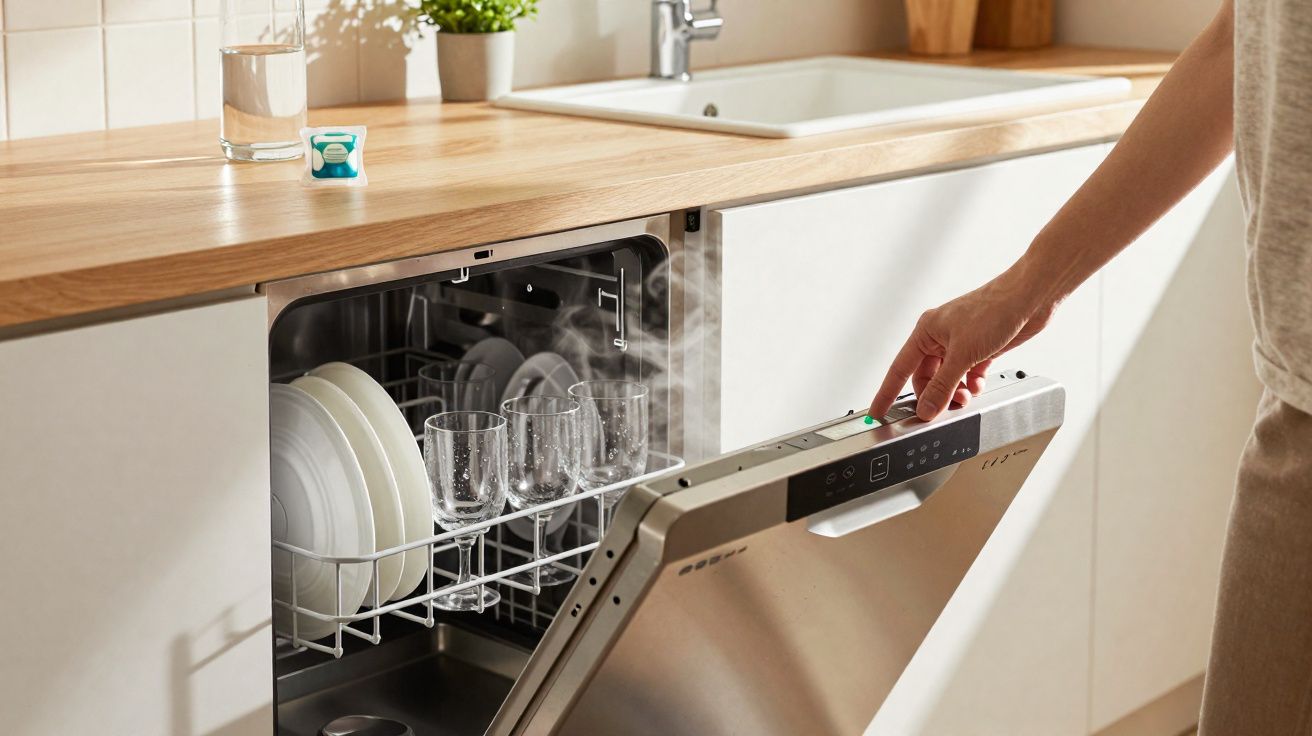
- Run the dishwasher when the sun is at its strongest
- Keep home office devices, routers and chargers running during daylight hours
If you are rarely at home during the day, smart plugs are worth considering. They can switch appliances on automatically when your balcony solar power station is generating well.
Terms that often confuse balcony solar beginners
Many newcomers get stuck on the difference between “rated power” and “export power”. Rated power refers to the sum of the module values under laboratory conditions; export power refers to what the inverter can feed into the home network at most. A system with 900 watts of module power can, for example, export only 800 watts, with the remainder simply being lost at peak times.
Another useful distinction is between generation and self-consumption. Apps often show total production, while the electricity meter records only what you additionally draw from the grid. The better you understand your own usage, the more precisely you can size and configure your balcony solar power station.
With a structured spring check covering hardware, cleaning, smart control and a quick look at the rules, two unassuming balcony modules can become a small but highly effective electricity-saving project for the whole summer.



Comments
No comments yet. Be the first to comment!
Leave a Comment