
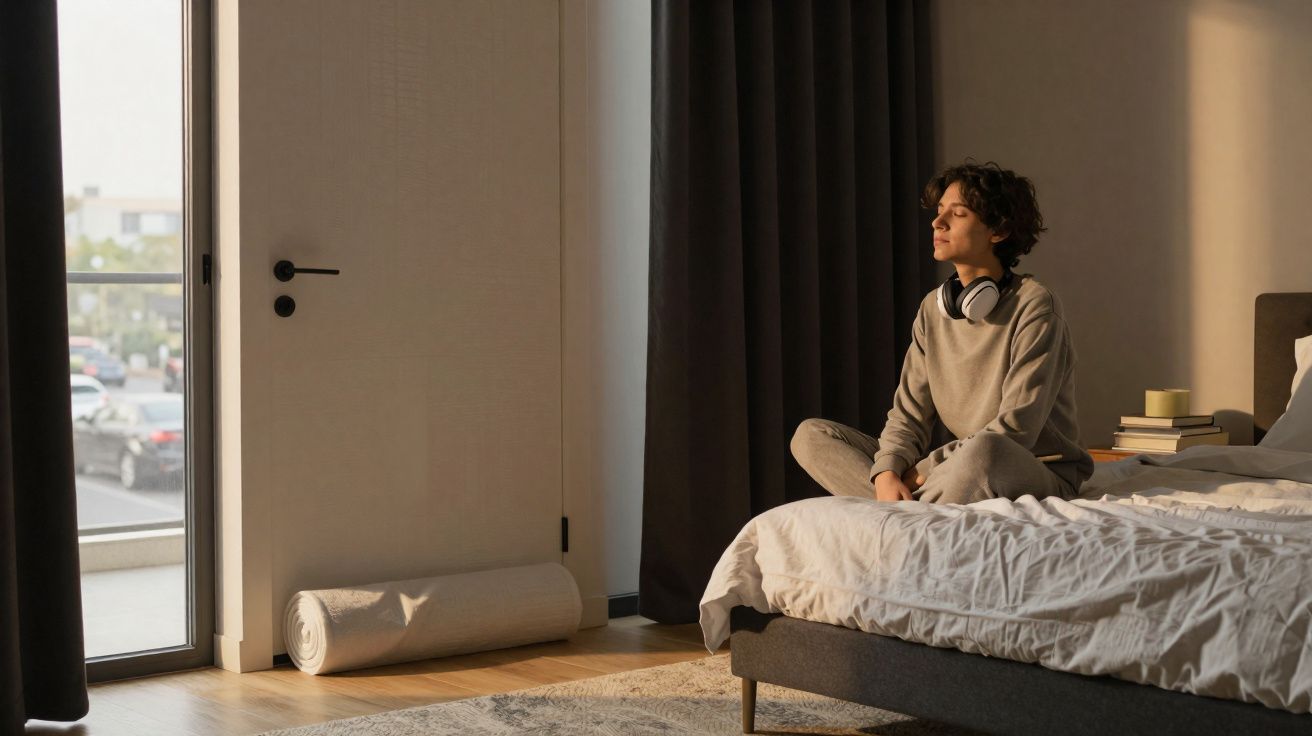
The neighbour’s telly was on again.
Tinny gunfire crackled through the wall, and a canned laugh track seeped straight into your pillow. You check the time - 00:47 - and you can already tell tomorrow’s meeting will feel like trudging through wet concrete. It isn’t even that loud. It’s the fact it never really stops.
By morning, it’s builders drilling up the pavement outside. By midday, it’s your flatmate on Zoom. At night, it’s a scooter revving beneath the window. The room stops feeling like a sanctuary and starts feeling like a badly insulated station concourse.
You start scrolling through “professional soundproofing” quotes and nearly spit out your coffee. Hundreds - sometimes thousands - just to buy a bit of quiet. There has to be another option, you think, looking at your thin walls and that rattly window frame.
There is. And it’s closer than you think.
Why your room is so noisy (and what’s really going on)
Most rooms aren’t built with your brain in mind. They’re built to keep costs down, wipe clean easily, and get repainted every five years. That’s how you end up with hollow doors, thin plasterboard, hard flooring and flat, bare walls. Perfect for a landlord - less so when the neighbour upstairs decides to practise tap dancing in heels at 23:00.
Noise doesn’t just “show up”. It moves along predictable routes: through air gaps, under doors, through floorboards, and even through the structure of the wall itself. Once you understand that, your room stops being a mystery and becomes a practical question: where, exactly, is the sound getting in?
Try this on a quiet afternoon: sit in the centre of the room, shut your eyes, and listen properly. You’ll pick up layers - a low rumble of traffic outside, muffled TV voices, the sharp click of heels in the hallway made louder by the gap under your door. Those are three different kinds of noise, and each one responds best to a slightly different low-cost fix.
For many people, the pandemic was the moment it all tipped over. One UK survey found that almost half of people working from home said noise seriously damaged their ability to concentrate. They didn’t all move. They didn’t all rebuild walls. They adjusted the space they already had.
Take Emma, a junior lawyer sharing a London flat. No spare room - just a small bedroom with paper-thin walls. Her neighbour’s evening workouts were shaking her Zoom calls. She had about £70 and no DIY confidence. Over a single weekend, she turned the room into a soft, improvised cocoon: a rug from Facebook Marketplace, a stack of old bookcases pushed against the party wall, and two thick blankets pinned behind her curtain pole.
Was it studio-level silence? Not even close. But those heavy thuds became softer, distant bumps. Street noise dropped into a low hiss. And that mental shift - from “I’m exposed” to “I’ve done something about this” - was almost as important as the reduction in decibels.
There’s a physics reason these small hacks punch above their weight. Sound is vibration. To stop it travelling, you need mass and airtightness. To reduce echo, you need soft, uneven surfaces. A hollow door with a gap beneath is basically an open invitation for noise. A window that isn’t sealed properly acts like a tiny loudspeaker aimed at your bed.
When you add a heavy rug, wedge a towel at the door, or place a bookcase against the wall, you’re doing two things at once: you make it harder for vibration to pass through, and you reduce the way sound ricochets around your room like a ping-pong ball. Budget soundproofing isn’t about miracle materials - it’s about placing ordinary objects so they do more work for you.
Cheap, practical moves that make a real difference
Begin with the room’s biggest bully: the door. Interior doors are often light, frequently hollow, and nearly always have a gap big enough to slide your fingers under. That gap is a motorway for sound. The cheapest fix is to block it - a thick draught excluder, or even a tightly rolled towel wedged along the bottom whenever you need quiet.
If you can spend a little, a door sweep strip costs only a few pounds online and sticks or screws to the bottom edge. You can also add instant mass by fitting a hook to the back of the door and hanging a dense blanket or winter coat over it. It feels almost comically simple - and it works because your flimsy door becomes closer to a padded barrier.
Then check the windows. Glass is relatively thin, and frames can warp over time. Tiny gaps around the edges let air - and road noise - leak straight in. A fast hack is to create a second layer: hang a thick curtain, or even a duvet, across the full window area (not just the glass). If you’re renting, removable adhesive hooks are ideal. Pull the fabric tight to the wall so you create a trapped “pocket” of air. Oddly enough, that trapped air becomes a cheap buffer between the outside chaos and your pillow.
For many people, the big win comes from treating one surface rather than trying to overhaul the entire room. Pick the “noisy wall” - the one shared with a neighbour, or the side facing the street. You don’t need professional acoustic panels to get a noticeable change. You need weight, depth, and a bit of ingenuity.
One straightforward option is to shove a full bookcase, wardrobe or chest of drawers flush against that wall. Fill it up: books, folded clothes, storage boxes, even old blankets. All that everyday clutter turns into a dense, layered barrier that absorbs more sound than you’d expect.
You’ll also see social media clips of people covering everything in cheap foam tiles. Let’s be honest: nobody covers their whole flat in foam and keeps it that way for more than a month. Foam panels alone don’t block much neighbour noise; they’re mainly for reducing echo inside your own room. Pair a heavy piece of furniture on the wall with a few softer layers on top (a hanging blanket, a corkboard, a canvas) and you get both benefits: less sound travelling through, and a calmer sound inside.
The most common mistake is demanding perfection. People make one small change, still hear the neighbour’s music, and decide nothing works. But this isn’t an on/off switch - it’s about steadily shrinking the noise from “I can hear every lyric” to “faint background I can ignore”.
Your bed can be either the problem or part of the fix. If the headboard sits directly against a shared wall, you’re essentially plugging yourself into it like a sensor. Pulling the bed 10–15 cm away can make the same noise feel dramatically quieter. If you don’t have much space, putting a thick cushion or folded blanket between the headboard and the wall can reduce mechanical vibration.
One sound engineer I spoke to put it like this:
“Don’t ask, ‘How do I make this room silent?’ Ask, ‘How do I make this specific noise less annoying?’ The second question is where cheap fixes start to work.”
To put it into simple steps you can test tonight:
- Seal the biggest air gaps first: under the door, around the window, cracks in the frame.
- Add heavy, dense items to the noisiest wall: bookcases, wardrobes, stacked storage.
- Layer soft materials where sound bounces: rugs, curtains, throws, cushions.
- Separate your bed and desk from shared walls by a small gap or soft buffer.
- Use “active” help when needed: white noise, a fan, or a phone app with rain sounds.
On a bad night, a cheap white-noise playlist and a rolled-up towel at the door can feel like a small miracle. That isn’t melodrama - it’s what it looks like when your nervous system finally stops flinching in anticipation of the next sound.
Making your quiet last (and sharing the space with others)
Low-cost soundproofing has an unexpected superpower: it makes you aware of your own habits. Once you’ve blocked the door gap and upgraded the curtains, you start noticing when your noise might be escaping too - a slightly softer footstep in the hallway, headphones in the evening, cupboards closed carefully instead of slammed.
That awareness often does more to improve a flatshare than any foam tile ever will. In shared homes, a quick conversation plus a few practical adjustments can change the whole atmosphere. “Hey, my desk is right by that wall, can we avoid loud calls after 10?” tends to land better when you’ve already done your bit on your side.
The point isn’t to build a padded cell. It’s to shape a room that supports the version of you who needs to focus, sleep, or simply lie there in quiet without feeling invaded. Those budget layers - the rug, the draught excluder, the overstuffed bookcase - quietly signal, every time you step in, that this space is being looked after.
You’ll probably find your best tool is routine. Not a complicated checklist - just a handful of small rituals you can switch on when you need them. Before a deep-work session, you drop the towel by the door, pull the heavy curtain closed, and run the fan for gentle background sound. Before bed, you move the phone away from your head, dim the lights, and let the room feel… softer.
One reader put it bluntly in an email: “Soundproofing wasn’t about silence for me. It was about not feeling at the mercy of everyone else’s life.” It sticks because it’s painfully accurate. We live closer together - stacked into flats, separated by thin walls, next to busy roads - and there’s a constant, invisible negotiation about whose noise gets to dominate.
We’ve all had the moment where the upstairs neighbour chooses midnight to assemble flat-pack furniture, and you’re lying there counting screws instead of sheep. You may not be able to change them - but you can change what the noise lands on, and how much of it makes it through to your nervous system.
The appeal of cheap fixes is that they’re reversible and tailored to you. Today you might be blocking street noise so you can sleep. Next year, those same curtains and furniture choices might help you carve out a focus bubble in a noisy shared house. The materials stay; the purpose evolves.
And once you’ve felt the difference between a harsh, echoey room and a gently muffled one, you can’t unlearn it. You start spotting sound leaks in hotels, at your parents’ place, even in cafés. You end up carrying your own pocket version of quiet - an eye for gaps, and a habit of softening the edges.
| Key point | Detail | Benefit for the reader |
|---|---|---|
| Track down air leaks | Gaps under doors, around windows, and wall cracks let noise travel freely. | Gives you simple, cheap starting points with immediate results. |
| Add mass and softness | Heavy furniture on noisy walls, thick curtains, rugs and textiles. | Transforms everyday items into an effective sound barrier. |
| Create calm rituals | Small repeatable actions before sleep or focus sessions. | Turns soundproofing into a sustainable habit, not a one-off project. |
FAQs:
- What’s the single cheapest way to reduce noise in my room? Start with the door. Block the gap underneath using a draught excluder, rolled towel or door sweep, and close it fully whenever you need quiet. It’s often the fastest, most noticeable change for almost no money.
- Do cheap foam panels from the internet really work? They can help reduce echo inside your room, so your own voice and devices sound softer. They won’t do much to stop your neighbour’s music or street noise coming through the wall by themselves.
- How can I sleep better if I can’t change the walls at all? Use movable solutions: thick curtains or a duvet over the window, a rug on the floor, white noise from a fan or app, and a buffer between your bed and any shared wall. Earplugs can be a useful backup on bad nights.
- Is white noise really helpful, or just a fad? For many people, a steady sound like a fan, rain track or white-noise machine makes sudden noises less jarring. It doesn’t remove the noise, but it masks it so your brain stops reacting so strongly.
- How do I deal with noisy neighbours without starting a war? First, do what you can on your side: seal gaps, move furniture, soften the room. Then have a calm, specific conversation: mention times and types of noise, and suggest small changes. Offering a compromise tends to go further than complaining in general terms.






Comments
No comments yet. Be the first to comment!
Leave a Comment