
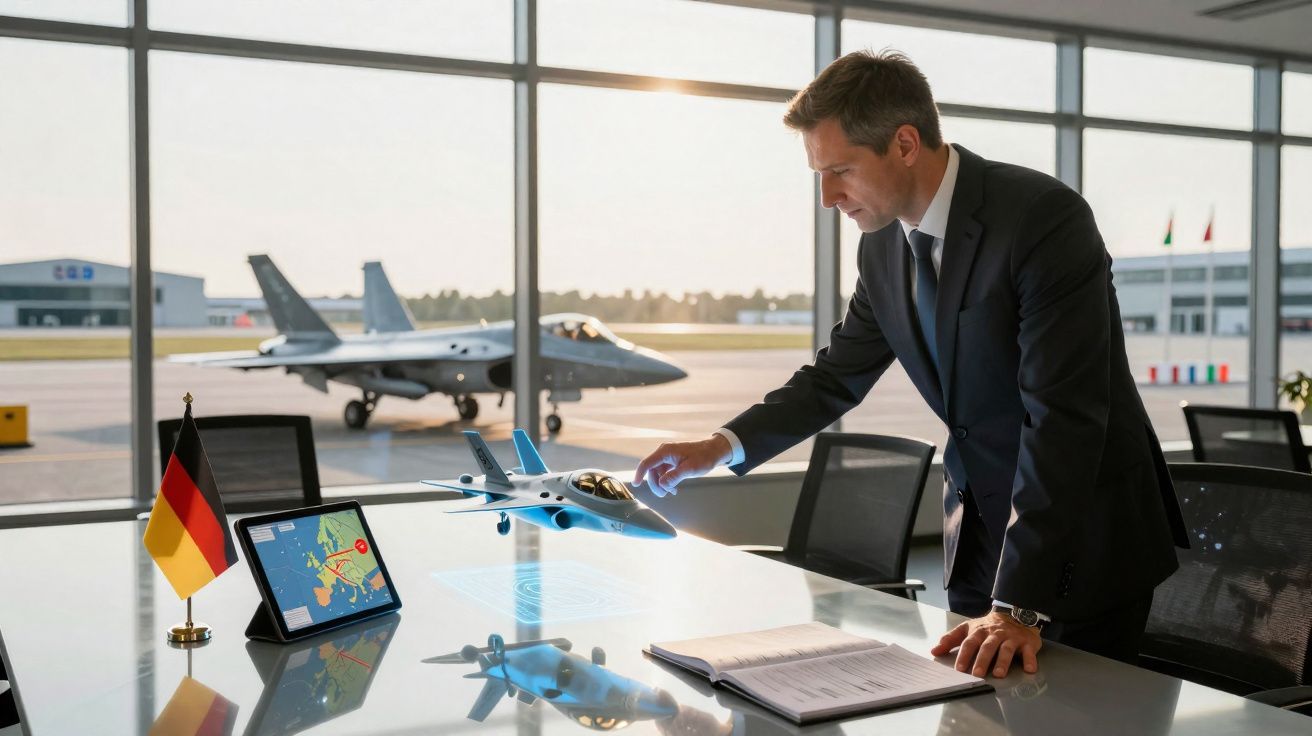
Fresh reports suggest Germany is drawing nearer to-and appearing more willing to consider-joining the Global Combat Air Programme (GCAP), the UK-, Italy- and Japan-led effort to develop a sixth-generation fighter. Although GCAP remains in the research and development stage, the partner nations are working towards an entry into service in 2035.
GCAP: the UK–Italy–Japan sixth-generation fighter programme
The renewed focus on GCAP follows a recent trip to Italy by German Chancellor Friedrich Merz. European outlets reported that Rome had indicated it was open to exploring whether Berlin could be brought into the programme.
GCAP is being driven industrially by Mitsubishi Heavy Industries in Japan, BAE Systems in the United Kingdom and Leonardo in Italy. The project centres on a low-observable (stealth) combat aircraft intended to operate alongside drones and other collaborative combat systems. It is also envisaged as a future successor to the Rafale and the Eurofighter Typhoon.
FCAS disputes and industrial tensions
Germany’s apparent interest in GCAP comes as frictions continue within FCAS (Future Combat Air System), the sixth-generation air-combat system being pursued by France, Germany and Spain, with an operational timeframe around 2040. After more than eight years, FCAS has repeatedly run into problems linked to industrial workshare and questions of technological leadership between Dassault Aviation and Airbus Defence and Space.
By December 2025, sources said Dassault was seeking to take control of 80% of the programme-an allegation the French company rejects. Meanwhile, French sources accuse Airbus of attempting to increase its influence over decisions by using its position as the industrial representative for Germany and Spain. The resulting stand-offs have slowed progress towards the technological demonstrator phase and have added uncertainty to the schedule.
Germany and GCAP: leverage, alternatives and upcoming talks
In this context, Germany has appeared to take a clearer interest in GCAP. Even so, the precise logic behind the shift has not been fully explained; some observers read it as both a strategic fall-back and a bargaining tool in discussions with France.
At the same time, Europe’s split between two major sixth-generation efforts-FCAS and GCAP-has prompted questions about whether funding and industrial capacity can sustain parallel development tracks at a time of constrained resources and intensifying global competition.
Whatever the eventual outcome, Germany’s posture points to a continuing reshaping of Europe’s defence-industrial landscape, as long-standing partnerships are tested by the technological ambition and economic weight involved in building the continent’s next generation of airpower. In the near term, officials from Japan’s foreign affairs and defence ministries are expected to travel to Germany in the days ahead of the Munich Security Conference, where analysts believe German participation in GCAP could be on the agenda.
You may also like: Amid the potential cancellation of the F126 programme, Germany has begun purchasing new MEKO A-200 frigates from TKMS




Comments
No comments yet. Be the first to comment!
Leave a Comment