
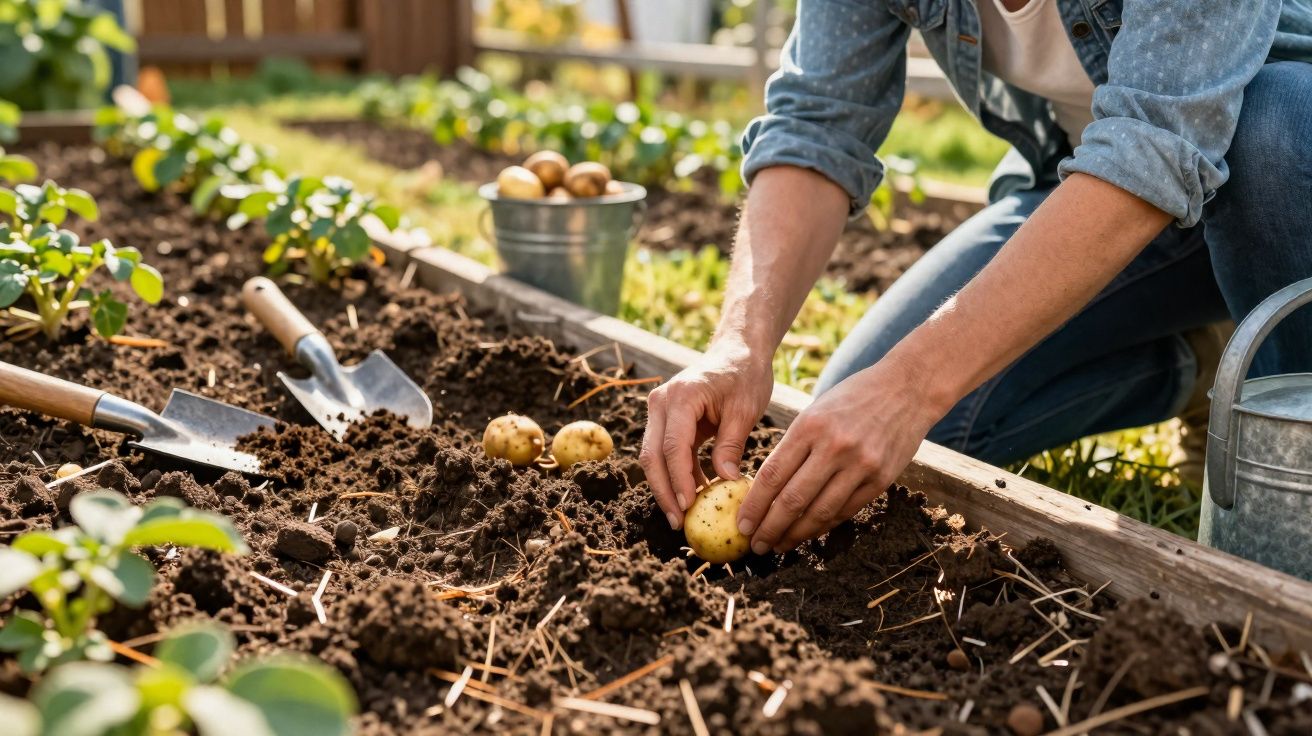
Many gardeners spend money on varieties and fertilisers, yet the real yield driver is often a few centimetres lower in the ground.
Anyone planting potatoes in spring dreams of crates full to the brim rather than a handful of poor-looking tubers. The first instinct is usually to look at variety recommendations or specialist feeds. In reality, a very modest factor often decides whether the crop thrives or disappoints: correct planting depth. Just a few centimetres can be the difference between weak rows and a potato bed bursting with strong foliage and hefty tubers.
A further point often overlooked is soil temperature. Potatoes should go into soil that is warming up but not still bitterly cold. If the ground is too chilly, the seed potatoes sit and sulk; if it is far too warm and dry, they can struggle to establish evenly. A simple hand test or soil thermometer can help confirm that the bed is ready.
Why potato planting depth determines yield
A seed potato is, in effect, a small store of energy. From that reserve, roots, stems and eventually many new tubers must develop. For that to happen, the potato needs a safe pocket in the soil: shielded from cold and light, but not buried so deeply that the young shoots are exhausted on the way up.
Planting depth influences how quickly the crop emerges, how healthy it stays and how generous the harvest will be in the end.
If the tuber sits too close to the surface, late frosts, drying out and greening become real threats. If it is placed too deep, the young shoots take too long to reach daylight, lose energy and often remain weak. The trick is to hit the zone where the earth is warm, crumbly and sufficiently moist without overburdening the plant.
The ideal depth for planting potatoes
Gardening guides and seasoned vegetable growers are remarkably consistent on one point: potatoes should be covered by roughly 10 to 15 centimetres of soil.
- 10 cm: better in light, warmer soils and sheltered spots
- 12–13 cm: the usual standard for many gardens
- 15 cm: more suitable in exposed places where late frost is a risk and the ground has been well prepared
What matters is not only the soil above the tuber, but also what lies below it. The bed should be loosened to a depth of around 15 to 20 centimetres so the roots can spread downwards and water does not sit around the tubers.
Place the seed potatoes in the furrow with the eyes - the small budding points - facing upwards. That way the shoots do not have to make unnecessary turns and can grow towards the surface more directly. Go deeper than 15 centimetres and you risk slow emergence and sluggish growth. Stay under 10 centimetres and sunlight and frost become more likely to damage the seed potatoes.
How soil type affects the right potato planting depth
No two garden soils are the same. The general advice of 10 to 15 centimetres works in almost every case, but it still pays to assess the soil in your own garden properly.
Heavy, loamy or clay soils
In dense soils, water builds up quickly. The top few centimetres can crust over easily while moisture remains trapped below. If potatoes are planted too deeply here, rot and poor aeration can follow.
- Loosen the soil thoroughly before planting and break up clods
- Stay towards the middle of the range: about 12 centimetres of soil above the tuber
- Encourage drainage, for example by using loose planting drills
This gives the shoots a manageable distance to travel while keeping the tubers protected without leaving them sitting in wet conditions.
Light, sandy or very loose soils
Sandy soils drain rapidly and dry out strongly. That is initially comfortable for potatoes, but it can become a problem in dry springs.
Here it makes sense to use the upper end of the recommendation, so closer to 15 centimetres, provided the soil remains genuinely loose. Adding plenty of well-rotted compost also helps water and nutrients stay in the root zone for longer.
In dry, light soils, a little extra depth helps maintain moisture around the tuber for longer.
Climate, late frost and the role of earthing up
Gardeners in areas prone to late frosts face the same dilemma every year: plant early for an earlier harvest, or wait until the nights are reliably mild. Planting depth can help reduce the risk to some extent.
In cooler areas, a soil cover of around 15 centimetres over the tuber is useful because it protects against cold spells in the ground. Once the first shoots appear, another protective measure comes into play: earthing up.
Why earthing up matters so much
Earthing up means pulling soil from the spaces between the rows up around the stems to form small ridges. This brings several advantages at once:
- shoots and young tubers stay in the dark and do not turn green
- extra room is created for new tubers to form
- frost damage is reduced because there is more soil over the vulnerable parts
- weeds between the rows are covered with soil and weakened
The starting depth and earthing up work together. If you plant very deeply and then earth up heavily as well, you force the plant to travel an extreme distance through the soil. A better approach is to choose a moderate depth and then draw soil up in two or three stages once the shoots are about 15 to 20 centimetres tall.
Spacing: how potato plants stand at their best
Even the best planting depth will not do much good if the potatoes are crammed together or left too far apart. Spacing determines whether each plant gets enough light, water and nutrients.
| Setting | Recommended value |
|---|---|
| Distance within the row | 30–40 cm between tubers |
| Distance between rows | 60–75 cm |
| Soil cover | 10–15 cm over the tuber |
With these measurements, there is enough room for strong foliage. At the same time, you can hoe, mulch and earth up comfortably between the rows without damaging the plants.
Mulch and watering: partners of the correct depth
If, after emergence, you cover the soil over the potato rows with a layer of organic material - such as chopped straw, slightly wilted grass clippings or leaves - you help retain moisture in the root zone. That means you do not need to plant unnaturally deep just to “seek the cool”.
Regular, thorough watering during dry spells supports this system. Tubers do best when the soil stays evenly lightly moist without becoming waterlogged. The combination of the right depth, mulch and adjusted watering means the plants are neither stressed by drought nor by standing water.
Common mistakes with potato planting depth - and how to avoid them
The same problems come back year after year. The good news is that a few small corrections are usually enough to put things right.
- Planting too shallow: tubers soon sit near the surface, turn green or shrink in dry periods. Solution: plant a little deeper and earth up consistently.
- Planting too deep: shoots emerge late or unevenly, and the plants remain weak overall. Solution: keep 10–15 centimetres of soil above the tuber and loosen the ground below rather than going deeper.
- Unprepared soil: tubers sit like they are in a brick bed, and the roots struggle with clumps. Solution: loosen the bed thoroughly before planting, especially to a depth of 15–20 centimetres.
Practical example: how to plant potatoes in a typical home garden bed
In many gardens, the soil is medium-heavy and slightly loamy. In that kind of bed, a simple routine works very well:
- Loosen the bed to spade depth and remove stones and large clods.
- Mark rows about 70 centimetres apart and make drills 8–10 centimetres deep.
- Place the seed potatoes in the drill with the eyes facing upwards, spacing them every 30–35 centimetres.
- Backfill with soil so that the tubers end up about 12 centimetres below the surface.
- When the shoots are 15–20 centimetres tall, earth up for the first time.
- Depending on growth, draw up soil a second time and mulch later on.
Used like this, the recommended depth becomes the base, while earthing up and mulch allow you to fine-tune conditions. In most cases, the result is noticeably better than planting by guesswork.
Another useful habit is to mark the rows and note what you planted where. That makes it much easier to compare different depths, varieties and bed conditions at harvest time. Small records can turn an ordinary patch into a useful learning tool for the following season.
What terms like “late frost” and “waterlogging” actually mean
Many guides mention late frost without explaining it clearly. It refers to nights in spring when temperatures drop below freezing again, even though the daytime already feels mild. Potato shoots cope poorly with those sub-zero temperatures: they blacken and have to grow again from scratch. A sufficient layer of soil, plus earthing up, helps shield them from that cold shock.
Waterlogging describes the condition in which water cannot drain away in the soil and gathers around the tubers. The result is a lack of oxygen and rot. The risk falls sharply when the bed is loosened deeply before planting and the planting depth stays moderate instead of pushing the tubers into a wet, heavy layer.
More yield through a combination of measures
Correct depth on its own will not produce a record harvest. It simply provides the foundation on which other factors can build: a suitable variety for the region, healthy seed potatoes, loose soil, plenty of organic matter and consistent earthing up. Only when these elements work together do a few unremarkable tubers turn into a substantial pile of potatoes.
If you feel like experimenting next spring, you could plant two or three short rows at slightly different depths and compare the results carefully. That way, the 10 to 15 centimetre guideline can be adapted gradually to your own garden - and all without expensive additives, just a spade and a careful look into the soil.


Comments
No comments yet. Be the first to comment!
Leave a Comment