
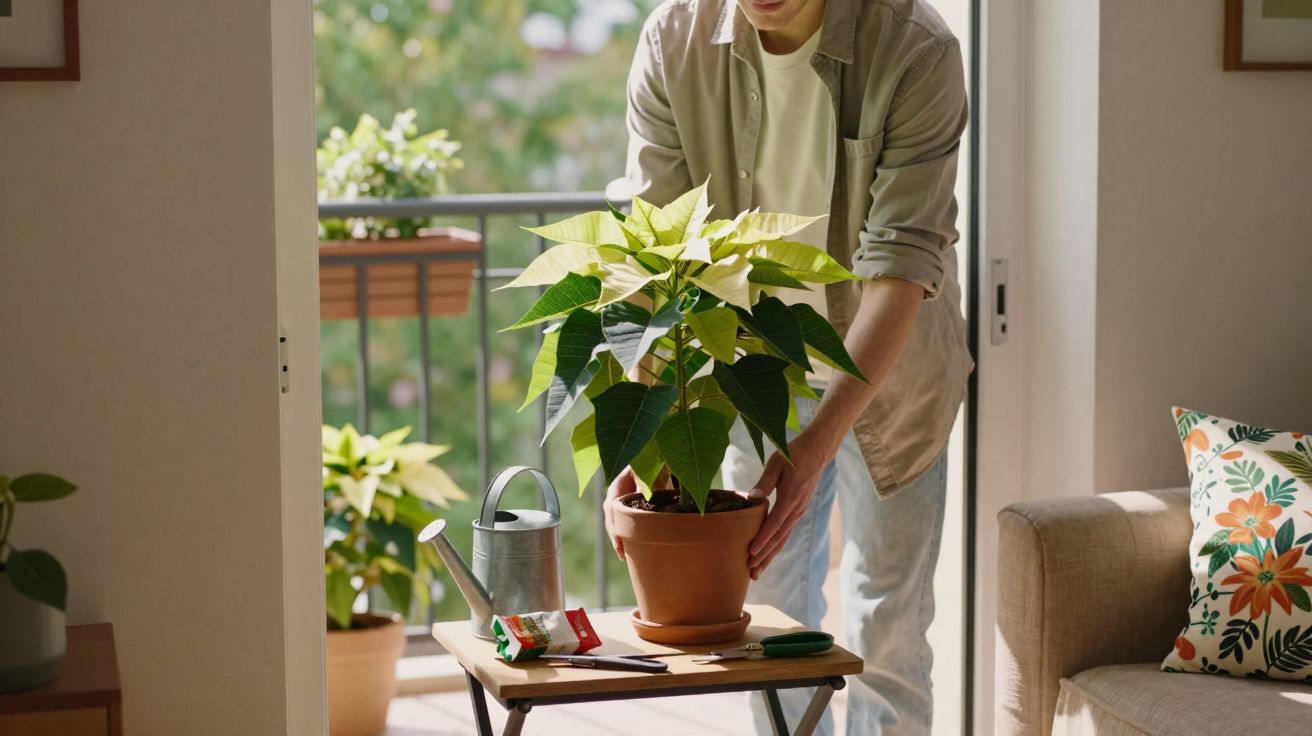
With a few simple tricks, what is often treated as a throwaway decoration can become a sturdy plant for the whole summer.
In January, the poinsettia often looks tired; by March, it can appear to be on its last legs: the red bracts have faded, the leaves have yellowed and the pot has been pushed into a corner. That is the moment many people decide the plant is “finished”. But the colourful star of the Christmas season is anything but disposable. If you avoid the wrong move in spring, you can keep a healthy, decorative green plant in the living room or on the balcony all summer long.
What a Poinsettia Really Is
Botanically, the poinsettia is called Euphorbia pulcherrima. In the wild, it grows as a large shrub, not as the tiny, short-lived plant sold cheaply in supermarkets. In a pot, it usually reaches between 30 and 60 cm in height and about the same in width.
| Botanical name | Euphorbia pulcherrima |
|---|---|
| Common name | Poinsettia |
| Size in a pot | approx. 30–60 cm tall, 30–50 cm wide |
| Position | Bright light without direct sun; can be moved outdoors into partial shade in summer |
| Temperature | Do not go below about 13 °C; extremely sensitive to frost |
| Foliage | Stays green indoors, but drops leaves quickly if stressed |
The coloured parts that shine so brightly at Christmas are not flowers, but bracts. The true flowers are tiny and inconspicuous. After the festive period, the plant enters a resting phase - and that is exactly where most mistakes happen.
If you treat a poinsettia in March exactly as you did in December, you will almost certainly lose it. The trick is to respect its resting period.
In March: Leave It Alone Instead of Drowning It
At the end of winter, the poinsettia slips into a kind of dormancy. Many people notice the yellowing leaves and faded bracts, then respond by watering even more. That is the classic mistake that kills the plant.
The Right Position During Dormancy
In March, a poinsettia needs:
- a bright but cool room, around 13–16 °C
- protection from radiators and draughts
- no harsh sun behind glass
The plant slows its metabolism. It barely grows, so it uses far less water and nutrients.
Watering: Less Is More Now
If you keep watering out of habit, the compost becomes waterlogged. The roots rot, the leaves fall, and the pot ends up in the bin. A strict, restrained approach works much better:
- water only when the compost is almost completely dry
- leave two to three weeks between watering if needed
- never allow water to sit in a cache pot or saucer
If the root ball dries out slightly once, the poinsettia copes with that far better than with constant wetness.
Gentle Care in March
Many people reach for the scissors and cut the plant back hard. That is not necessary at this stage. Usually, it is enough to:
- gently remove wilted, brown leaves
- take out thin, clearly dead shoots
Anyone working on the plant should wear gloves. The white sap can irritate the skin, and extra care is needed if children or pets are around.
In April: Repot and Wake It Up Slowly
At some point in April, fresh green buds appear on the stems. That is the signal: the resting phase is over and the poinsettia is starting its spring growth.
Once new shoots appear, it is the ideal moment for a careful spring refresh in the pot: fresh compost, a little more light, but no shock.
Repotting with Care
A complete restart in a huge container does more harm than good. A sensible approach is:
- a pot only one size larger than the old one
- several drainage holes so water cannot build up
- a layer of expanded clay or coarse grit for drainage
- loose, nutrient-rich houseplant compost, ideally with a little perlite or sand mixed in
When repotting, loosen the roots only slightly and carefully remove compacted compost. Then water moderately once - not until the pot is overflowing.
Adjust Light and Temperature
At this point, the plant can handle more energy again:
- a bright spot with plenty of indirect light
- room temperatures around 18–20 °C
- no hours of direct midday sun through glass
A simple finger test helps with watering: if the top layer feels dry, it can be watered. If it still feels slightly damp, wait a few more days.
Before moving it outside for the season, it also helps to inspect the plant for pests such as whitefly or spider mites. A quick check at this stage can prevent a summer-long problem later on.
From Late April: From Festive Plant to Summer Foliage Plant
As temperatures rise and the days lengthen, the poinsettia gets going again. It produces fresh shoots, becomes denser and starts to look like an exotic green houseplant.
Watering and Feeding Plan for Strong Summer Growth
From May to August, care generally follows this pattern:
- water regularly, but always allow a dry spell between waterings
- remove excess water from the saucer after a few minutes
- apply a liquid flowering-plant feed every two to three weeks
The feed helps the leaves grow back more densely and healthily. There is no need to overdo it: using a weaker dose than the one stated on the bottle is often enough.
Out into the Fresh Air - But Not into Full Sun
As soon as frost is no longer expected in spring, the poinsettia can go outside. A few rules will prevent scorching and stress:
- place it in partial shade at first, for example on a north- or east-facing balcony
- during the first few days, keep it outside for only a few hours and bring it back in at night if it turns cold
- acclimatise it gradually to more light; never put it straight into the midday sun
Once it is outdoors, it is easy to see how well the plant is doing: it sends out stronger growth and becomes a bushy, decorative potted shrub.
If the nights are still cool, it is better to bring it back indoors rather than risk a sharp temperature drop. Sudden changes are one of the main reasons poinsettias shed leaves.
How to Make a Poinsettia Red Again in Autumn
Anyone who keeps the plant alive until late summer can trigger the famous colour change again in autumn. Poinsettias respond to day length: longer nights encourage the bracts to colour.
In practice, this works like this:
- from around October, give it about 14 hours of darkness every day for 8–10 weeks
- for example, place a light-proof cardboard box over the pot in the evening
- make sure no streetlight or lamp light reaches it during this period
The healthier the plant is through spring and summer, the more easily it will produce coloured bracts again in winter.
Common Mistakes and How to Avoid Them
Many people do not fail because the plant has “difficult” needs, but because of small habits that the poinsettia dislikes. Common problems include:
- Compost that stays damp: this leads to root rot, yellow leaves and leaf drop.
- Central heating and draughts: these dry the plant out and stress it.
- Temperature shock: moving it from a warm room straight out into the cold balcony air is poorly tolerated.
- The wrong pot: cache pots without drainage or heavily compacted compost trap water.
Keep these points in mind and you will quickly see that the poinsettia is not a diva at all - it simply reacts sensitively to extreme conditions.
Toxicity, Children and Pets
The poinsettia has long had a reputation for being dangerously poisonous. That is not quite accurate, but it should still be handled with care.
- The sap can irritate skin and mucous membranes.
- Pets, especially cats, should not nibble the leaves or stems.
- For small children, it is best to keep the pot out of reach.
If sap gets on the skin, thorough rinsing with water is usually enough. If there is significant irritation or a large amount has been swallowed, contact a poisons information service.
Why the Effort Is Worth It
Keeping a poinsettia alive through the year is not just about saving money. Over the months, the plant changes, becomes a proper foliage plant, and in the next winter can show much stronger colour than a freshly bought supermarket specimen.
If you enjoy gardening, you can even experiment with several plants: one in the living room, one on the balcony, one kept deliberately a little drier. That makes it easy to see how adaptable the poinsettia really is - as long as you give it the chance to get through March and April in peace.


Comments
No comments yet. Be the first to comment!
Leave a Comment