
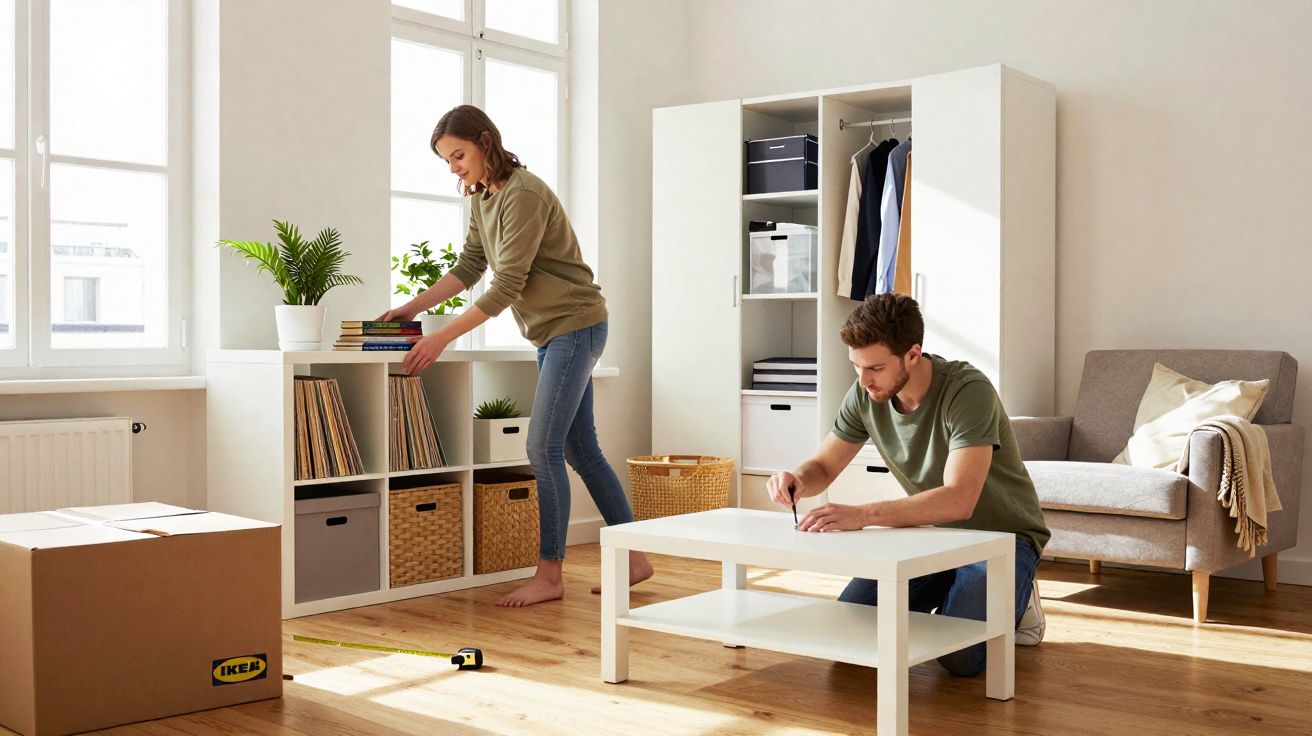
Anyone who has ever been steered through an Ikea store on a Saturday will recognise the feeling: some pieces seem to appear in almost every home. Ikea France has now revealed which items really sit at the top of its sales charts - and alongside the expected favourites, one armchair has shown up that many people would never have predicted.
Why these Ikea furnishings have taken off
The French figures paint a very clear picture: the big winners are the pieces that can do several jobs at once. Living in smaller spaces, rising rents and working from home all mean that people are looking for furniture that stays adaptable, grows with them and fits changing life situations.
Ikea bestsellers in France stand out above all because they can be combined in different ways, transformed easily and bought at a price that does not blow the budget.
According to Ikea France, modular shelving, adjustable wardrobe systems and timeless basics dominate the list. They can be upgraded, moved around, expanded and reinterpreted again and again. That is exactly what turns straightforward furniture into a kind of silent housemate that stays for years.
A broader trend also sits behind this popularity: more and more households want furniture that supports a circular way of living. Pieces that can be adapted rather than replaced are easier to keep in use for longer, whether they are passed on, reconfigured or moved into a different room. That matters not only for the wallet, but also for reducing waste.
Billy: the long-running bookcase that survives every house move
At the top of the rankings sits an old favourite: the Billy bookcase. For decades it has been one of the Swedes’ most successful products - and France is no exception.
Its success is no accident. Billy is a textbook example of the Ikea idea:
- simple, understated design
- a comparatively low price
- modules that can be extended step by step
Many people begin with a single bookcase in the living room. Later, more sections are added until a full wall of shelving takes shape. Others use Billy in a home office, a child’s bedroom or as storage in the hallway. Doors, top units and different heights turn the standard shelf into a small modular system.
To keep Billy from feeling stale, Ikea regularly introduces new colours and finishes. In France, a blue version is currently bringing fresh energy to the range - a detail that shows how closely the brand follows contemporary interiors trends without changing the basic concept.
Kallax: the shelving unit that can handle almost anything
Straight after Billy comes Kallax, the open cube shelving unit that feels as though it is in every student flat - and later often follows people into their first family home. In France, it is one of the most versatile pieces in the entire range.
Kallax can stand horizontally, vertically, against a wall or in the middle of a room. In smaller homes, it often works as a room divider, creating at least a semi-separated study corner or sleeping area in a living room.
What makes it especially interesting is the variety of ways people use it. One example from France: a music fan uses Kallax as a record storage unit because the compartments are almost exactly sized for vinyl. That little detail has spread through music forums and social media, and today Kallax is effectively regarded as the unofficial standard for record collections.
Much suggests that Kallax remains so popular because it can be repurposed without effort - from a child’s room to a home studio in the living room.
Pax: a wardrobe system built to measure from modular parts
Third place goes to Pax, the wardrobe system Ikea introduced back in the 1970s. In France it is especially in demand in cities with compact floor plans, because Pax can be tailored very precisely to the space available.
Width, height, internal fittings and doors - everything can be configured. People with lots of shirts plan in more hanging rails. Shoe lovers choose extra shelves. In narrow rooms, customers often go for sliding doors so the wardrobe does not take up precious space when opened.
Interior designers have pointed out for years how strongly well-planned wardrobe solutions can ease everyday life. When clothes are properly organised, you do not just gain storage space, you also save time. That is exactly where Pax hits the mark: it feels custom-made while still staying within reach financially.
Saving space as a climate issue
One particularly interesting point has become more prominent in France: resource-conscious living. The national agency for ecological transition recommends flexible furnishing systems in order to make better use of living space. The more easily a wardrobe or shelving unit can be adapted, the less often it needs replacing - a point Ikea also emphasises in its own communication.
Poäng: the armchair almost nobody expected
The real surprise in the French ranking appears in fourth place: not the much-known Malm chest of drawers, but an armchair - Poäng. Many people know this model from student rooms, waiting areas or holiday flats, with its curved wooden frame and plain upholstery.
Poäng has been around since the 1970s, yet its design language still looks remarkably contemporary. The chair feels light, takes up little visual space and therefore suits small rooms very well. In many living rooms it sits beside a bookcase or in a bright corner by the window - the classic spot for an evening of reading.
So why does Poäng sell so well in France? Three points stand out:
- Comfort: the gently springy structure creates a pleasant seat.
- Appearance: a clean Scandinavian style that looks neither rustic nor flashy.
- Variations: different covers and wood tones, from subtle to striking.
Poäng shows that not only storage, but also comfort furniture, belongs among the hidden stars of the Ikea range.
Lack: the coffee table icon for the first home of your own
In fifth place is Lack, a piece almost everyone has owned at some point or at least seen somewhere: the plain, boxy coffee table. In France, just as in Germany, it counts as a typical starter product for young adults.
One major factor is the extremely low price. Anyone moving into their first home is unlikely to want to spend hundreds of euros on a table that will regularly host crisps, red wine or pizza boxes. Lack offers a simple answer: minimalist, easy to replace - and surprisingly sturdy, provided nobody tries to use it as a stool.
Because the table is so understated, it fits into almost any room scheme. In colourful homes it blends into the background; in very pared-back interiors it matches the clean look. Many people later keep using it, for example in a guest room, as a side table or even in a child’s room for drawing.
What the bestsellers reveal about how we furnish our homes
Looking at the French sales figures shows one thing above all: people like to invest in furniture that leaves room for choice. A shelf that stores books at first, toys later and files eventually. A wardrobe that can adapt to a new flat. An armchair that lasts for decades because you can simply change the cover.
For consumers in the UK, that has a practical side: the models mentioned here are also long-standing favourites, especially in cities where every square metre counts. Anyone planning a home can take a good cue from the French top sellers, particularly when it comes to flexible storage solutions.
Getting more out of the classics
Many people underestimate how much standard furniture can do with a few smart adjustments. Here are some examples that have become established in France and here:
- Billy with doors and LED strips as a stylish display cabinet for crockery or collectables.
- Kallax with inserts and baskets as combined storage for a home office and living room.
- Pax with internal boxes, hooks and extra hanging rails as a substitute for a full dressing room.
- Poäng with a footstool as a compact reading nook instead of a bulky sofa.
- Lack as a bedside table when a conventional bedside cabinet will not fit.
Choosing furniture in this deliberate way saves money and materials over the long term. Instead of buying everything new with each move, you adapt what you already have. That pays off financially and also reduces the pile of waste that the furniture industry would otherwise keep producing.
At the same time, the French data shows that Ikea still understands the market with its mix of modular systems and affordable basics. The bestseller list reads like a small primer in compact living - with room for a bit of comfort that makes even the tiniest flat feel more homely.




Comments
No comments yet. Be the first to comment!
Leave a Comment