
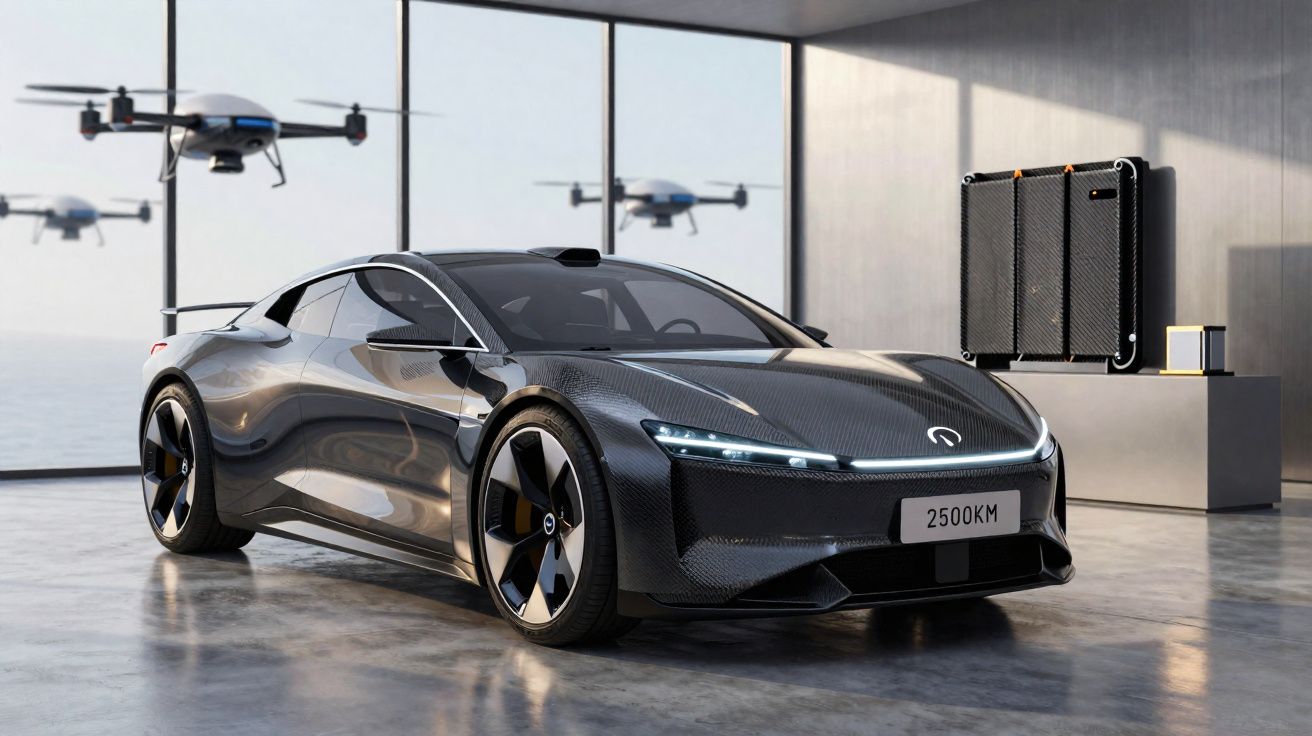
Engineers are beginning to treat carbon fibre as more than a structural champion: it is being reimagined as an energy workhorse. The concept is straightforward on paper-make the vehicle’s body store electricity, rather than merely withstand potholes, torsion and vibration. Delivering that in the real world is harder: it requires new material systems, more intelligent interfaces and a careful compromise between mechanical strength and charge capacity. If those trade-offs can be managed, the payoff could be electric road trips measured in days and drones that can remain aloft for hours.
What structural batteries are
Structural batteries perform two roles at the same time: they carry mechanical loads and store energy. For cars, drones and aircraft, this changes the architecture completely. Instead of transporting a heavy battery pack in a protective box, energy storage is built into the shell, floor, wing or fuselage. In effect, weight that used to be “dead mass” starts contributing to both stiffness and range.
When the battery becomes part of the chassis, mass you previously carried purely for structure can also provide propulsion energy.
At the centre of much of this work is carbon fibre. It is lightweight, very stiff and electrically conductive. Used as both reinforcement and current collector, carbon fibre can replace certain metal parts and reduce wiring, while also hosting electrochemically active materials that store charge. The decisive factor is often not the fibre itself, but the interfaces between fibre, binder and electrolyte-where performance is frequently won or lost.
Two paths to lighter power with structural batteries
Decoupled designs
In decoupled structural batteries, familiar commercial cells are embedded within a carbon-fibre laminate. This can improve packaging and add some rigidity, because the composite becomes a supportive cradle for the cells. However, the approach still relies on dedicated battery units, so the structural contribution remains limited. Weight savings are real, but the structure is not fully “electrified”.
Coupled designs
Coupled designs go further by integrating battery functions directly into the load-bearing composite. Here, the carbon fibres themselves act as electrodes, and the electrolyte is incorporated into the matrix. Fewer discrete parts are needed, hardware count falls and total mass can drop more meaningfully-so the effect on range is greater.
The challenge is that coupled systems demand electrodes that keep their capacity under mechanical stress, alongside solid or quasi-solid electrolytes that can conduct ions without cracking under load, impacts or repeated flexing.
Interface engineering in carbon fibre structural batteries
In a structural battery, the electrodes must satisfy two competing demands: high energy storage and the ability to withstand bending, vibration and thermal cycling without losing integrity. To improve robustness, researchers are reinforcing carbon-fibre electrodes with epoxy-based binders. Traditional PVDF binders can allow slippage when components flex, whereas epoxy can better lock active material onto fibres, improving cohesion while preserving pathways for electrons and ions.
Stronger adhesion at the fibre–binder–electrolyte interface can raise mechanical strength without choking charge transport.
Electrolytes introduce a second balancing act. Epoxy-rich matrices can be mechanically tough, but may restrict ion mobility. Adding liquid plasticisers can increase ionic conductivity, yet may raise leakage risk if the network becomes too rigid or develops microcracks. New hybrid matrices are designed to land in the middle ground: enough elasticity for ion movement, enough stiffness for structural loads, and stable behaviour across changing temperatures.
An increasingly important (and often under-discussed) element is quality control during manufacture. Processes such as resin infusion, curing and fibre lay-up need to deliver consistent electrolyte distribution and void-free laminates; small defects can become crack initiators or pathways for moisture ingress. For real vehicles, manufacturers will also want embedded sensing-simple voltage taps, strain gauges or fibre-optic monitoring-to track both structural health and cell ageing over time.
Why zinc-ion is getting attention
Zinc-ion chemistry is attracting interest as a practical route for structural batteries. Zinc is abundant and comparatively inexpensive, with a respectable charge storage per unit mass. Aqueous or gel electrolytes can reduce fire risk, and manufacturing can often be done in ambient air, helping to lower cost. A common configuration pairs a zinc powder anode with a manganese dioxide cathode, often nano-structured to increase activity.
By combining zinc-ion cells with carbon-fibre composites, developers are targeting safer structures that still provide useful energy density. In many applications, the system-level benefit matters more than record-breaking cell numbers: if a structural battery replaces floor panels, sills or crash members, total vehicle mass can fall even if the cell-level energy density lags today’s highest-performance lithium-ion cells.
| Attribute | Lithium-ion | Zinc-ion | Structural carbon + zinc-ion |
|---|---|---|---|
| Material availability | Moderate | High | High |
| Fire risk | Elevated | Low | Low |
| Energy density | High | Moderate | Moderate (offset by weight removal) |
| Cost trajectory | Volatile | Favourable | Favourable at scale |
| Structural role | External to structure | External or semi-structural | Primary load-bearing |
What 2,500 kilometres could look like in practice
The 2,500-kilometre headline is eye-catching, but reaching it would rely on several levers working together. Structural batteries reduce mass by folding energy storage into the body. Aerodynamic refinement lowers drag, while efficient motors and heat pumps cut parasitic losses. On their own, structural batteries could plausibly deliver a double-digit percentage range uplift in otherwise like-for-like vehicles, and further gains may come from reduced wiring, fewer fasteners and smarter packaging.
- Mass reduction: replace floor, roof or sill panels with structural cells.
- Volume efficiency: reclaim space previously taken by bulky modules and protective enclosures.
- Thermal efficiency: build cooling channels directly into the laminate.
- Wiring cuts: use carbon fibres to carry current locally, reducing copper mass.
Trips of several thousand kilometres without stopping would still require excellent aerodynamics and a large overall energy budget. Heavy-duty vehicles, coaches and long-range saloons may benefit first. For city cars, the more immediate value may be improved packaging, lower cost and freed-up interior space rather than extreme range.
Drones may win first
Small aircraft are dominated by mass fractions: every gram saved tends to translate directly into endurance. A drone wing or fuselage that doubles as its battery can shed housings, brackets and redundant casings. That increases flight time and can expand payload options. Fixed-wing drones could patrol longer with the same stored energy, while multirotors could carry higher-grade sensors or operate in hotter weather without running into thermal limits as quickly.
What still stands in the way
Making a battery carry load is only part of the job. It must also withstand crashes, potholes, bird strikes and rain exposure. Repairs need to be local, quick and repeatable, and end-of-life processing should allow separation of fibres, metals and polymers without overly harsh chemistry.
- Electrolyte durability under repeated flexing and temperature cycling.
- Long-term adhesion between fibre, binder and active material.
- Self-healing resins to limit microcracks and preserve conductivity.
- Moisture barriers that do not block ion transport.
- Standardised test methods covering both crashworthiness and cell ageing.
To move from demonstrations to everyday vehicles, structural batteries must pass battery qualification and crash testing-and then prove they are repairable.
A further practical barrier is serviceability. If a damaged panel is also an energy store, workshops will need safe isolation steps, approved bonding and patch procedures, and clear diagnostics to confirm both structural integrity and electrochemical performance after repair. Recycling pathways will need to mature in parallel so that composites do not become an end-of-life bottleneck.
Near-term signals to watch
Car makers are already evaluating composite floor structures that integrate energy storage for prototypes and niche vehicles. Drone manufacturers are trialling structural packs in lower-risk airframes where endurance is the primary value. Meanwhile, universities and start-ups continue to publish advances in epoxy-based electrolytes and fibre-compatible binders that maintain ionic pathways. Early commercial traction is most likely in drones, robotics and lightweight vehicles operating at moderate voltages.
Helpful context for buyers and builders
Structural batteries will alter servicing and insurance expectations. A collision-damaged side panel may also be a compromised battery, so insurers will push for validated repair protocols and isolation strategies. First responders will require clear cut points, shut-down procedures and guidance for water exposure. Regulators are likely to enforce dual certification routes-one for energy systems and another for structural performance-and those frameworks are taking shape now.
A simple sizing example illustrates the appeal. If a mid-sized EV reduces mass by 12% through structural cells while keeping the same energy content, motorway-cycle efficiency can improve by a similar order of magnitude. Add modest aerodynamic improvements plus well-designed thermal routing inside the laminate, and the combined gains can make long-distance travel feel far more routine. Apply the same arithmetic to delivery drones and it becomes extra minutes of endurance-often enough to reduce fleet size for a given route density.
A few terms are worth remembering: decoupled vs coupled structural batteries; binder cohesion vs ionic conductivity; aqueous zinc-ion vs non-aqueous systems; and failure modes such as delamination, dendrite growth and electrolyte drying. Each connects to practical questions: How repairable is it? How safe is it under abuse? How does it age during winter operation?
Risks remain, but the advantages are clear. Carbon fibres combine high stiffness and conductivity in a single material system, while zinc-ion points towards safer production and potentially simpler recycling. If interface engineering continues to progress, the most noticeable upgrade may be the least dramatic: lighter vehicles, longer journeys and energy storage that is built into the structure-almost invisible, yet doing double duty.




Comments
No comments yet. Be the first to comment!
Leave a Comment