
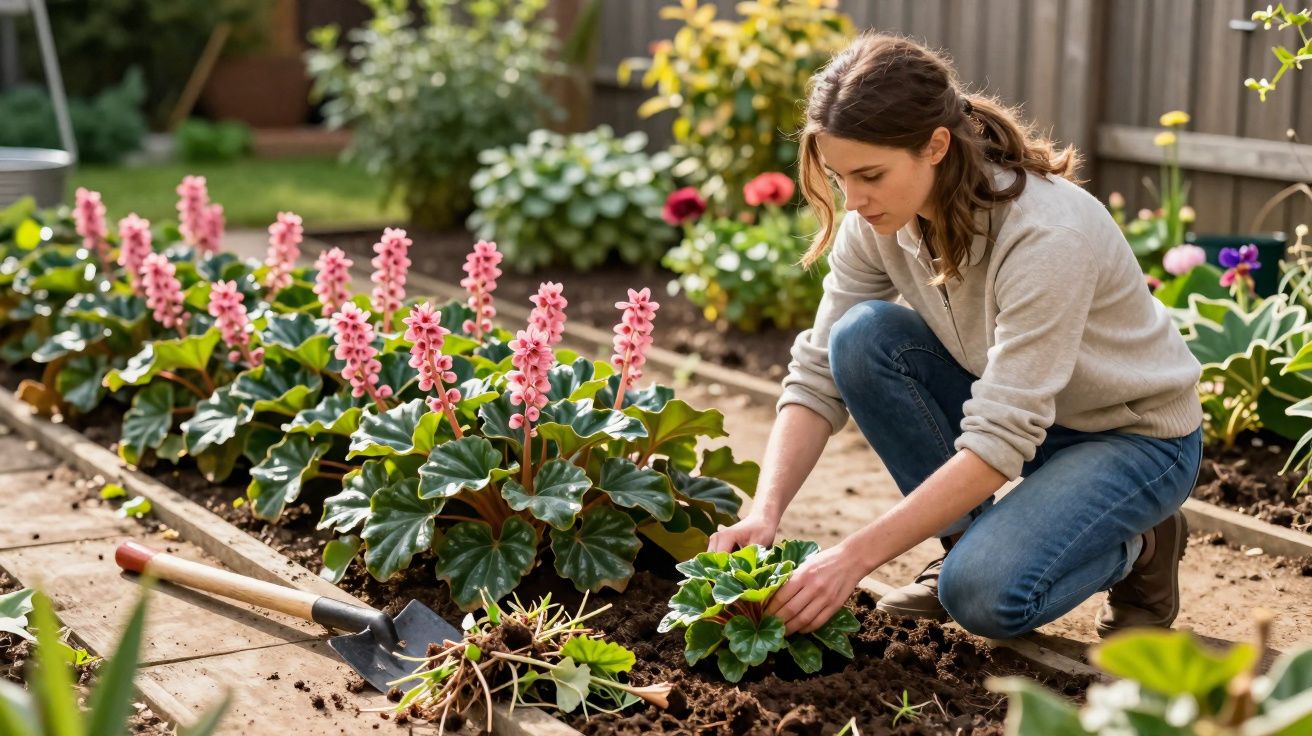
With one particular perennial, you can save yourself a large share of the back-breaking work.
Wherever soil is left exposed - between perennials, beneath trees or along a house wall - weeds soon push through. Chemical weedkillers are off-limits for home gardeners, and the frustration keeps growing. This is exactly where an underrated garden perennial comes in: it forms such a dense carpet over the soil that wild plants have very little chance to establish themselves. Right now is also an excellent time to plant it.
The perennial that makes weeds in the border almost redundant
The plant in question is bergenia, usually sold botanically as Bergenia purpurascens. Many people know it from graveyards or old cottage gardens, where it has often survived for decades with almost no attention. It is exceptionally tough, tolerates severe frost down to around -20°C and, in some cases, even -30°C, and still remains evergreen.
Individual plants gradually build into broad clumps over a few years. Each perennial reaches roughly 30 to 50 centimetres in height and 40 to 70 centimetres in width. The leaves are large, thick and leathery, starting off fresh green and often turning red to purple in cold weather. In early spring, sturdy stems carrying pink flowers rise above the foliage - attractive to look at and popular with insects.
Thanks to its dense, long-lasting cover of leaves, bergenia acts like a living mulch and significantly slows weed growth.
Garden specialists class bergenia as an excellent ground cover. In perennial beds, along paths or at the base of trees, it performs a double role: it decorates the area while protecting the soil at the same time.
How bergenia prevents weeds from emerging at all
The effect against wild plants is surprisingly easy to explain. Bergenia’s thick leaves overlap like roof tiles and close up the surface more and more tightly. As a result, far less light reaches the soil. Many common weeds are light germinators: without brightness, their seeds hardly sprout, or do so only very slowly.
At the same time, the leaf layer acts as a physical barrier. Even if a seed does germinate, the tender shoots often cannot push through the dense foliage. They wither in the shade of the bergenias or break as they try to reach the light.
- Less light at soil level = fewer weed seeds germinate
- Dense foliage = a mechanical barrier for new shoots
- Living mulch = soil stays looser and more evenly moist
- Less bare ground = less drying out and erosion
Experts estimate that a well-established patch of ground cover can reduce the amount of emerging weed growth by 70 to 90 per cent. You will not get away without any weeding at all, but the amount of work drops noticeably - especially in larger gardens.
A further advantage is that bergenia keeps the planting looking tidy for much of the year. Because the leaves remain present through winter, it is especially useful where you want a neat, permanent framework, such as at the front edge of a border or beside a drive.
Best planting time for bergenia in the UK and other temperate gardens
For gardens in Germany, Austria and Switzerland - and for similarly mild temperate conditions elsewhere - the two best planting windows are spring and autumn. March and April are particularly attractive. At that point, the soil is still well supplied with moisture after winter, while temperatures are beginning to rise gradually.
If you plant bergenias in early spring, they can root strongly before summer, and the weed-suppressing effect often starts in the very first year.
Autumn planting also works well, provided the ground is not frozen. The plants will then put out more roots, enter winter in a stable condition and begin the following spring with a clear head start.
Bergenia ground cover: where the plant works best
Bergenias are among the most versatile plants in an ornamental garden. They cope with more locations than many people expect:
- Partial shade: ideal, for example on the north side of a house or beneath open-grown trees
- Sun: possible if the soil is not extremely dry and the midday sun is not scorching
- Dry shade: for example under older trees or shrubs where very little rain reaches
Typical places where bergenia can serve as a weed barrier:
- At the foot of deciduous trees and larger shrubs
- Along garden paths and driveways
- On slopes that are difficult to mow or weed
- In rock gardens or against dry-stone walls
- As edging for perennial borders
Very dark corners or areas that stay wet all the time are less suitable. In those places, bergenia can be combined with other ground covers, such as tough cranesbills or small periwinkle varieties. This creates a closed, varied surface where wild plants struggle to find gaps.
Step by step: how to create a bergenia carpet
Prepare the soil once, save work for years
At the beginning, a bit of hand labour is needed. That effort pays off later because you will have far less weeding to do.
- Remove all existing weeds thoroughly, especially root weeds such as goutweed or couch grass.
- Loosen the soil to a depth of about 20 centimetres and remove stones and hard clods.
- In heavy, clay-rich soil, work in a little sand or fine gravel so water can drain better.
- In very poor soil, mix in a thin layer of mature compost.
Bergenias do not like waterlogging. The ground should therefore be loose, but not overly rich in nutrients - they do not need luxury, just good drainage.
Plant at the right spacing and give them room
Set the individual plants about 35 to 40 centimetres apart. That may seem generous at first, but the gaps will close on their own after one or two years.
Here is how to plant them:
- Dig holes slightly wider than the root ball.
- Place the plant so deeply that the transition between root and shoot, known as the root collar, sits level with the soil surface.
- Firm the soil down gently so no air pockets remain.
- Water thoroughly so the soil settles around the roots.
During the establishment phase, a thin layer of mulch - for example leaf mould or bark compost - between the plants is helpful. It protects the soil until the bergenia leaves have filled the gaps.
Extra tip: choose healthy plants and plant in groups
When buying bergenias, look for compact, well-rooted pots with firm leaves and no soft or blackened patches at the crown. If the root ball is tightly packed, gently loosen the outside roots before planting. That helps the plant establish more quickly once it is in the ground.
If you want the weed-suppressing effect to develop faster, plant in small groups rather than in a single straight line. Staggered planting closes the surface earlier and creates a more natural-looking mat.
Care: minimal effort, strong results
During the first year, bergenias appreciate regular watering if dry spells last for some time. They do not tolerate soggy feet, but once established they can cope with moderate dryness. Later on, many plantings manage perfectly well without extra irrigation - even in difficult spots.
Care at a glance:
| Task | Frequency | Note |
|---|---|---|
| Water in the first year | During dry periods | Keep the soil fresh, but not waterlogged |
| Cut back faded flower stems | After flowering | Keeps the planting looking tidy |
| Remove old or brown leaves | As needed | Reduces fungal problems and improves appearance |
| Divide and rejuvenate | Every 3–5 years | Keeps clumps vigorous and lets you spread them further |
In most cases, feeding is not necessary. A little compost in spring is more than enough if the plants start to look tired. Usually, weaker growth is caused more by too much shade or overly wet conditions than by a lack of nutrients.
Risks, limits and smart combinations
Even though bergenias are very robust, a few points are worth noting. In very harsh winters, the leaves may die back, but the plant usually resprouts reliably from the rootstock. Slugs show surprisingly little interest in the thick foliage, which makes it appealing compared with many other perennials.
Allergic reactions to bergenia are rare, but sensitive people should still wear gloves when cutting the plants back. The leaves contain tannins, which can cause mild irritation in very sensitive skin.
It becomes even more interesting when you combine bergenia deliberately with other plants. Spring bulbs such as crocuses or small daffodils work well between the clumps. They send up their leaves and flowers through the gaps before the bergenias are fully in growth. Later, the thick leaves take over again and keep the ground covered.
In a perennial border, ornamental grasses, hostas or ferns can add extra structure. Here it is worth paying attention to height and leaf shape. Bergenias stay relatively low and spread horizontally, so taller, finer-textured companions above them create an appealing contrast without reducing the weed-suppressing effect.
If you want to maintain beds for the long term with as little work as possible, ground covers are hard to avoid. Bergenia plays a leading role here: long-lived, undemanding, attractive and, at the same time, a natural shield against weeds - one of those classic garden plants that you set in place once and then wonder why you did not use it much earlier.



Comments
No comments yet. Be the first to comment!
Leave a Comment