
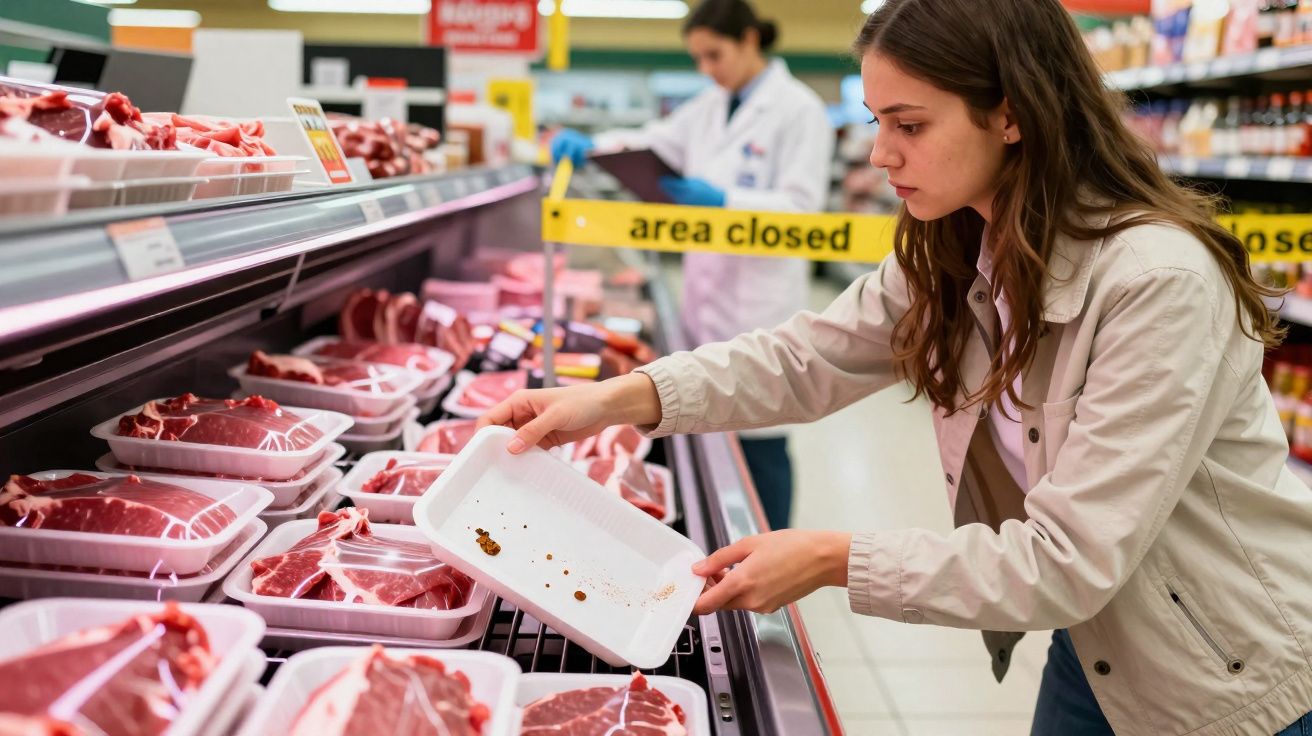
Where Sunday roasts and grill steaks would normally be on display, inspectors instead found dead mice and droppings - and the counter is now back in service.
In an Intermarché hypermarket in the French department of Yvelines, the meat counter was shut down for several days after a severe hygiene scandal. Only after the authorities listed a long series of shortcomings and the operator carried out improvements was the counter allowed to reopen. The case is prompting discussion well beyond the region about cleanliness and oversight in large supermarkets.
Shock discovery in the meat section of an Intermarché hypermarket in Yvelines
On the morning of 13 February 2026, an inspector from the relevant authority, the Departmental Directorate for Population Protection (DDPP), arrived at the Intermarché in Freneuse. The store is located in Yvelines, west of Paris, and serves many local residents as a key place to shop.
What the inspector found in the meat and sausage counter later read in the official report like a nightmare scenario for any customer: badly soiled rooms, poorly maintained equipment, food stored incorrectly, and signs of rodents.
Officials described “dirty, poorly maintained rooms”, inadequate waste disposal and dead rodents close to the preparation area.
According to the report, several mouse carcasses were found in the chilled and working areas. The inspectors also uncovered droppings in “very large quantities” in several places, particularly near the area where fresh meat is prepared. This is exactly where staff cut, portion and prepare meat for sale.
The authorities also established that some goods were being kept at the wrong temperatures or under unsuitable conditions. The handwashing facilities for staff also failed to meet the required standard: the set-up did not allow hands to be cleaned in a hygienically safe way, which is a major risk when dealing with raw meat.
From “satisfactory” to a public health risk in one year
What makes the case especially striking is that at the previous inspection on 19 March 2025, the authorities had rated the market’s meat and sausage section as “satisfactory”. At that point, nothing had been made public to suggest an imminent hygiene problem.
Within a few months, however, the situation appears to have deteriorated sharply. The published excerpts do not spell out the reasons in detail. In practice, several factors may have played a part, for example:
- fewer staff, or cleaning staff being badly organised
- problems with pest control and sealing the premises
- cutbacks in the upkeep of cooling and working equipment
- pressure on staff that led to carelessness
Exactly what went wrong has to be clarified internally by the operator. What is clear is that the authorities considered the conditions serious enough to use forceful language. In the official order, they referred to a “dangerous situation for public health”. The meat section was regarded as risky because pathogens could develop or multiply in the products, with possible food poisoning as a result.
A case like this also underlines how dependent food retail is on routine record-keeping. Cleaning schedules, temperature logs and pest-control checks are not paperwork for its own sake; they are what allows a shop to prove that standards are being maintained. When that chain breaks, even a busy supermarket can move from routine trading to a serious regulatory problem very quickly.
Authorities order immediate closure
The control report was followed the very same day by a decisive step: the prefect of the department ordered the meat section to close immediately. Only that part of the store was affected, not the whole hypermarket.
The decision came without any transition period. For customers, the clearest sign was the suddenly cordoned-off counter. Official notices were placed in front of the barrier announcing an “administrative closure” without listing every disgusting detail publicly.
The mayor of Freneuse, Ghislaine Haueter, came to the site and attached the order directly at the entrance to the area. That made the measure visible to everyone and put the operator under immediate pressure: reopening was tied to a complete “restoration of compliance”, in other words a clearly demonstrable hygienic standard.
The meat section could only reopen once the faults had been proven to be rectified and the rooms were safe from a hygiene point of view.
Only a few days until reopening
The meat department remained closed for several days. Behind the scenes, there was evidently a major effort to put things right. According to the lifting order, the store operator carried out “sufficient corrective measures” in order to meet the authorities’ requirements.
On 18 February, five days after the first inspection, officials examined the counter again. The outcome was clear: the responsible authority lifted the closure. The meat department at the Intermarché in Freneuse was allowed to resume work and serve customers once more.
| Date | Event |
|---|---|
| 19 March 2025 | Previous inspection, rated “satisfactory” |
| 13 February 2026 | Inspection with shocking findings, immediate closure of the meat counter |
| 18 February 2026 | Follow-up inspection, clearance to reopen |
For shoppers in the area, the decision means they can once again buy fresh meat at the counter as usual. At the same time, the unpleasant aftertaste remains: many will be asking how long the problems had already been present and whether they may previously have taken affected goods home.
What the case says about hygiene inspections in supermarkets
The incident in Freneuse also offers a useful look at how food inspections work in large retail outlets. In France, as in the United Kingdom, authorities carry out both routine inspections and checks triggered by concerns. Most of the time, everything remains in order; sometimes conditions are imposed, and in rare cases closures follow.
This case makes several points especially clear:
- even businesses that were rated positively can deteriorate quickly
- pest infestations often remain hidden in day-to-day operations until inspectors intervene
- authorities will step in firmly if there is a suspicion of risk, even in major stores
- once faults have been corrected, businesses can sometimes reopen again fairly quickly
For supermarkets, an incident like this is a major blow to their image. Trust in food retail is hard to win back. Many customers react strongly as soon as rodents, droppings or spoiled food are involved, even if the authorities say there is no longer any immediate danger.
How consumers can protect themselves in everyday shopping
Even though shoppers cannot see into the back rooms of a meat counter, there are still a few signs that can help them make a personal judgement:
- Look at the surroundings: Does the open counter appear clean? Are knives, boards and scales tidy? Are there leftovers lying around?
- Staff hygiene: Are staff wearing gloves or visibly washing their hands? Are tools changed between different types of meat?
- Smell: Fresh meat should smell neutral, or at most slightly metallic. A strong or sweet smell is a warning sign.
- Temperature: Does the refrigeration seem even? Are the glass panels heavily misted up, or does the cold chain appear to have been interrupted?
If you have doubts while shopping, you should not hesitate to speak to a member of staff or, if in doubt, leave the goods behind. In serious cases, it is worth reporting the issue to the local food safety authority so that independent experts can examine the conditions.
Rodents, hygiene and health risk: a brief overview
Rodents such as mice can transmit a wide range of germs, including salmonella and certain viruses found in droppings and urine. If such pathogens get into open food, the risk of stomach and intestinal infections rises, with symptoms such as diarrhoea, vomiting and fever.
In meat departments in particular, several factors combine to create problems: raw meat already carries bacteria, and there may also be warm temperatures, damp surfaces and organic residue. This environment is ideal for germs if cleaning and pest control are not tightly organised.
A well-run operation therefore relies on a package of measures:
- consistent cleaning according to fixed schedules
- airtight building structures to keep rodents out
- professional traps and monitoring systems
- staff training so that irregularities are reported early
- complete temperature checks and documentation
The case from Yvelines shows how quickly confidence can disappear when this chain breaks. At the same time, the rapid reopening demonstrates that even serious faults can be fixed - provided operators are willing to invest time, staff and money in hygiene and maintenance.




Comments
No comments yet. Be the first to comment!
Leave a Comment