
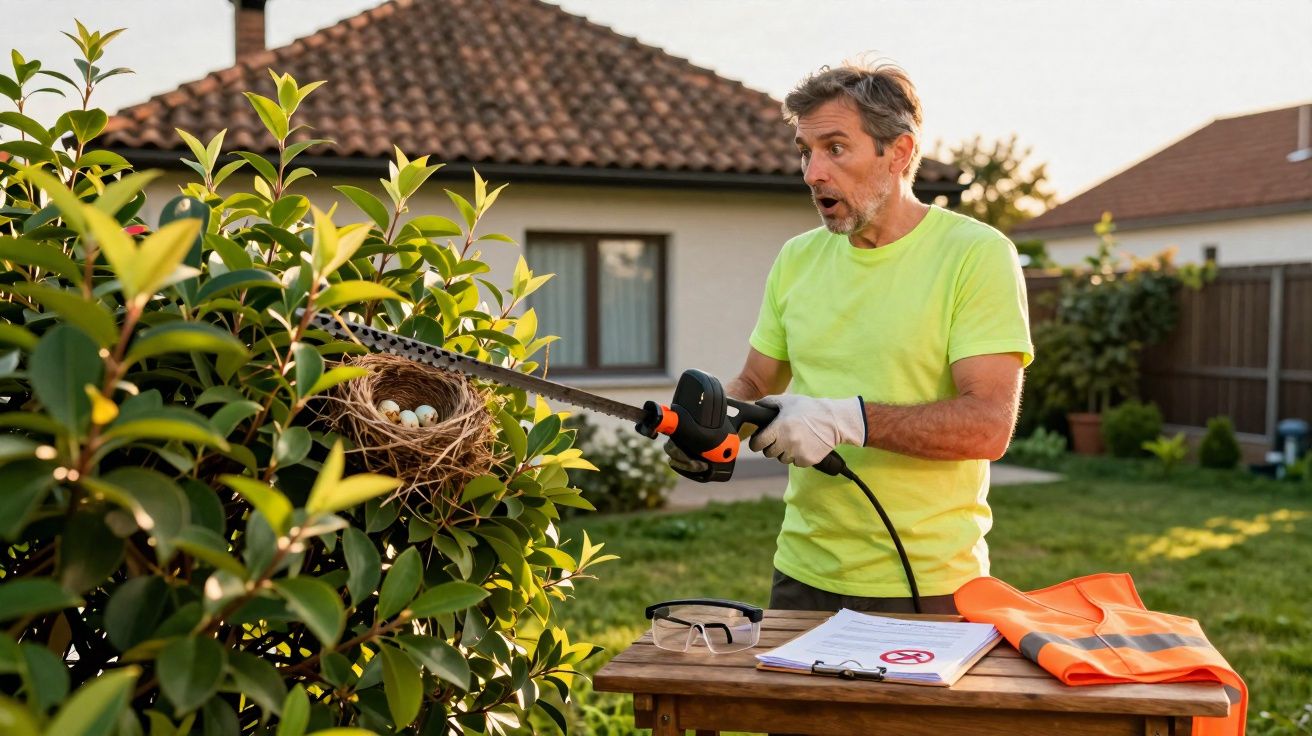
What looks like an ordinary bit of garden maintenance can become a serious legal issue in France. For many amateur gardeners, a quick trim seems like harmless routine work. Yet warnings are currently spreading on social media claiming that any hedge cutting from mid-March is banned and can lead straight to prison. That is an exaggeration, but the rules are far tighter than many people realise - and if you are unlucky, you could still face a fine large enough to disrupt your entire household budget.
Why hedge cutting between mid-March and the end of July is so sensitive in France
A freshly clipped hedge may look neat and tidy from a gardening point of view. For wildlife, however, that same hedge is a functioning ecosystem. In France, the period from 15 March to 31 July marks the height of the nesting season for many bird species.
As sap rises and new growth thickens the branches, blackbirds, finches, robins and goldfinches start looking for shelter in shrubs and hedges. They build nests, lay eggs and rear several broods. Many hedges also already contain hedgehogs, insects and other small animals that spent the winter there and become active again in spring.
One pass with a motorised hedge trimmer in this period can destroy several nests at once, kill young birds and permanently eliminate shelter for wild animals.
The damage is not only hidden from view. If a hedge is cut back brutally to the stump, it loses much of its ecological value for months. Chicks that survive by chance are suddenly left exposed and become easier targets for cats, crows or magpies. For insects, an important feeding and refuge area disappears.
From routine gardening to an environmental offence
In France, conservation groups such as the LPO, the League for the Protection of Birds, and the state environmental agency OFB, the French Office for Biodiversity, treat this spring period as especially delicate. Both organisations report cases in which apparently ordinary garden work caused major harm.
One case that attracted attention in France involved a homeowner who had her roadside hedge neatly trimmed on a Saturday in March. She had hired equipment, the cut was clean, and the pavement was swept afterwards - in her view, everything had been done properly. A few days later, OFB staff arrived at the property and found destroyed goldfinch nests in the cut hedge. She was suddenly accused of breaching wildlife protection law, with a possible penalty of up to €150,000.
What French law actually says about hedges and nesting sites
Online, you will often see the claim that hedge cutting after 15 March is generally forbidden for private individuals. That is not correct. France has no nationwide rule that bans all hedge trimming for amateur gardeners after that date.
The key rule is found elsewhere: in the French Environmental Code, the Code de l’Environnement. Article L.411-1 prohibits the destruction of protected animal species and their habitats. That includes nests and breeding sites - explicitly whether they are in woodland, in a field or in a private garden.
Anyone who destroys an active nest containing eggs or chicks breaks French wildlife protection law, even if the hedge stands on their own land.
Article L.415-3 sets out the possible penalty: up to three years in prison and a fine of €150,000 if someone deliberately or through gross negligence destroys protected species or their habitats. In practice, the maximum sentence is rarely imposed. It does, however, show how seriously the legislature treats the issue.
Stricter rules for farmers
The rules are even tighter for farmers who benefit from the European Union’s Common Agricultural Policy (CAP). They must comply with the so-called GAEC standards, known in French as BCAE. One of these, BCAE 8, covers hedges and trees.
- Hedge and tree cutting is prohibited from 16 March to 15 August
- Only narrowly defined exceptions are allowed with official authorisation
- Breaches can lead to reductions or clawbacks of EU direct payments
Those who ignore the rule are unlikely to face criminal prosecution, but they do risk heavy financial losses through the loss of agricultural subsidies. For farming businesses, that can hit the economic foundations of the operation directly.
Local bans for private gardens
France also has local rules. Prefectures or councils can issue their own orders limiting or banning hedge cutting during the nesting season. Some municipalities prohibit trimming entirely between 15 March and 31 July, while others allow only light shaping cuts.
Anyone who ignores such local rules commits a regulatory offence. The fine can be as much as €750. That can still hurt, especially when many people believe in good faith that they are only cutting back growth over the pavement.
How amateur gardeners can prune hedges without getting into legal trouble
Conservationists and authorities in France recommend a simple rule of thumb for private individuals: major hedge work belongs in late autumn or winter, not in spring or early summer.
If you want to play it safe, do your final heavy prune before mid-March and leave larger interventions until the end of July or, even better, until autumn.
Of course, real life does not always pause for wildlife. Branches overhang pavements, block sight lines at driveways or interfere with power lines. In those situations, specialists advise a phased approach:
- Make only small corrections in specific places using hand shears or loppers
- Check the hedge carefully from both inside and outside for nests before you start
- If there is a risk to traffic or utilities, contact the council or the network operator
- Seek written permission if an exemption may be needed
In urban areas, it can also help to leave a few sections untouched as temporary wildlife cover. A staggered approach - trimming one part now and another later - reduces disturbance while still keeping the hedge manageable.
Three simple checks before starting a hedge trimmer
If you still need to cut during spring or summer, a short checklist can help:
| Question | What it means |
|---|---|
| What is today’s date? | If it falls between mid-March and the end of July, avoid major cutting if possible. |
| Are there local restrictions? | Check the council website or town hall for any local orders. |
| Are there visible signs of nests? | If you spot a nest or notice bird activity, stop work immediately. |
Why the issue matters in Germany, Austria and Switzerland too
The penalties described above apply specifically in France. But the underlying logic is relevant across Central Europe. In Germany, Austria and Switzerland alike, nature conservation laws protect nesting sites and breeding habitats.
Conservation groups in all three countries have warned for years against drastic spring pruning. Anyone who cuts hedges back to the stump without checking for nests can quickly breach wildlife protection rules or local by-laws. Fines are usually lower than in France, but in individual cases they can still reach several thousand euros.
Common misunderstandings in everyday gardening
Many amateur gardeners rely on ignorance as a defence: they were only “tidying up a bit”. Legally, that argument carries little weight. The real question is whether the person could have recognised, with a minimum level of care, that animals might be affected.
Another widespread misconception is: “Nothing nests in my thuja hedge.” In practice, even conifer hedges or apparently impenetrable shrub borders can contain nesting niches. Dense, uncut sections in particular make ideal hiding places.
Practical scenarios: where amateur gardeners run the risk
The “before the holiday” rush
A classic example: it is late June, the summer holiday is approaching, the garden looks untidy and the hedge is spilling over the fence. A contractor is called at short notice to “sort everything out”. If several metres of hedge are then cut back severely, the chances are high that breeding birds will be affected.
If a complaint follows later - perhaps because neighbours find dead chicks and alert the authorities - the person who commissioned the work may also be held responsible. In France, prosecutors then examine whether gross negligence was involved.
When the council asks for cutting
Some councils write to property owners asking them to trim hedges along public paths. These letters often arrive in spring. Anyone who responds by cutting aggressively without considering nesting birds can find themselves caught between the duty to keep routes safe and wildlife protection law.
In France, specialists recommend replying to the council, showing photographs of the hedge, pointing out the nesting season and asking for a staged solution. Often, a very narrow trim right beside the pavement is enough, while the rest of the hedge can be left standing until late summer.
Useful terms and background for greater legal certainty
Anyone who looks into the subject in more detail will quickly come across specialist terms. Three in particular appear often:
- Nidification: the French term for birds’ nesting and rearing period
- Habitat: a living environment that provides an animal species with food, shelter and places to reproduce
- BCAE/GAEC: environmental and climate standards linked to EU farm subsidies
Understanding these terms makes it easier to see why the authorities react so strongly when hedges are cut hard in spring. For them, the issue is not just individual birds but entire habitats that play a key role in landscapes that have already been heavily simplified by farming and development.
How to avoid conflict - including with neighbours
Hedges are frequent sources of dispute in densely built residential areas: they cast shade, need maintenance and may overhang next door. Once wildlife law and possible fines are added to the mix, the potential for conflict grows even further.
A straightforward approach often works best in practice: if you are planning major cutting, inform your neighbours early, explain the time of year you have chosen and make clear that you are taking nesting birds into account. That reduces the chance of someone calling the authorities out of irritation when a careful and legally sound solution is already in place.
A second useful habit is to check the hedge from several angles before taking out any powered equipment. Look not only at the outside facing the street, but also the interior side and the base of the hedge. Small birds often choose the less obvious parts of a hedge precisely because they offer cover. A few minutes of inspection can prevent a costly mistake.
In France, the bottom line is this: not every clipping that falls from a hedge in spring leads automatically to a €150,000 penalty. But anyone who cuts back hard without checking for nests or local rules is taking a risk that reaches far beyond their own garden fence. A quick look into the hedge and at the calendar protects birds - and, in the worst case, it can also protect the family bank account.






Comments
No comments yet. Be the first to comment!
Leave a Comment