
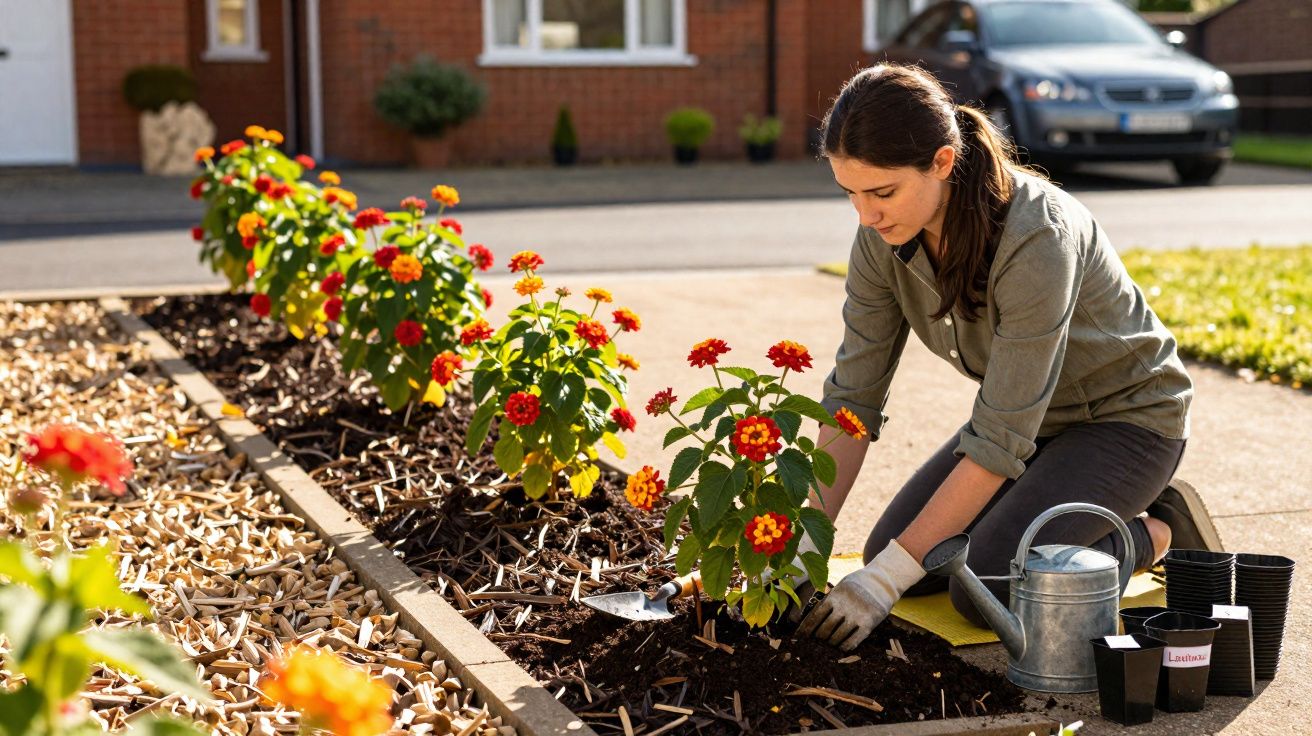
Glowing blooms instead of dreary grey: a rather modest-looking shrub from warm climates can create a striking ribbon of colour along driveways.
Many homeowners know the issue well. A driveway may be practical and neatly laid with paving or tarmac, yet still feel lifeless despite every effort. Very few plants can tolerate the combination of heat, passing cars and winter road salt for long. A compact ornamental shrub with vivid red flowers shows that it can be done after all - and it performs surprisingly well in heat-prone areas and on sunny driveways.
Why this red shrub performs so well beside a driveway
The standout plant here is a compact lantana cultivar called Lantana camara ‘Hot Blooded’. It originates from warmer regions and belongs to the verbena family. Its greatest strength is that it thrives where many other plants soon give up - on the sun-baked edges of driveways and parking areas.
The shrub forms a dense, cushion-like mound that grows to around 60 centimetres in both height and width. That means it does not encroach too far onto the driveway, block visibility or get in the way when car doors are opened. Visually, though, it more than holds its own. The flowers begin in a strong yellow, shift through orange and deepen into red. It is common to see all of these shades on a single plant at the same time.
The result is a blazing strip of colour along the driveway that draws attention from spring right through to autumn.
The abundance of flowers is irresistible to bees and butterflies. At the same time, the plant remains comparatively easy to care for. It copes far better than many traditional border perennials with high temperatures, reflected heat from tarmac or paving, and longer dry spells.
A major advantage: sterile and easy to control
Another benefit of ‘Hot Blooded’ is that the cultivar is sterile. It does not produce viable seed and therefore does not sow itself around uncontrollably. Anyone who wants a tidy, clearly defined edging along a driveway does not need to worry about it spreading into the lawn or gravel bed.
Even so, the flowers still provide food for insects and for birds that feed on nectar. For wildlife-friendly gardens in hot, exposed locations, that makes it an appealing mix of order and ecology.
Best conditions for the fiery shrub
Lantana comes originally from warmer climates. It will only survive outdoors through winter in places where frost is very light. In the United States it is commonly regarded as suitable for roughly USDA zones 7 to 11.
For the United Kingdom and similarly temperate regions, that means it may survive for several years in exceptionally mild coastal districts or sheltered urban spots, but in most places it is better treated as a lavishly flowering summer plant or as a container shrub that is moved to winter shelter in autumn.
The key requirement is a fully sunny position: at least six hours of direct sunlight a day are needed for a dense display of flowers.
Soil conditions at the edge of a driveway
The ground beside driveways is usually heavily compacted. Tyres, building work and rainfall often press the soil down until it becomes hard and inhospitable. That is a problem for many ornamental plants, but lantana can cope well enough if the planting area is prepared in advance.
The soil should be:
- loose and free draining,
- unable to hold standing water,
- ideally sandy or gravelly in texture.
With a few targeted improvements, even difficult spots can be turned into a suitable planting strip.
How to plant it along a driveway
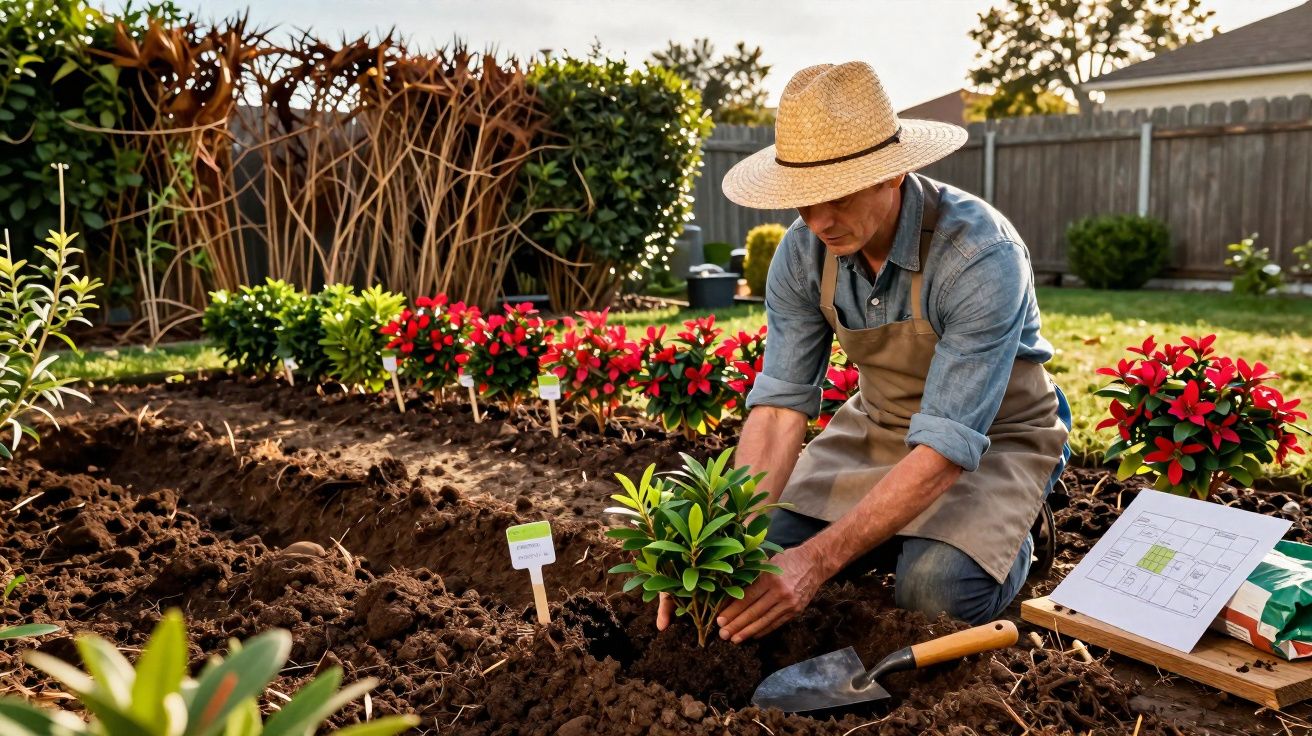
Anyone wanting to turn a grey driveway into a red line of flowers should ideally plan a narrow, sunny strip beside the paving or tarmac. The spacing between plants will later determine whether the result is a continuous band of colour or a looser series of bright highlights.
Step by step to a flowering strip
- Dig a planting hole at least twice as wide as the root ball.
- Loosen the base of the hole thoroughly so the roots can spread.
- Mix heavy, clay-rich soil with gravel, sand or expanded clay to improve drainage.
- Set the plant in so that the root ball sits exactly at soil level.
- Water in well after planting so the soil and root ball settle together properly.
- Apply a thin layer of gravel or decorative chippings as mulch, matched to the style of the driveway.
For a continuous band, spacing of about 60 to 90 centimetres between plants works well. Closer planting fills gaps more quickly, while wider spacing creates a lighter look and gives each shrub more room.
Care through the season: from heat to winter
The trickiest period is the first summer after planting. During this time, the roots need to establish themselves in the new soil. If young plants are watered too infrequently in the early weeks, they can dry out despite their high tolerance for heat.
Watering and tolerance of heat
In the first year, regular watering is essential, especially during prolonged dry spells and when heat is being reflected off asphalt or concrete. Once established, lantana shows its tougher side. Mature plants can go for several weeks without extra water, provided the soil is not rock-hard and completely parched.
On very hot driveways, where other perennials collapse in the heat, the lantana shrub remains impressively healthy and continues to flower generously.
Another advantage in snowy regions is that the plant handles splashes of road salt from winter gritting with surprising composure. Deer are also usually put off by its strongly scented foliage, which can be a real bonus in rural edge-of-village settings.
Pruning and overwintering
How hard the shrub is cut back depends on the climate and how it is being used:
- Mild regions: In late winter, shorten the shoots quite heavily. This prevents the plant becoming woody and encourages fresh, flower-rich growth.
- Cooler regions: The stems can be cut back close to the ground. A thick mulch of leaves or bark chips protects the base. The safest option is to keep the shrub in a large container and overwinter it in a light, frost-free place.
In a pot, lantana can be moved to the driveway in spring and then simply taken into a garage or a bright unheated room in autumn.
A light trim after the main flowering spell can also help keep the plant compact and encourage more branching. That is particularly useful where space is tight and you want the shrub to stay neatly within its allotted strip beside the driveway.
Attractive, but poisonous: handle with care
However appealing the red blooms may be, all parts of the plant are considered poisonous. If you have young children or pets, it is best to position the shrub where no one can nibble on it regularly. Gloves are sensible when pruning, as they help avoid skin irritation.
The bright flowers are tempting to touch, so the planting position should be chosen carefully - especially in family gardens.
That said, there is no need to rule it out entirely. Along a driveway mainly used by adults, beside a garage, or in the front garden away from play areas, the risk remains manageable.
Where the bold flowering shrub looks especially effective
Lantana works particularly well beside driveways in contemporary, clean-lined designs using gravel, concrete or large-format slabs. The red flowering strip softens the coolness of the hard landscaping without disrupting its tidy appearance.
It combines especially well with:
- ornamental grasses that visually break up the hard edge,
- low, silver-leaved perennials such as santolina or curry plant,
- pale or dark gravel that heightens the contrast of the flowers.
If you enjoy experimenting with colour, the red cultivar can be mixed with yellow-orange or pink lantana varieties. Even then, it is important to keep the planting rhythm along the driveway consistent so that the overall effect does not become visually messy.
Practical advice for home gardeners in the UK
In many areas, lantana is best treated first and foremost as a premium seasonal planting. Set it out in the prepared strip after the risk of frost has passed in May, enjoy the summer display, and then decide in autumn whether it should be overwintered.
Gardeners without a suitable winter space can simply replace the plant the following year. For homeowners who like to refresh their driveway display every spring anyway, that is a flexible solution. By contrast, gardeners in mild city climates or sheltered south-facing spots may want to test whether the plant can survive several years with good winter protection. Both approaches work, as long as the position is sunny and the soil drains freely.
For extra impact, the planting strip can be repeated on both sides of the driveway entrance, creating a stronger sense of arrival. A matching container near the front door can then echo the same flower colour and tie the whole frontage together.
What was once a drab strip beside asphalt or paving can therefore become a striking, low-maintenance calling card for the house - a red, flame-like band that brings colour from the first warm days to the last.


Comments
No comments yet. Be the first to comment!
Leave a Comment