
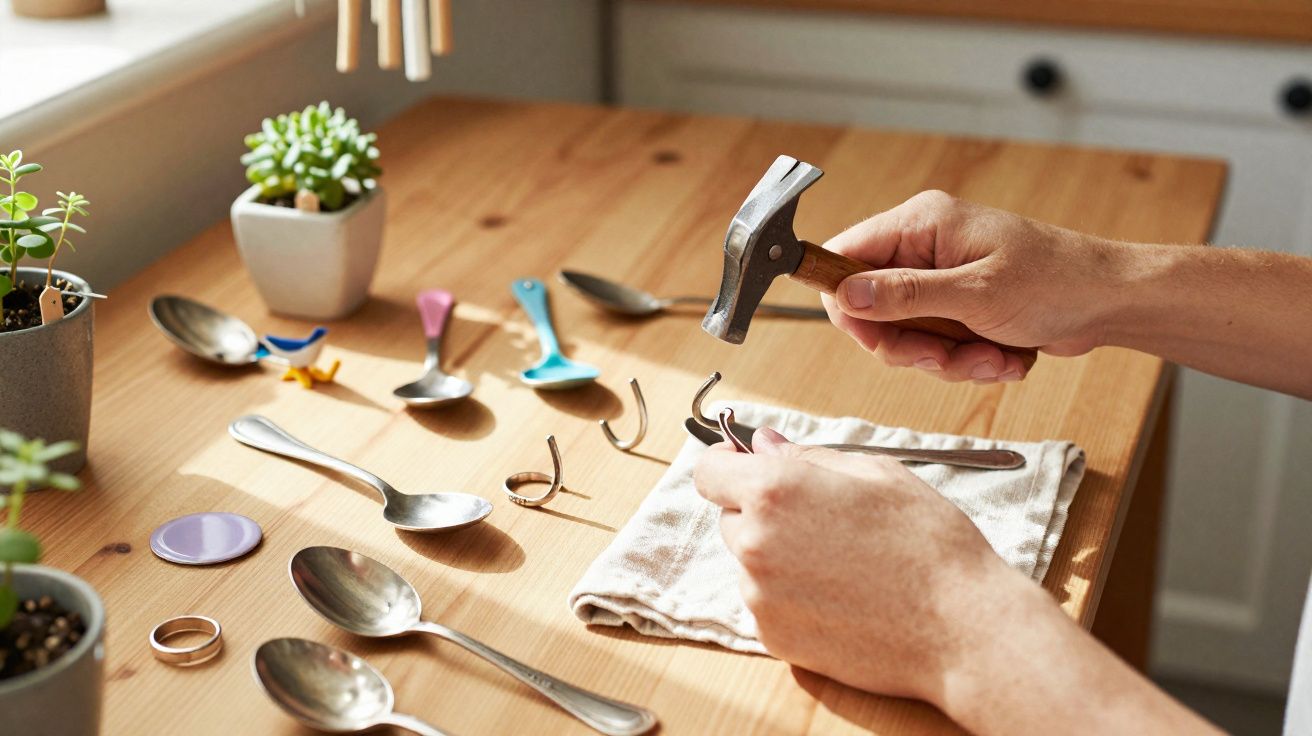
Anyone who walks past the box of old cutlery on their next trip to a flea market or second-hand shop is missing out on genuine creative potential. Those discarded spoons, often sold for just a few pence, are perfect for making a home and garden feel more personal, distinctive and sustainable - without needing a big budget.
Why old spoons are such an exciting upcycling material
Old spoons turn up everywhere: in charity shops, at house clearances and on flea markets. They are usually a mixed lot, lightly scratched and not especially appealing at first glance. That is exactly what makes them interesting.
Discarded spoons provide low-cost raw material for sturdy, long-lasting decoration - and stay out of the scrap skip.
Three materials are especially common:
- Silver or silver-plated: soft, easy to shape, ideal for rings, pendants and delicate decorative pieces.
- Stainless steel: very tough, perfect for hooks, handles and garden projects.
- Wood: easy to paint, ideal for bright accents in the kitchen and children’s room.
With a little experimentation, it quickly becomes clear that a spoon is not just a spoon. The handle, bowl and material all offer plenty of possibilities for creative transformations.
A small sorting box at home can be very helpful. If you collect spoons by material and size as you go, it becomes much easier to match the right piece to the right project later on. That also saves time once the tools come out.
Choosing and preparing spoons properly
Before the crafting begins, it is worth taking a close look at the condition and material. Small scratches are no problem, but cracks or deep breaks are.
Material test in seconds
Many people ask themselves: is it really silver, or just a stubborn stainless-steel spoon? A simple trick helps:
- Hold a magnet to it - if it sticks, it is not solid silver.
- Silver feels slightly softer and bends more easily.
- Strong discolouration can often be removed again with polish.
Softer material is best for jewellery and delicate decoration, while sturdier stainless steel is more suitable for coat hooks and handles.
Cleaning and basic preparation
Every project starts with cleaning:
- Soak the spoons in hot washing-up water.
- Remove dirt and grease with a brush or sponge.
- Rinse thoroughly and leave to dry completely.
If you later want to label or flatten the spoons, place the bowl on a solid surface and tap gently with a rubber mallet. This creates a smooth area for stamps, engraving or paint.
For more elaborate projects, simple tools are needed: a metal saw or wire cutters for cuts, and a drill with suitable metal bits for holes. Safety glasses and gloves are essential for this kind of work.
If you want a cleaner finish, it helps to plan the end result before you begin. A spoon that will become jewellery needs a different surface treatment from one that will be used outdoors. A quick decision at the start makes shaping, polishing and sealing much easier later on.
Twelve creative DIY ideas using flea-market spoons
With a few basic tools, you can get far more out of a plain-looking pile of cutlery than you might expect. The ideas below are there to inspire you and can be adapted to suit your own taste.
1. Wall hooks made from bent spoons
A classic: bend the spoon handle forwards in an arc, screw the back to a wooden board, and the coat rack is done. Depending on their size, the hooks can hold mugs, tea towels, keys, light jackets or bags.
2. Serving tray with spoon handles
A simple wooden board becomes a serving tray when fitted with two sturdy spoons as side handles. First bend the spoons into shape, drill the holes, screw them on - and the tray suddenly looks like a country-style designer piece.
3. Bird feeder
Combined with a jar or small dish, a wooden spoon becomes a holder for bird food. Hung in the garden, the homemade feeder attracts tits and sparrows - sustainable and decorative at the same time.
4. Wind chime made from spoon bowls
Several spoons with their bowls sawn off and drilled can be combined with beads or old keys to create a tinkling wind chime. In the breeze, it produces a gentle sound that brings life to a balcony or patio.
5. Plant labels for beds and herbs
Flattened spoon bowls can be marked with letter stamps or waterproof paint - perfect for identifying tomatoes, basil or thyme in a garden bed. Metal stands up to rain and sunlight much better than paper labels.
6. Painted wooden spoons as kitchen décor
Wooden spoons are ideal for paint. Acrylic colours can be used to create patterns, faces, slogans or graphic designs. Gathered together in a vase, they become a colourful focal point on the kitchen worktop.
7. Spoons with a new handle finish
Anyone wanting to update existing cutlery can dip the handles in coloured varnish or coat them with epoxy resin and glitter particles. The result is a unique set, ideal for parties or as a gift.
8. Pendant from a spoon bowl
The spoon bowl can be cut and filed into a teardrop or oval shape with a metal saw and file. Add a hole for the chain and finish it with engraving, a small stone or a motif, and it becomes a one-of-a-kind pendant.
9. Rings from spoon handles
Old silver spoons with decorative handles are especially suitable for rings. The handle is shortened, carefully bent into a circle and adjusted to fit. Depending on the width, around 30 to 50 grams of metal per spoon can be usefully repurposed.
10. Pull chains for lamps and fans
Ceiling fans or standing lamps with pull switches can quickly look old-fashioned. A pretty spoon handle as the end piece gives the whole thing a personal touch and is also nicer to hold.
11. Jewellery holder from an old spoon board
Many households still remember them: wooden boards displaying collected souvenir spoons. These boards are hardly in demand in the second-hand market - yet they work brilliantly as jewellery holders. A little sanding, painting and adding hooks, and necklaces, bracelets and earrings all have a place to hang.
12. Place cards made from flattened spoons
For special occasions, flattened spoons can be personalised with names. Whether stamped or written in a delicate hand, the guests not only find their correct seats - they can also take their cutlery place card home afterwards.
How to find the best spoon bargains
When browsing, it is worth choosing mixed cutlery bundles on purpose. They usually cost very little and provide enough raw material for several projects.
Decorative handles, solid serving spoons and wooden spoons with signs of use are often the most interesting finds.
Useful buying criteria:
- Different sizes for flexible projects.
- Decorative handles for jewellery and decoration.
- Sturdy serving spoons for handles and wall hooks.
- Wooden spoons without deep cracks for painting projects.
A quick test, in which the handle is bent slightly, shows whether the material is brittle. If it snaps straight away, it is better to leave it behind.
What to bear in mind when working with metal spoons
Upcycling should be fun, not hazardous. Anyone who saws, drills or hammers should protect their eyes and hands. A sturdy vice or clamp will keep the spoon firmly in place.
Heat can help when bending: a spoon dipped in hot water is a little easier to shape, especially with thicker handles. Even so, it is best to work slowly to avoid breaks.
Keeping a few safety basics in mind also helps with better results. Clean edges, well-placed holes and careful bending make the finished piece look more professional and last longer in daily use.
Sustainable benefits and practical combination ideas
These projects save not only money, but also resources. Every spoon that does not have to be melted down extends the life cycle of the material. At the same time, the home looks more individual, because there are no mass-produced items from a furniture warehouse hanging on the wall.
The results become even more interesting when spoons are combined with other finds: old wooden boards, glass bottles and leftover paint from previous renovations. This creates a coordinated style that runs through several rooms - from the kitchen to the balcony.
If you are not sure where to begin, start with a simple project such as plant labels or painted wooden spoons. With growing confidence, jewellery, coat racks or more complex wind chimes can follow. In the end, the realisation is often the same: the inconspicuous cutlery basket in the charity shop is not a jumble of odds and ends, but a well-stocked craft box at a tiny price.
Comments
No comments yet. Be the first to comment!
Leave a Comment