
The first thing that hits you isn’t the temperature.
It’s the green.
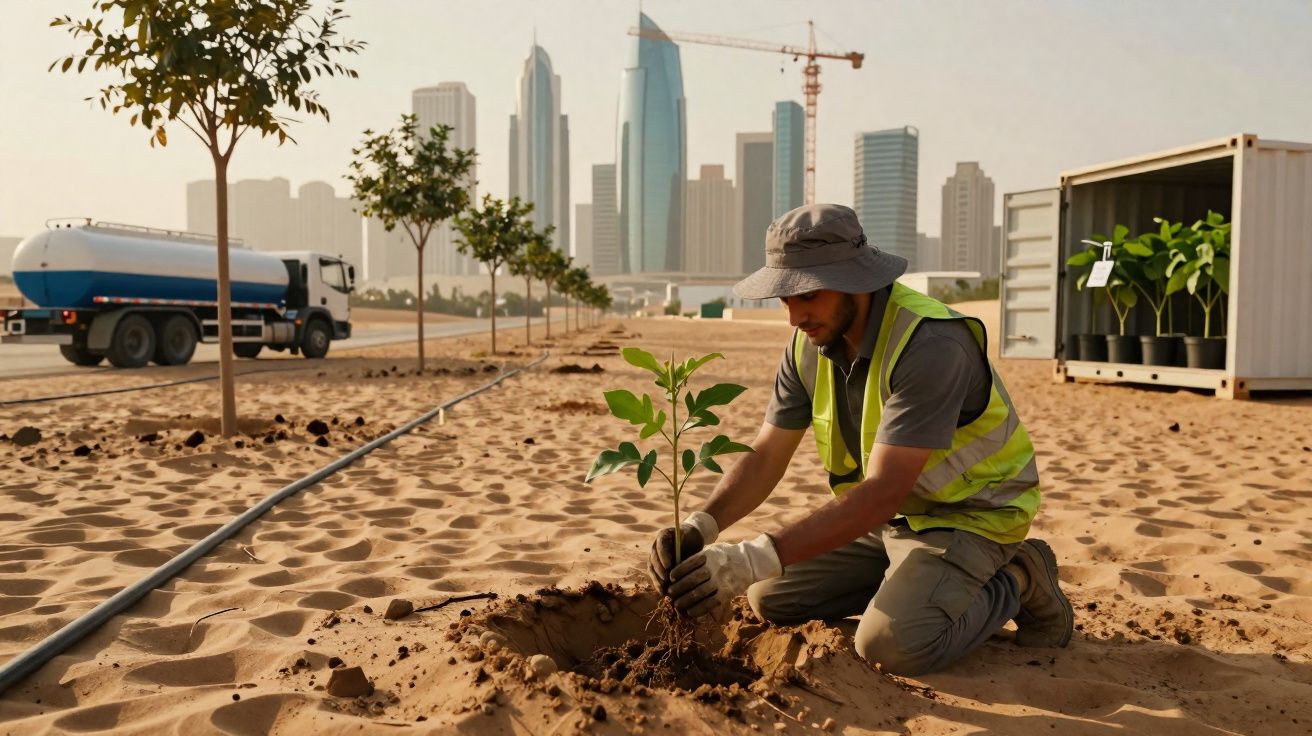
Out on the fringes of Riyadh, where beige tower blocks fade into open desert, long low-loader lorries inch along, piled with trees bundled in hessian. Young labourers in dust-coated high-vis hop down, faces slick with sweat, steering palm after palm into holes already cut into the sand beside a brand-new boulevard that, for now, leads to very little. The air carries diesel, damp soil, and an oddly unfamiliar note for this landscape: a faint, almost-impossible hint of woodland.
Hundreds of kilometres away in Dubai, cranes pivot above a waterfront park while hoses drive reclaimed water into fresh trenches. Under shade cloths, imported saplings from abroad wait like delicate VIPs-protected, labelled, and timed for planting.
This is what climate strategy looks like when a desert becomes a mega-city and then discovers it is edging towards air that feels too hot to breathe.
Desert nations racing to plant forests of shade in Saudi Arabia and the United Arab Emirates
Across Saudi Arabia and the United Arab Emirates, city authorities are now bringing in millions of trees every year, trying to cool urban areas that have expanded faster than shade could ever keep up. Wide motorways, glass-heavy skylines, and concrete villa districts intensify the urban heat island effect, turning a simple late-afternoon stroll into something closer to an endurance test.
Under pressure from residents, employers, and international investors, planners are staking a lot on green infrastructure. The language is grand-“climate resilience corridors” and “urban forests”-yet the reality at street level often looks like line after line of workers digging into sand, attempting to plant a cooler future sapling by sapling.
Riyadh’s King Salman Park shows the scale of the ambition. Still being built, it is intended to become one of the largest urban parks in the world-so vast it will function like a small city in its own right. Beyond the capital, officials point to the Saudi Green Initiative, which sets out an extraordinary national goal: planting 10 billion trees across the country over the coming decades.
In Dubai and Abu Dhabi, municipal nurseries are packed to capacity. Cargo ships unload containers of young trees from Spain, Italy, Kenya and even Australia, selected for their ability to tolerate intense sunlight and salty soils. A Dubai landscaping manager quipped that his job has become “traffic control for trees”, directing drivers on where to tip the next load of living freight.
The logic is simple on paper: more trees means more shade, and more shade means less heat. Research from Gulf universities suggests shaded streets can feel about 5–10°C cooler than unshaded ones, and neighbourhoods with thick canopy often show markedly lower surface temperatures in satellite imagery.
There is also a communications dimension. As Saudi Arabia promotes futuristic developments such as NEOM and The Line, images of greenery threading between glass and steel can soften international criticism around fossil fuels. The UAE, fresh from hosting COP28, leans on photographs of leafy boulevards and expanding mangrove belts to reinforce its “climate-conscious hub” message. In this context, trees operate both as a practical cooling tool and as a global PR symbol-taking root in sand and in reputation at the same time.
One further driver is economic: heat changes how people use cities. If walking becomes unbearable, footfall drops, public transport becomes less appealing, and outdoor public life shrinks. In that sense, shade is being treated less like decoration and more like productivity infrastructure-something that keeps daily routines functioning.
The hidden cost of importing a forest into the desert
Planting a tree on the Arabian Peninsula is nothing like planting one in a damp suburb of northern Europe. Each sapling that arrives by ship or plane needs a miniature life-support network: drip irrigation, treated wastewater, and often protective mesh to shield it from wind and blowing sand. Increasingly, landscape teams talk more about pipe diameters, salt tolerance and soil chemistry than about visual style.
The approach is highly engineered. Planners lay out “cooling corridors” of trees along major roads and pedestrian routes, linking parks, malls and metro stations so people can move under shade for as much of a journey as possible. The goal is not simply to make streets look pleasant; it is to make them usable after 3 p.m. in August.
Residents are beginning to adapt to this new geography of comfort. In Abu Dhabi, a Filipino delivery rider described choosing routes that follow streets lined with neem and ghaf trees, trimming a few degrees off an otherwise punishing shift. In Jeddah, parents time late-day trips to new coastal parks where imports from foreign nurseries stand beside tougher local species, both sustained by greywater from nearby buildings.
But there are uncomfortable gaps between the visuals and the reality. Some newly planted boulevards appear lush in official Instagram posts and then look brittle and dry in person, because irrigation lines are unfinished or budget approvals have slipped. And once the ribbon-cutting photographs are taken, not every sapling is monitored carefully. Some die quietly, a reminder that rapid planting is far easier than long-term care.
The rush for shade has also triggered serious debate among local professionals. Why buy water-demanding non-native trees when the region already has resilient species such as ghaf or sidr, which have survived centuries of drought? Why pursue a “European park” look in cities that receive very little rain?
Specialists warn about groundwater depletion, the energy cost of desalination, and the danger of creating thirsty urban forests that cannot survive without constant pumping. You cannot air-condition an entire country with leaves alone. A broad consensus is forming that trees deliver the most benefit when they are combined with cooler building materials, reflective roofs, shaded walkways and a reduction in dark asphalt that stores heat. Without those measures, greenery risks becoming a thin layer of comfort laid over an unchanged, overheated city.
Between ambition and reality: how the Gulf is learning to green wisely
Behind the polished renderings, a quieter shift is underway towards practical, almost modest techniques that focus on survival rates rather than spectacle. In Riyadh, engineers now shape “tree pits” to capture rare rainfall, letting it soak into root zones instead of disappearing into drains. Irrigation systems are increasingly linked to sensors and scheduled to run at night, when less water is lost to evaporation.
On the outskirts of the UAE, trial plots deliberately blend imported species with native plants, tracking which combinations cope with less water, stronger wind and harsher soil. Often, the most successful candidates are unglamorous local shrubs-species that never feature in glossy brochures but handle August as if it were routine.
Planners are also conceding something rarely stated in press releases: not every street needs dense greenery. Some districts are now designed for heavy canopy, while others rely on low-water planting paired with shade structures that perform even when trees are small or absent. That has pushed attention towards cool bus stops, arcades and covered walkways-features that work with or without a mature urban forest.
There is a social side too: planting is only the beginning. Cities are experimenting with clearer maintenance contracts, replacement guarantees, and stricter performance targets for contractors-because a dead tree is more than a lost plant; it is lost trust in public climate projects. In the long run, the most effective “urban forests” may be the ones backed by reliable maintenance budgets rather than ambitious launch announcements.
“Planting trees in the desert isn’t about copying Europe,” a landscape architect in Dubai told me. “It’s about designing shade that respects where we live. If the tree doesn’t make sense with our water, our soil, and our lifestyle, it’s just a very expensive decoration.”
- Choose hardy species first – Ghaf, sidr, date palm and acacia cope with heat, salt and wind far better than fragile imports.
- Use treated wastewater – Cities in both Saudi Arabia and the UAE increasingly send recycled water to parks, road medians and street trees.
- Think shade, not just beauty – Branch structure, leaf density and height matter more than flowers when the objective is cooler streets.
- Cool the ground too – Lighter paving, permeable surfaces and narrower roads reduce the heat that shaded areas radiate back upwards.
- Plan for maintenance – A dead tree is worse than no tree: it wastes water, money and confidence in climate resilience corridors and urban forests.
What kind of future grows out of a million imported trees?
Saudi Arabia and the UAE are attempting something unusually bold: they are trying to rewrite the relationship between desert cities and the landscapes they occupy. Rapid mega-city expansion made life more connected and modern-and then, for many, more physically draining. Now the region is racing to soften that impact with green belts, shade tunnels and vast urban parks that barely existed a decade ago.
A contradiction sits at the centre of the effort. Oil-rich states are paying for tree imports and desalination-powered irrigation to cool the very urban lifestyles that fossil fuels helped build. Yet within that tension lies a useful laboratory for other hot, crowded places. From Phoenix to New Delhi, officials are watching the Gulf’s experiments with treated wastewater, species choice, and the practical decision to place shade precisely where people need it most.
The decisive measure will not be this year’s satellite maps or the sheen of climate pledges. It will be whether, 20 years from now, a child walking to school in Riyadh or Sharjah remembers streets that felt humane-where the summer still burned, but someone had planned enough shade for them to keep walking.
| Key point | Detail | Value for the reader |
|---|---|---|
| Tree imports at massive scale | Millions of saplings shipped into Saudi and UAE cities to line roads, parks and mega-projects | Clarifies how fast-growing cities respond when heat becomes a daily obstacle |
| Water and species choice matter | A shift towards native or hardy trees, treated wastewater and smart irrigation rather than “European-style” lawns | Highlights what actually performs in hot, dry climates instead of what simply photographs well |
| Shade as infrastructure | Trees integrated with cool pavements, covered walkways and urban planning rules | Offers practical approaches any hot city can adapt to make streets more liveable |
FAQ
Question 1: Why are Saudi Arabia and the UAE importing so many trees instead of only planting local ones?
Local species are increasingly used, but the demand for fast, dense shade around new mega-projects has outstripped what regional nurseries can supply. Imports cover the gap while native plant programmes scale up.Question 2: Does planting all these trees genuinely cool cities down?
Yes at street level: shaded routes and parks can feel several degrees cooler, particularly for pedestrians. Trees will not solve the climate crisis, but they can make daily life more tolerable in extreme summer heat.Question 3: Isn’t this approach wasting scarce water in the desert?
That is the central criticism. Cities try to reduce the impact with treated wastewater and drip irrigation, but the overall water footprint remains significant and is widely debated.Question 4: Which tree species are proving most successful in Gulf mega-cities?
Tough, heat-tolerant species such as ghaf, sidr, date palms and acacia-plus carefully chosen imports with strong salt and heat tolerance-tend to survive best with lower water use and simpler maintenance.Question 5: Can other hot cities copy what Saudi and the UAE are doing?
Yes, with local adaptation. The core ideas-mixing shade trees with recycled water, cooler materials and planning streets around comfort-are already influencing policy from southern Europe to North Africa.


Comments
No comments yet. Be the first to comment!
Leave a Comment