
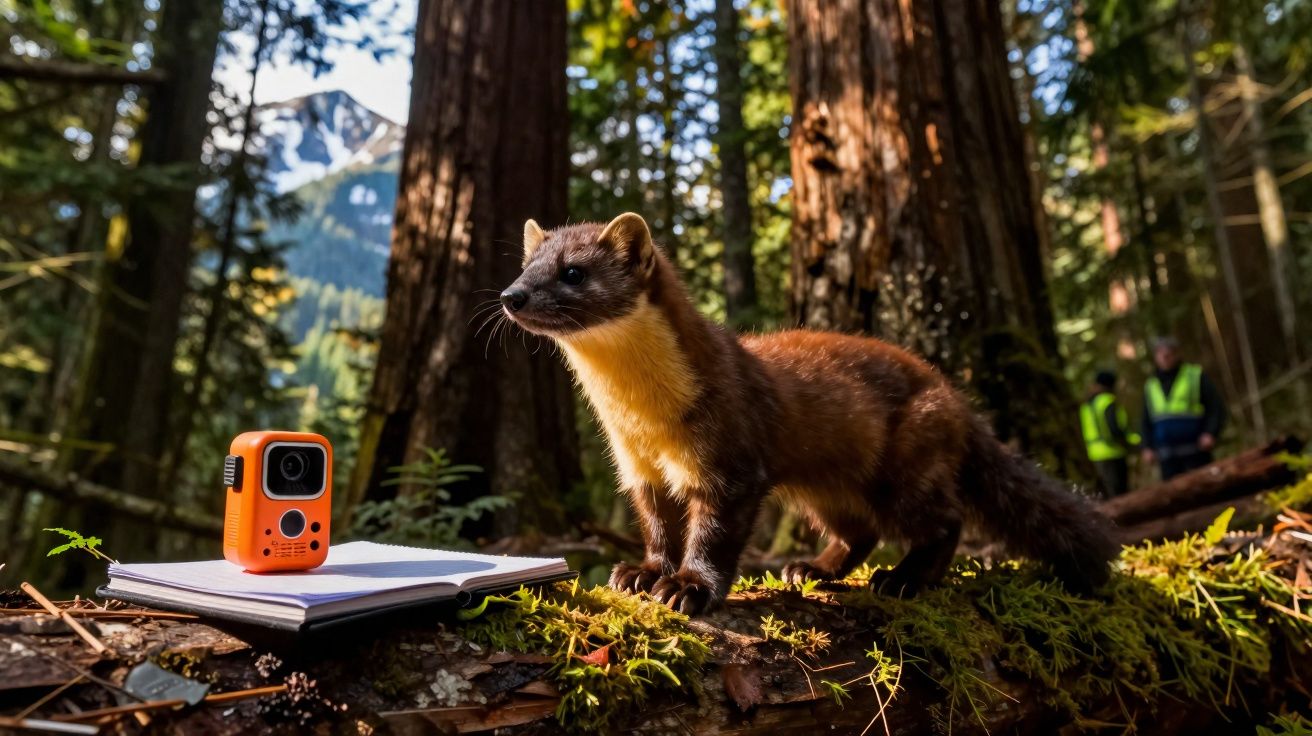
At the edge of a coastal forest in California, silent hair snares and concealed camera traps have been recording a comeback few people thought they would ever witness.
After decades in which it was treated as functionally lost across much of its former range, the elusive coastal marten is reappearing on biologists’ distribution maps. Its return in one of the last relatively intact stretches of the Pacific coast has revived arguments about conservation priorities, climate pressures and how governments and communities manage the region’s remaining old-growth forests.
The return of a forest “ghost”: the coastal marten
For much of the 20th century, the coastal marten-a mustelid with reddish-brown fur and a long tail-was heavily trapped for its valuable pelt. At the same time, industrial-scale logging progressively carved up California’s coastal old-growth forests, breaking once-continuous habitat into small, isolated remnants.
The combined effect was near-disappearance. In many North American mammal atlases, the species all but vanished. In several districts, researchers spent years without a single reliable record. It began to look as though the coastal marten would survive only as a cautionary footnote in the history of the fur trade.
That storyline shifted in 1996, when one animal was confirmed in a forest in northern California. The finding delivered a clear message: the species had persisted, but at very low densities, tucked away in fragments of forest that are difficult to reach and even harder to survey.
A painstaking census in Six Rivers of the coastal marten
Between August and November 2022, a research team set out to map this surviving population precisely in Six Rivers, a patchwork of mountainous woodland and damp valleys close to the Pacific coastline.
The survey covered 399 km²-not vast on a map, but exceptionally complex in terrain and vegetation. To avoid live capture, the scientists relied on two low-impact tools: hair traps and motion-sensor camera traps.
- 285 hair traps distributed through the forest
- 135 motion-triggered monitoring cameras
- roughly four months of sampling
- individual identification using physical features and DNA from collected hair
Using this approach, the team distinguished 46 different individuals (28 males and 18 females). Detection rates were low-underscoring just how rare and cautious the animal is-but the dataset still supported an estimate of roughly 111 martens within the study area.
The mean estimate was around one individual per 3.6 km², a density regarded as critical for such a specialised top predator.
Where the last coastal martens are holding on
Although its name suggests a tight link to the shoreline, the coastal marten does not rely directly on the immediate coastal strip. Instead, suitable territory is shaped by factors such as elevation, forest type and microclimate. The Six Rivers work indicates that the animals occupy only a small fraction of the old-growth that remains available.
Records were spread across most of the monitored landscape, but higher concentrations appeared in two clearly different settings: forested ridgelines north of Red Mountain, and the humid ravines of Blue Creek nearer the coast.
Snowy ridges and shaded valleys
At higher elevations, longer-lasting seasonal snow creates colder conditions and makes the area less accessible to competitors such as grey foxes, bobcats and fishers (another similarly sized carnivorous mustelid). Where snow persists alongside mature forest and limited human disturbance, the coastal marten appears to gain an advantage.
Down in valley bottoms, the key is the microclimate: cooler air, high humidity and dense, layered vegetation. These ravines act as biodiversity corridors, keeping cover and prey available even in drier years.
Where the coastal marten shows up most often, there is usually a closed canopy, thick trunks, hollow stumps and abundant dead wood on the forest floor.
These structural features provide hiding places, hunting grounds and safer sites for raising young. Without them, the predator is more exposed-to cougars and birds of prey, and to pressure from other carnivores.
Old-growth forests versus the prevailing economics of timber
The coastal marten has little tolerance for simplified landscapes. Open areas, young regrowth and plantations laid out in uniform rows are typically avoided. That preference clashes with conventional forestry systems built around short harvest rotations and even-aged stands.
Researchers noted that the species’ presence tracks structural diversity more strongly than it tracks tree count alone. Put simply: a forest with similar stem density but mixed ages, fallen branches, small gaps and a variety of tree species tends to be far more suitable than a uniform plantation.
| Habitat characteristic | Favourable for the coastal marten? |
|---|---|
| Old-growth forest, multi-layered structure | High |
| Young, uniform plantation | Low |
| Dead wood and hollow structures present | High |
| Open ground and extensive clearings | Low |
| Humid microclimate with ravines and springs | High |
Climate change, wildfire and an increasingly unstable balance
The coastal marten’s recovery runs into a second, rapidly intensifying obstacle: climate change. Pacific coastal old-growth forests are facing harsher droughts, longer and more severe fire seasons, and disease outbreaks affecting key tree species.
Different elevations respond differently. In lower areas, reduced moisture can simplify the dense valley vegetation the animals depend on. Higher up, diminished seasonal snow can open the door to competitors and reshape hunting dynamics.
Even the dead wood that provides vital shelter can become fuel in large, fast-moving wildfires. Management plans therefore face a difficult trade-off: retaining the structural features martens need, while lowering the risk of mega-fires that can erase entire habitat blocks.
The coastal marten’s survival depends on a mosaic of old-growth forests-across elevations and microclimates-linked by safe corridors.
An additional concern is genetic resilience. Small, scattered populations can become isolated for long enough that inbreeding risk rises and adaptive capacity falls. Maintaining connectivity is not only about movement today, but also about safeguarding long-term genetic diversity in a changing climate.
Management that requires unlikely alliances
In such a fragmented landscape, no single group can secure the species’ future alone. Public agencies, Indigenous nations, forestry companies and local organisations need aligned objectives and shared standards.
That means strict protection in some areas, but also changes in harvesting practices, the creation of buffer zones, and long-term monitoring using cameras and hair traps. Traditional ecological knowledge held by Indigenous communities can also highlight overlooked forest patches-places absent from official datasets yet potentially crucial as refuges.
A further, practical piece of the puzzle is human access. Roads, recreation and increasing forest-edge development can add disturbance and create mortality risks. Incorporating road planning, seasonal restrictions in sensitive sites and clearer guidance for visitors can reduce pressure without excluding people from public lands.
Key terms used in coastal marten conservation
Two concepts appear repeatedly in this work and often confuse readers who do not deal with conservation on a daily basis:
- Fragmented habitat: when continuous forest is broken into isolated pieces by roads, pasture, agriculture or towns. For animals like the coastal marten, crossing these “gaps” can be too risky.
- Microclimate: local conditions of temperature, humidity and wind that can differ sharply from the regional average. A shaded ravine, for example, can remain cooler and damper than the slope above it.
Fragmentation combined with shifting microclimates creates complicated outcomes. A site that works as a refuge today may stop being suitable within a few decades if surrounding cover is removed or rainfall patterns change dramatically.
Future scenarios for the coastal marten
Researchers are weighing different trajectories. Under strong conservation-expanded forest corridors, a slower pace of habitat loss and well-designed fire management-the Six Rivers population could stabilise and gradually spread into other suitable areas.
Under continued fragmentation and a rise in extreme wildfires, the risk is a return to “invisibility”: densities so low that the species slips out of records again, even while persisting in minimal numbers. This kind of ecological limbo often precedes local extinction.
For those living far from California, the coastal marten offers a warning. Many inconspicuous mammals in temperate and tropical forests follow similar paths: reduced populations, dependence on patches of mature vegetation and near-total absence from everyday notice. Whether they persist or disappear can hinge on decisions made now-about how each remaining forest block is logged, burned, protected and restored.






Comments
No comments yet. Be the first to comment!
Leave a Comment