
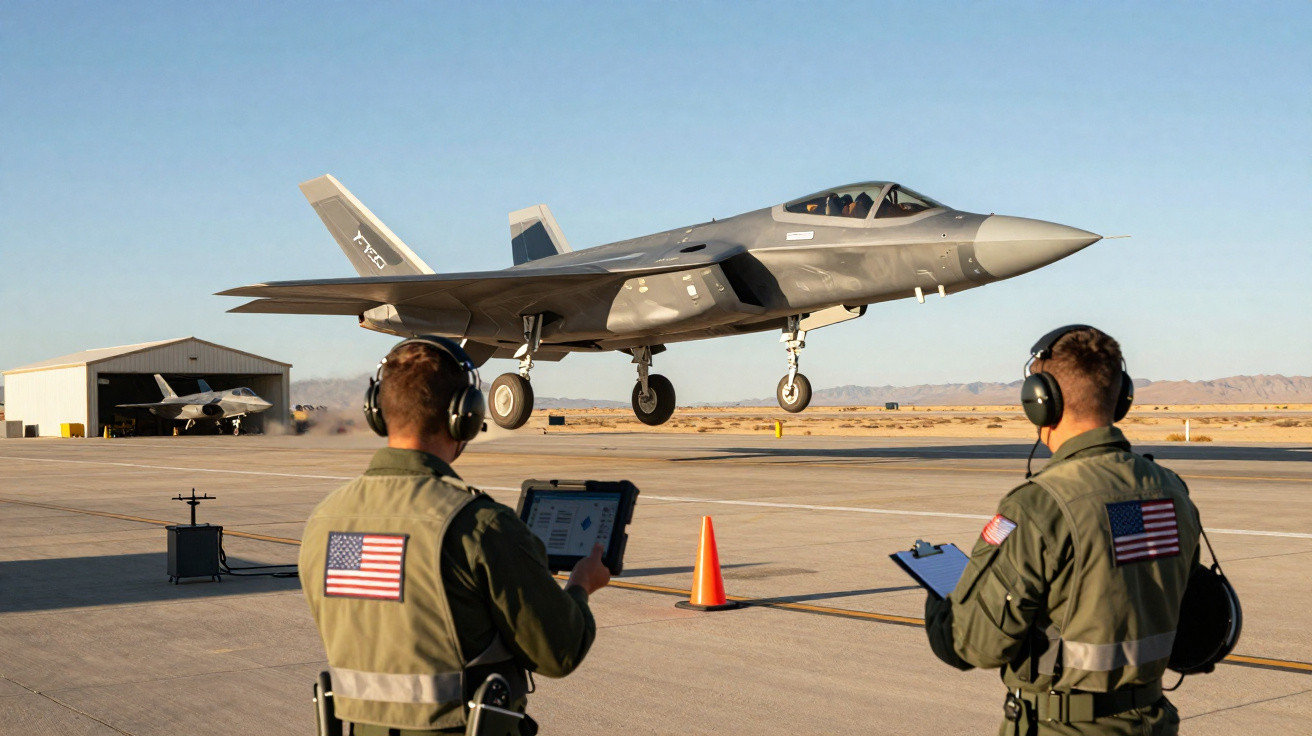
The United States Air Force (USAF) has confirmed that the YFQ-42A drone prototype, built by General Atomics under the Collaborative Combat Aircraft (CCA) programme, has successfully completed its first flight at a test centre in California. The milestone marks further progress in the effort to field uncrewed aircraft designed to operate alongside fifth- and sixth-generation fighter jets.
YFQ-42A flight milestone within CCA Increment 1
The YFQ-42A is one of two prototypes being developed for CCA Increment 1. The second aircraft is Anduril Industries’ YFQ-44A, whose flight-test campaign is expected to begin soon. Both designs began ground testing in May 2025.
As reported at the time, those ground activities covered assessments of propellants, avionics, endurance and control interfaces-an initial step ahead of formal flight trials.
USAF and industry reactions to the first flight
US Secretary of the Air Force Troy Meink underlined how quickly the programme has moved: “This milestone shows what’s possible when innovative acquisition meets a motivated industry. In record time, the CCA went from concept to flight, demonstrating that we can deliver combat capability quickly when we remove barriers and align around the warfighter.”
Similarly, the Chief of Staff of the Air Force, General David Allvin, said: “This is the More Air Force in action. We’re not just moving fast, we’re learning fast. The CCA will help us rethink the battlespace, expand range, flexibility and lethality in combat operations and optimise warfighter performance through man-machine teaming.”
Speaking for industry, David R. Alexander, President of General Atomics Aeronautical Systems Inc. (GA-ASI), said: “It was our collaboration that enabled the YFQ-42A to be built and flown in just over a year. This is a significant achievement, and I salute the Air Force for its vision, as well as our development team for delivering another historic innovation for our company.”
NGAD links, open-architecture approach and planned buys
The CCA programme sits within the Next Generation Air Dominance (NGAD) initiative and aims to establish a modular model of software-defined airpower built around open architectures. The Air Force plans to make a competitive production decision for Increment 1 in fiscal year 2026, weighing proposals from General Atomics and Anduril.
In April 2024, it was confirmed that the YFQ-42A design is derived from the experimental XQ-67A drone, developed under the Off-Board Sensing Station (OBSS) programme. That lineage has been described as a key input to the current CCA development effort.
Officials have indicated that the Air Force intends to buy between 100 and 150 drones in the programme’s first phase, although the longer-term aim is to reach more than 1,000 air vehicles through iterative development cycles. These semi-autonomous platforms are intended to broaden operational capacity, and the first CCA Aircraft Readiness Unit is planned for Beale Air Force Base, California.
In a separate statement, Anduril stressed: “Flight testing is one of those milestones that inevitably generates excitement. Congratulations to General Atomics and the U.S. Air Force on beginning flight testing of the YFQ-42A, an important step towards fielding CCA Increment 1 aircraft by the end of the decade,” said Jason Levin, Anduril’s Senior Vice President of Engineering.
With this first flight, the U.S. Air Force is moving forward with validating autonomy technologies, mission-system integration and collaborative operations between crewed and uncrewed aircraft, with the goal of delivering a new operational capability by the end of this decade.
Images sourced from the U.S. Air Force.
You may also be interested in: The U.S. Army is accelerating the replenishment of its Patriot missile stockpile with a US$ 9.8 billion contract awarded to Lockheed Martin
We’re looking for you! Vacancy on the Blue Field Media Editorial Team for the role of Correspondent in Brazil



Comments
No comments yet. Be the first to comment!
Leave a Comment