
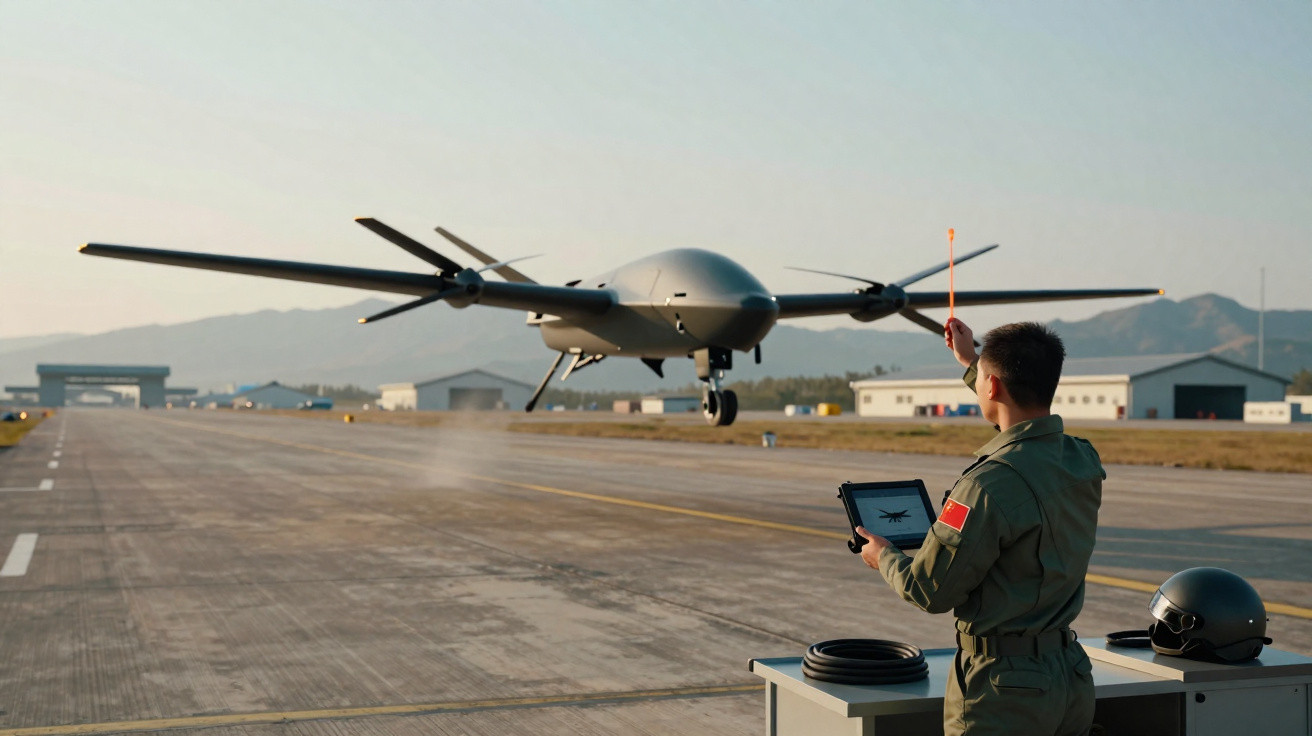
China appears to have made a notable advance in low-observable unmanned aviation, following reports of what seems to be the first flight of the CH-7 - a large, high-altitude stealth drone developed by the China Aerospace Science and Technology Corporation (CASC) for the Chinese Air Force.
The maiden sortie is said to have occurred recently at an airfield in north-western China, formally launching the flight-test phase for the flying-wing aircraft, which had previously been exhibited at earlier editions of Airshow China.
Start of the flight-test campaign
Li Jianhua, speaking as a CASC representative, stated that the first flight is “an exceptionally critical milestone for any aircraft.” The executive explained that this phase is intended to confirm the robustness of the overall design and to check the maturity of progress made in key technologies.
For the initial test, crews assessed core parameters including autonomous taxiing, automatic take-off and landing, attitude control, and trajectory tracking. Li said the outcomes were fully consistent with the design requirements and with the simulation models established in advance.
He added that, relative to other unmanned aerial vehicles, the CH-7 must demonstrate a larger set of critical technologies. That requirement stems in part from its tailless layout and high-aspect-ratio wing, which create bigger challenges for directional stability and raise the complexity - and therefore the risk - of the first flight.
CASC noted that this sortie examined only the platform’s most basic characteristics. In subsequent stages, the CH-7 is expected to face further flight-performance trials, alongside tests of how its payloads operate, including sensors and other mission systems.
Stealth design and technical features
The CH-7 uses a flying-wing aerodynamic configuration designed for high-altitude missions and reduced detectability. At Airshow China 2024, a full-scale airframe was shown publicly for the first time; observers noted an engine intake positioned on the upper fuselage, while the exhaust nozzle adopts a partially shrouded arrangement.
The aircraft also features radar-signature-reduction measures, including absorptive treatments along the leading edges, specialised surface coatings, and low-observable approaches applied to doors, landing gear, internal bays, and structural details such as fasteners.
Official information indicates that this configuration could enable CH-7 operations in both low-threat situations and in areas heavily protected by radar and air-defence systems.
Planned missions and operational employment
Demonstration animations shown during Airshow China 2024 depicted the CH-7 carrying out long-duration patrols over maritime zones. After identifying a target, the drone would be able to pass information to command centres via data links, supporting mid-course or terminal guidance for long-range weapons.
Specialists have suggested the CH-7 is chiefly intended for intelligence, surveillance, and reconnaissance (ISR) missions over land and sea. Its onboard radar is expected to support the detection of large naval targets, while also enabling discreet reconnaissance in highly contested combat environments.
Role within the Chinese Air Force framework
Chinese commentators have observed that the CH-7’s aerodynamic design would result in speeds below those of modern fighter aircraft, meaning it is not meant to function as a “wingman” in close-in air combat. Instead, its use would focus on forward operations inside combat zones, taking advantage of low observability and high endurance to conduct extended search and surveillance.
After a target is found, the drone could act as a designation or data-relay node, supporting attacks executed by other aircraft or by long-range missiles launched from land-based or sea-based platforms.
As this programme moves forward at what appears to be an advanced stage, China is continuing to broaden its range of stealth drones, amid increasing interest in unmanned systems able to operate at high altitude and penetrate heavily defended airspace.
Cover image: Credits to whom it may concern.
Translation credit: Constanza Matteo.
You may also like: For the second time this year, Chinese and Russian Air Forces strategic bombers H-6K and Tu-95 carried out a joint Pacific patrol



Comments
No comments yet. Be the first to comment!
Leave a Comment