
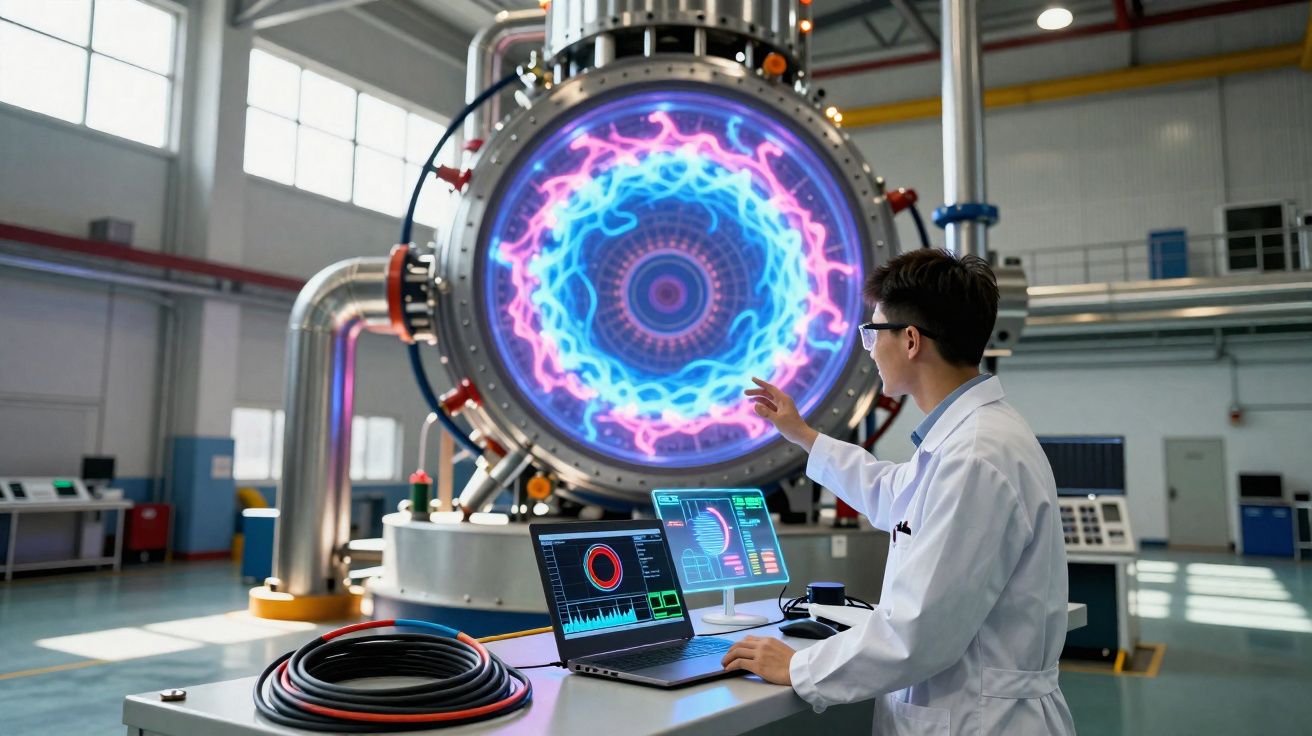
At Culham, just outside Oxford, the UK is discreetly advancing the next stage of an ambitious fusion plan, working with a spherical tokamak that treats plasma less like a delicate flame and more like something that can be shaped, pushed and brought to heel.
From Culham campus to a new fusion era
By the close of 2025, the Mega Amp Spherical Tokamak Upgrade – MAST Upgrade for short – entered its fifth major science campaign. For the UK Atomic Energy Authority (UKAEA), that step signals a shift into a more consequential phase. Across about six months, over 200 researchers from around 40 institutes intend to drive nearly 950 brief plasma bursts - known as pulses - through the device.
A single pulse runs for only a few seconds. Within that window, temperatures rise beyond those at the Sun’s core. Magnetic fields strain to confine charged, swirling particles that constantly try to break away. Meanwhile, the vessel walls must withstand heat fluxes that would rapidly liquefy most metals.
MAST Upgrade does not aim to power homes. It aims to torture plasma until it gives up the secrets needed to make fusion power plants possible.
That is the real purpose of Culham’s “plasma monster”: not generating electricity now, but charting the razor-thin boundary between stability and disorder inside a fusion reactor.
Turning up the heat: a serious power boost
Doubling the heating power
The fifth MAST Upgrade campaign arrives with a substantial hardware step-up intended to run the machine much harder than before. Two additional neutral beam injectors are being installed, which will approximately double the available heating power between 2026 and 2027.
Neutral beams act like battering rams for plasma. Fast, energetic neutral atoms punch into the plasma, transfer energy and help drive current within the tokamak. Increasing beam power supports hotter, denser plasmas - nearer to the punishing operating space that a commercial reactor must endure.
The beam expansion is not the only change. A new Electron Bernstein Wave (EBW) heating system will deliver radio-frequency waves that couple straight to the plasma’s electrons, without relying on a conventional line of sight. Practically, that means researchers can deposit energy with far more control, including in zones that standard microwave approaches struggle to access.
By shaping where and how energy enters the plasma, EBW heating turns MAST Upgrade into a precision tool for sculpting plasma profiles, not just heating them.
Together, the neutral beams and EBW capability enable more forceful studies: stronger pressure gradients, tighter current shaping and conditions that better resemble what next-generation devices will face.
Why a spherical tokamak looks different
A compact, high-pressure geometry
MAST Upgrade is not a typical doughnut-like tokamak in the mould of ITER or JET. As a spherical tokamak, it resembles a cored apple more than a ring. This geometry can support higher plasma pressure for a given magnetic field, which - at least in theory - points towards reactors that are smaller and potentially less expensive.
That shape also brings compromises. Hardware close to the central column experiences severe thermal and mechanical loading. Servicing and maintenance access is more constrained. Even so, the possible reward is a reactor that occupies a smaller footprint and relies on less costly magnets than the largest flagship machines.
In the previous campaign, MAST Upgrade recorded a world first: it used 3D magnetic coils to guide and calm plasma instabilities in real time. The result suggested that spherical tokamaks may offer not only compactness, but also greater agility in control.
How MAST fits into the global fusion ecosystem
The UK facility sits within a busy international landscape of fusion experiments, each aimed at a different bottleneck.
| Facility | Country | Main focus in 2026 |
|---|---|---|
| ITER | International (France) | Industrial‑scale tokamak, energy gain demonstration |
| JT‑60SA | Japan / Europe | Long‑duration plasmas and support for ITER |
| MAST Upgrade | United Kingdom | Spherical tokamak physics, advanced divertor concepts |
| WEST | France | Material endurance, tungsten divertor under steady heat |
| EAST | China | Very long pulses and high-temperature operation |
Instead of direct rivalry, these programmes frequently exchange results and align objectives. MAST Upgrade’s role is distinctive: it can trial bold, higher-risk configurations that large devices - slower and costlier to modify - cannot readily attempt.
Four brutal questions for the plasma
1. How hard can you squeeze it?
To reach meaningful power output, fusion systems need high-pressure plasmas: greater pressure usually translates to more fusion reactions per unit volume. On MAST Upgrade, teams will press towards these boundaries while closely observing the plasma’s response, especially at the edge where turbulence and instabilities tend to flare.
The difficulty is that pushing pressure upward can unleash violent instability. Such events can dump energy onto plasma-facing surfaces, terminate the discharge or harm components. Researchers will explore a range of magnetic configurations and heating timelines to identify which combinations remain stable for longest.
2. Can control beat chaos?
Even the strongest magnetic “cage” can fail if fluctuations take over. Control, therefore, is central to the campaign. Groups will intentionally trigger hazardous modes and then attempt to suppress them using:
- 3D magnetic fields that steer the plasma away from unstable shapes,
- rapid shifts in heating and fuelling patterns,
- real‑time feedback systems powered by advanced diagnostics.
The target is not a flawless plasma, but one that misbehaves in consistent, trackable ways - so that algorithms can act before anything is damaged.
3. What kind of exhaust system can survive?
A fusion plant needs more than a hot core; it must also remove heat and particles without destroying itself. This is the divertor’s task: a lower region of the machine where magnetic field lines guide exhausted plasma onto armour plates.
Today’s divertors are large and challenging to build. MAST Upgrade is investigating more compact “divertor geometries” that distribute heat loads while consuming less internal volume. Improving the divertor could unlock smaller reactors, easier upkeep and reduced costs.
Designing a fusion plant without a robust divertor is like building a jet engine without a turbine blade that can survive the exhaust.
4. Can computers predict the next pulse?
Each major tokamak shot carries substantial cost, which is why UKAEA and partners put major effort into numerical modelling that forecasts plasma behaviour ahead of experiments. In this campaign, MAST Upgrade will provide a demanding reality check for those simulation tools.
Scientists will set model predictions against measurements from nearly a thousand pulses: densities, temperatures, magnetic fluctuations, divertor heat loads and edge turbulence. Machine‑learning systems will begin to train on the resulting dataset, with the long-term objective of AI‑assisted control that can adjust parameters mid‑pulse.
From “physics playground” to prototype power plant
A direct link to the UK’s STEP project
MAST Upgrade is not an isolated laboratory curiosity. It feeds directly into STEP, the UK’s Spherical Tokamak for Energy Production programme, which is aiming for a prototype fusion power plant in the 2040s. Many subsystems and approaches proven at Culham now will shape STEP’s decisions later.
This includes divertor configurations, heating set-ups, control methods and the assumptions used for permissible heat loads on components. Every unexpected instability and every small failure helps cut the risk of billion‑pound errors when designs are scaled up.
When JET closed at the end of 2023, the UK’s fusion centre of gravity shifted. MAST Upgrade now underpins much of the country’s publicly funded tokamak research, while private efforts concentrate on compact power-plant architectures and high‑field magnets. The UK is seeking to convert its long fusion track record into industrial capability, not merely academic prestige.
How MAST compares to France’s WEST and other players
MAST Upgrade and France’s WEST tokamak are often discussed together, but their objectives are markedly different. WEST - developed from an older machine called Tore Supra - concentrates on a single pivotal issue: whether tungsten divertors can tolerate continuous heat loads comparable to those anticipated in ITER‑class devices for hundreds of seconds.
MAST Upgrade, by contrast:
- operates with shorter pulses, prioritising plasma shaping and control over pure endurance,
- exploits spherical geometry to explore high-pressure conditions,
- functions as a platform for alternative divertor designs rather than long-duration material wear studies.
Other facilities contribute additional perspectives. China’s EAST aims for very long pulses and high temperatures. South Korea’s KSTAR focuses on advanced control and steady operation. Germany’s Wendelstein 7‑X moves away from tokamaks entirely, using a stellarator configuration to pursue stable confinement without depending on a strong plasma current.
The international picture can look untidy, but that variety is deliberate: no-one yet knows which mix of geometry, materials and control will deliver the first economically viable fusion plant. Pursuing multiple routes reduces the risk that the field as a whole gets trapped by the same dead end.
Risks, realities and side benefits
Fusion still involves substantial scientific and financial uncertainty. Experiments such as MAST Upgrade do not guarantee that commercial fusion will arrive on schedule or at scale. Instead, they expose how many hurdles remain: edge instabilities, component fatigue, difficult maintenance, large capital costs and regulatory challenges.
Even so, the spill-over is already influencing other sectors. High‑power radio‑frequency technology, fast control electronics, sophisticated data techniques and vacuum engineering migrate from fusion laboratories into medicine, semiconductor production and space systems. Know-how in extreme magnets and cryogenics also supports next-generation particle accelerators and quantum devices.
A further theme to watch is the increasing importance of digital twins. As MAST Upgrade produces richer diagnostic data, teams can construct high‑fidelity virtual replicas of the device. These twins allow engineers to trial divertor concepts, evaluate AI controllers and explore failure modes that would be too hazardous to test on the real machine.
Fuel is another dimension. Most major efforts, including STEP, plan around deuterium‑tritium fuel, which releases neutrons that batter reactor walls. Work at Culham and elsewhere helps quantify how thick those walls must be, how quickly they degrade and what breeding systems are required to produce tritium on site. Those parameters shape not only the physics, but also the long-term economics and waste profile of future plants.






Comments
No comments yet. Be the first to comment!
Leave a Comment