
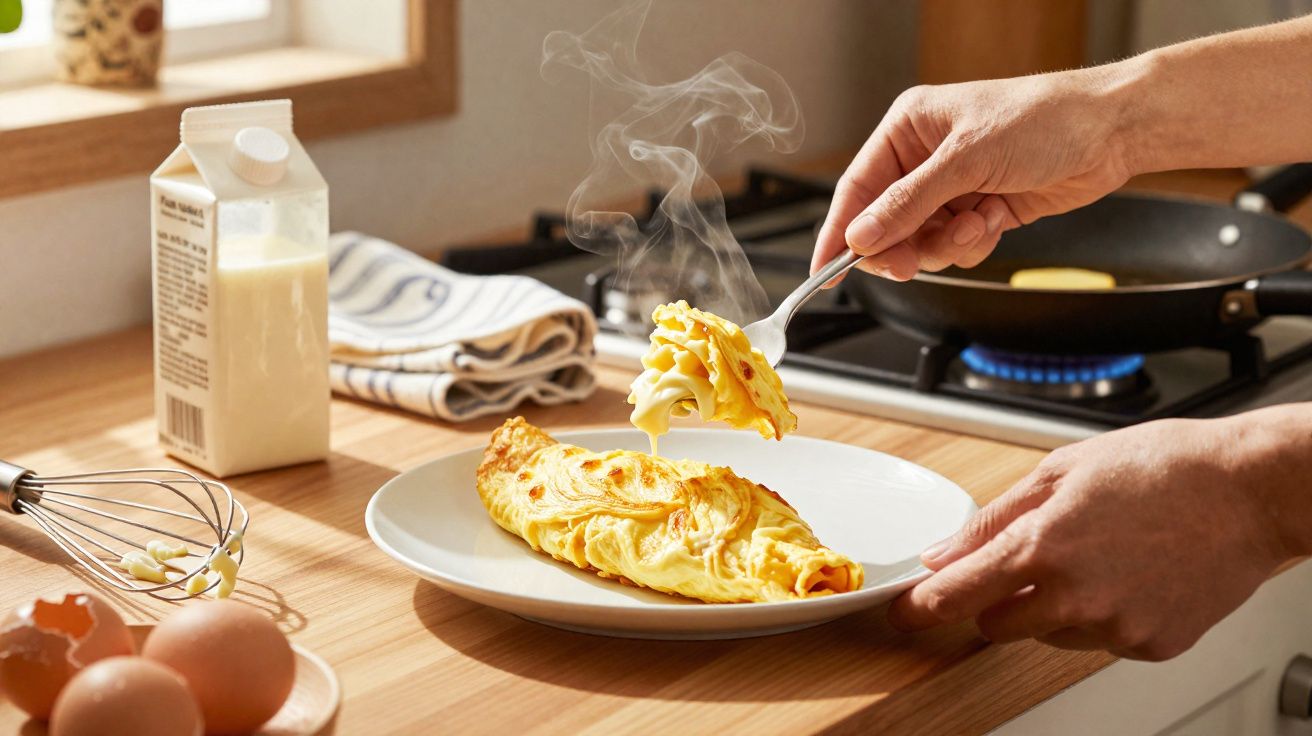
That airy, foam-topped omelette you spot at brunch isn’t reserved for chefs in crisp whites working an open pass.
With one small change to how you make eggs - and one very ordinary ingredient - you can turn a midweek scramble into a cloud-like omelette that looks and tastes as though it came straight from a French bistro.
Why most home omelettes stay flat
At home, we tend to whisk a couple of eggs with a fork, tip them into a hot pan, add a bit of cheese and call it breakfast. It’s perfectly edible, but it often ends up slim, compact and sometimes a little overdone at the edges.
The reason is simple: a standard omelette cooks fast with the eggs fully combined. With very little air worked in, there’s nothing to give the mixture any real “lift” as it sets.
A restaurant-style soufflé omelette follows another route. The yolks and whites are split, the whites are beaten into a foam, then everything is folded back together. As the omelette heats, the bubbles held in the whites expand, pushing it upwards.
"The secret to a puffy omelette isn’t magic, it’s air: trap it in the egg whites, then protect it during cooking."
Two common issues tend to ruin attempts at home:
- Egg whites that are under-whipped, or whipped too far until they’re dry and gritty
- Fillings piled in too heavily, weighing the mixture down so it sinks
Temperature control can trip you up as well. If the pan is too hot, the base catches quickly while the middle stays loose. People then turn the heat up again or flip the omelette - both of which press out the trapped air and leave it flat.
The understated ingredient that changes everything
The neat trick many professionals rely on isn’t a fancy gadget or a specialist pan. It’s simply a spoonful of plain pouring cream.
"A tablespoon of liquid cream whisked into the yolks helps keep the omelette airy, tender and stable once it leaves the pan."
This small addition does a lot of work:
- Fat from the cream lightly coats the egg proteins, helping stop them tightening too aggressively and turning chewy.
- Extra moisture becomes steam as it warms, encouraging the mixture to swell while it cooks.
- A slightly richer base helps support the whipped whites, so the foam holds on longer instead of collapsing straight away.
What you get is a soft, almost mousse-like interior that still sits proudly on the plate. It gives you that bistro-style wedge that stands up rather than spreading out.
Step-by-step: from basic eggs to cloud-like omelette
Preparing the egg mixture
For one hearty portion, use the following straightforward ratio:
| Ingredient | Quantity |
|---|---|
| Eggs | 3 medium |
| Liquid cream (double) | 1 tablespoon |
| Butter | 1 small knob |
| Salt and pepper | To taste |
Split the eggs, putting the whites into one clean bowl and the yolks into another. Even a small smudge of yolk can make the whites harder to whip, so it’s worth taking your time.
Beat the yolks together with the cream until the mixture is smooth, pale and lightly frothy. Add salt and pepper now, so you don’t need to mix much once the whites are folded in.
Next, whisk the whites. You can do this by hand, though an electric mixer will speed things up. Stop at soft peaks: when you lift the whisk, the foam should droop over at the tip rather than forming a stiff point.
Folding without losing the air
Add roughly a third of the whipped whites to the yolk-and-cream bowl and mix it in to lighten the base. Then tip in the remaining whites and fold carefully using a spatula.
"The goal is to blend the colours without crushing the foam: wide, slow movements beat frantic stirring every time."
As soon as the mixture looks mostly uniform and there are no large white streaks, stop. If you keep going, you’ll knock out the air you worked to build.
The low-and-slow cooking trick
Heat control makes or breaks the omelette
Place a non-stick or well-seasoned pan over a medium heat and melt in the butter. When the butter is gently foaming but not turning brown, pour in the egg mixture.
If you need to, nudge it out lightly - then immediately lower the heat. Keeping it moderate to low gives the bubbles time to expand while the base cooks without scorching.
"A lid on the pan turns it into a mini-oven, cooking the centre by steam instead of aggressive direct heat."
Put a lid on and let the omelette set for a few minutes. You’ll notice it rise and firm up. The top should look just set, with a slight wobble in the middle. Serve it like that, or fold it carefully in half.
Choosing fillings that won’t weigh it down
A thick layer of cheese, ham and veg will flatten a delicate foam. Keep fillings light, finely chopped and cooked in advance.
- Cheese: a fine sprinkle of grated Cheddar, Gruyère, or feta used sparingly
- Herbs: chives, parsley or tarragon mixed into the yolks (not the whites)
- Vegetables: mushrooms, onions or peppers cooked beforehand and blotted dry
If you’re adding fillings, scatter them over the top just before you cover the pan, rather than mixing them all the way through. That way the base stays airy and the omelette can rise properly.
How cream compares with milk and water
Many home cooks loosen eggs with milk, or even a splash of water. Both increase moisture, but they behave differently to cream.
- Milk: adds some protein and lactose, yet with much less fat the eggs can still become a bit rubbery if you overcook them.
- Water: increases steam and can lighten the texture, but it doesn’t add richness and may leave the eggs slightly spongy.
- Cream: provides both moisture and fat, giving a silkier mouthfeel and more protection against overcooking.
If you’re keeping an eye on saturated fat, swap to single cream or even half-and-half. You won’t get quite the same richness, but you’ll still end up with a more delicate omelette than using eggs alone.
Handling common mistakes and small risks
The first time you try this, three problems tend to crop up - and each has a straightforward fix.
- Omelette stays runny inside: the heat was too gentle or the lid came off too soon; leave it covered for another minute.
- Bottom burns before it puffs: the pan started too hot; warm the pan more gently and drop the heat as soon as the eggs go in.
- Omelette collapses on the plate: the whites were whipped too far or folded too roughly; stop at soft peaks and fold more slowly next time.
As with any recipe that depends on beaten whites, timing matters. Cook soon after whipping, before the foam begins to release liquid and lose volume.
Turning the technique into an everyday habit
Once you’ve got the knack, it’s easy to scale. For a speedy weekday breakfast, use two eggs with a teaspoon of cream in a smaller pan. For a brunch centrepiece, double everything and slice the finished omelette into wedges, like a cake.
The same idea - cream in the yolks plus gently beaten whites - also translates to other egg dishes. It can lift a frittata, a crustless quiche, or even simple scrambled eggs, making them softly fluffy without needing a restaurant kitchen.






Comments
No comments yet. Be the first to comment!
Leave a Comment