
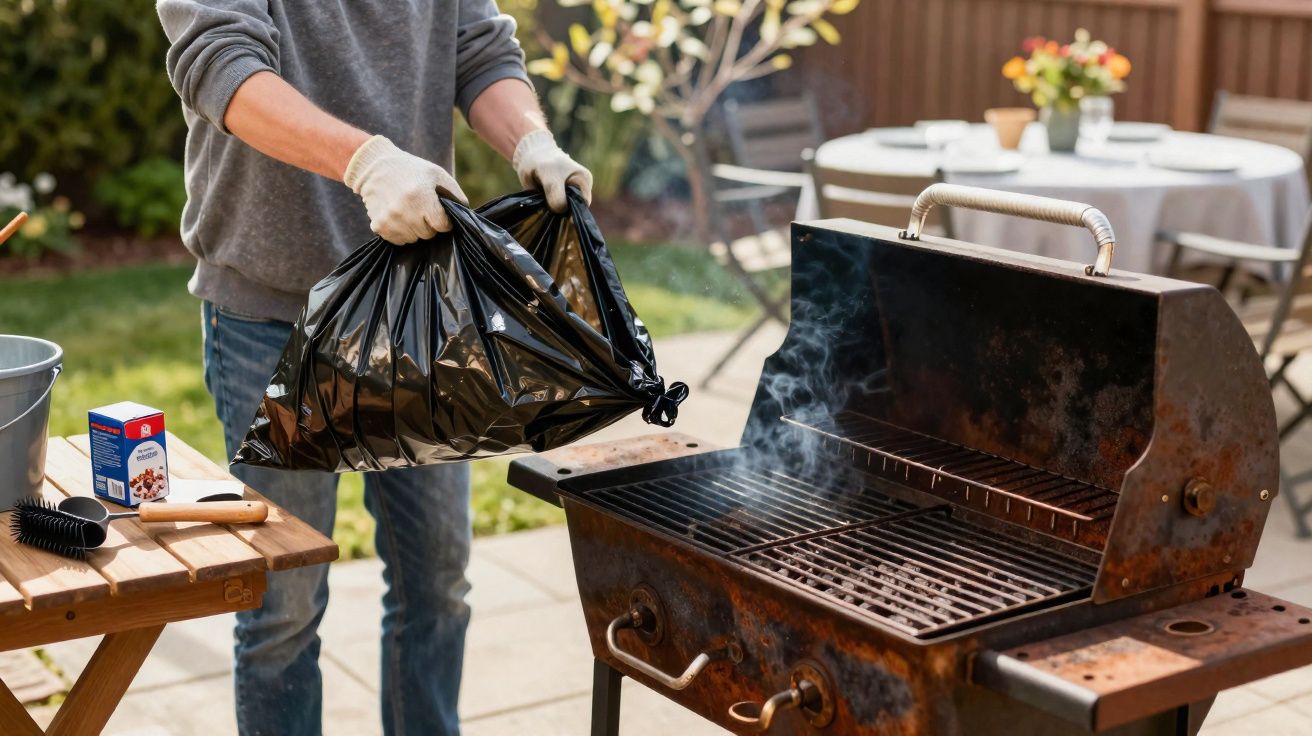
Plenty of people reach for the laptop in frustration and start searching for a new grill grate. Others resign themselves to hours of scrubbing with harsh cleaners. Yet the fix is often hiding in plain sight in the kitchen cupboard: a household staple, boiling water and a sturdy bin bag. Get the order right and follow a few safety rules, and even a rusty grate can look surprisingly respectable again-without any specialist chemicals.
Why the grill grate rusts so quickly
A grill grate feels tough enough to cope with heat, grease and heavy food. But once it’s put away, it can be far more vulnerable. If you store the grate damp inside a closed barbecue, or leave it outdoors under a tight cover, you’re effectively creating perfect conditions for corrosion.
Moisture sits on the metal bars, while old fat and marinade form a film over the surface. Under that layer, water doesn’t dry easily. Add oxygen and exposed steel, and you have the ideal three-part recipe for rust.
The problem is more than cosmetic. A roughened surface makes meat stick more readily, and grime clings on stubbornly. With each season, more residue bakes on, the grate looks duller, and individual bars can even start to warp.
"Removing rust early noticeably extends the life of the grill grate and prevents major jobs later during the spring clean."
The surprising solution from the cupboard
Rather than buying expensive barbecue cleaners or handling strongly caustic products, this straightforward approach relies on two ingredients: boiling water and washing soda (also known as crystal soda). This powder is commonly sold alongside laundry and cleaning products and typically costs only a few pounds.
Mixed with very hot water, washing soda loosens baked-on grease and softens rust deposits so they’re much easier to shift. To make it work with larger grill grates, you add a third helper that most households already have: a thick bin bag.
Step by step: how the bin-bag method works
The process looks almost too simple, but it takes the dread out of cleaning the barbecue. What matters most is setting everything up calmly before you start.
- Brush the grate dry to knock off loose, burnt-on debris.
- Get a bin bag or a large tub ready-ideally heat-resistant and robust.
- Pour in very hot water, ideally boiling.
- Add washing soda according to the instructions on the packet and dissolve it thoroughly.
- Place the grill grate fully into the liquid and tie the bag shut.
- Leave it to work for several hours, preferably overnight.
- The next day, scrub the grate with a stainless-steel scourer or a brush.
- Rinse with clean water and dry immediately and thoroughly.
Because the solution has time to work, it does most of the hard labour for you. Stuck-on grease swells and loosens; rust marks turn dull and can be removed far more easily with a bit of mechanical scrubbing.
"The real ‘hands-on time’ is just a few minutes of prep and finishing-the hot washing-soda mix does the rest overnight."
Safety: how to protect skin, eyes and the barbecue
Washing soda is strongly alkaline. It’s a trusted household product, but it can irritate skin and eyes. When using it, a few simple precautions are worth taking seriously.
- Wear rubber gloves, especially when mixing the solution.
- Avoid splashes: sprinkle it in slowly and stir carefully.
- Keep children and pets away while the grate and solution are standing around.
- Only use fully dissolved crystals so no granules are left sitting on the metal.
If you have enamelled or coated grates, check the manufacturer’s guidance first. Some coatings can be sensitive to strong alkaline solutions. In those cases, reduce the soaking time and use a less abrasive sponge.
When the method makes sense-and when it doesn’t
Many owners wonder whether a grate covered in rust spots can still be trusted. It depends on how far the metal has deteriorated. Surface staining, a light brown haze and a few stubborn patches can usually be treated successfully.
It becomes a concern when bars are visibly distorted, look thin, or start crumbling in places. At that point, the grate has lost a significant amount of its material.
| Visual condition | Recommended action |
|---|---|
| Light surface rust, some grease | Bin-bag method is sufficient |
| Thick crusting, several rust patches | Washing-soda clean, then inspect carefully |
| Loose bars, flaking | Replace the grate; do not continue using it |
As soon as metal starts flaking off, the risk increases that particles could end up on food. Then replacing the grate isn’t just about appearance-it’s a safety issue.
How to prevent new rust effectively
A freshly cleaned grate only stays that way if it’s stored correctly, and that starts straight after a barbecue.
While the grate is still warm (but no longer hot), cooking residues lift off most easily. A wire brush or a dedicated barbecue-cleaning pad is often enough to remove the worst of the dirt. After that, a quick wash with hot water helps.
Drying is the decisive step. If you slide the grate back into the barbecue wet and close the lid, you’re inviting the next wave of rust. Better: wipe it down thoroughly with a tea towel, then leave it in the air for a few minutes.
Many grilling enthusiasts swear by a very thin film of cooking oil before storage. With a sheet of kitchen roll and a little sunflower or rapeseed oil, you can apply a fine coating that helps keep moisture away from the metal.
"A dry grate with a whisper-thin oil film, stored in a ventilated, sheltered place, rusts far less often."
Where you store the barbecue also matters. A dry shed or cellar with some air circulation is ideal. If you use covers or tarpaulins, don’t let them sit tight to the ground-otherwise moisture can become trapped.
What washing soda actually is
The term “crystal soda” sounds highly chemical, but it has a long history as a practical household cleaner. It refers to sodium carbonate, a salt that reacts strongly as a base. Dissolved in water, it forms an alkaline solution that breaks down fats and softens stubborn dirt.
Compared with heavily chlorine-based products, the solution smells fairly neutral. It attacks organic deposits when the concentration, contact time and temperature are right. On metal, this is usually manageable-provided you rinse thoroughly with clean water afterwards.
If you’re sensitive to fragrances and additives, washing soda can be a relatively straightforward alternative. Many packs contain no perfume or colourants, which can suit people with allergies.
A practical scenario: firing up the grill after winter
Imagine the barbecue sat on the balcony all winter, covered but damp. When the first sunny day arrives, you find a grate with dark crusts and orange-brown spots. In that situation, a quick brush-down rarely does the job.
A practical plan is this: in the evening, scrape the grate dry with a wire brush, then place it in the prepared bin bag filled with hot washing-soda water. Leave it overnight. The next morning-before guests arrive-a sturdy sponge, a hose and a towel are usually enough. That leaves your time at the barbecue for what matters: steaks, vegetable skewers and perhaps a piece of halloumi.
How to combine the method with other tricks
Some barbecue fans also use household remedies such as baking powder, vinegar or citric acid. These substances work differently: acids help with limescale and some types of rust, while alkaline cleaners like washing soda are best at cutting through fats and organic grime.
If you want to combine approaches, keep one rule in mind: don’t mix acids and alkalis together in large amounts, because they neutralise each other. A better option is to use them in sequence-start with the washing-soda soak for grease and general dirt, then, if needed, briefly follow with an acidic cleaner for persistent rust spots.
If you have stainless-steel grates, you can often get away with much less chemistry. A decent scraper, a bit of washing-up liquid and a shorter washing-soda soak are frequently sufficient. The same bin-bag technique can then be used with a lower concentration.
With a clear view of the material, the condition and the time you have, you end up with a simple cleaning strategy that makes the first barbecue of the season feel easier-and saves an old grate from an unnecessary trip to the tip.





Comments
No comments yet. Be the first to comment!
Leave a Comment