
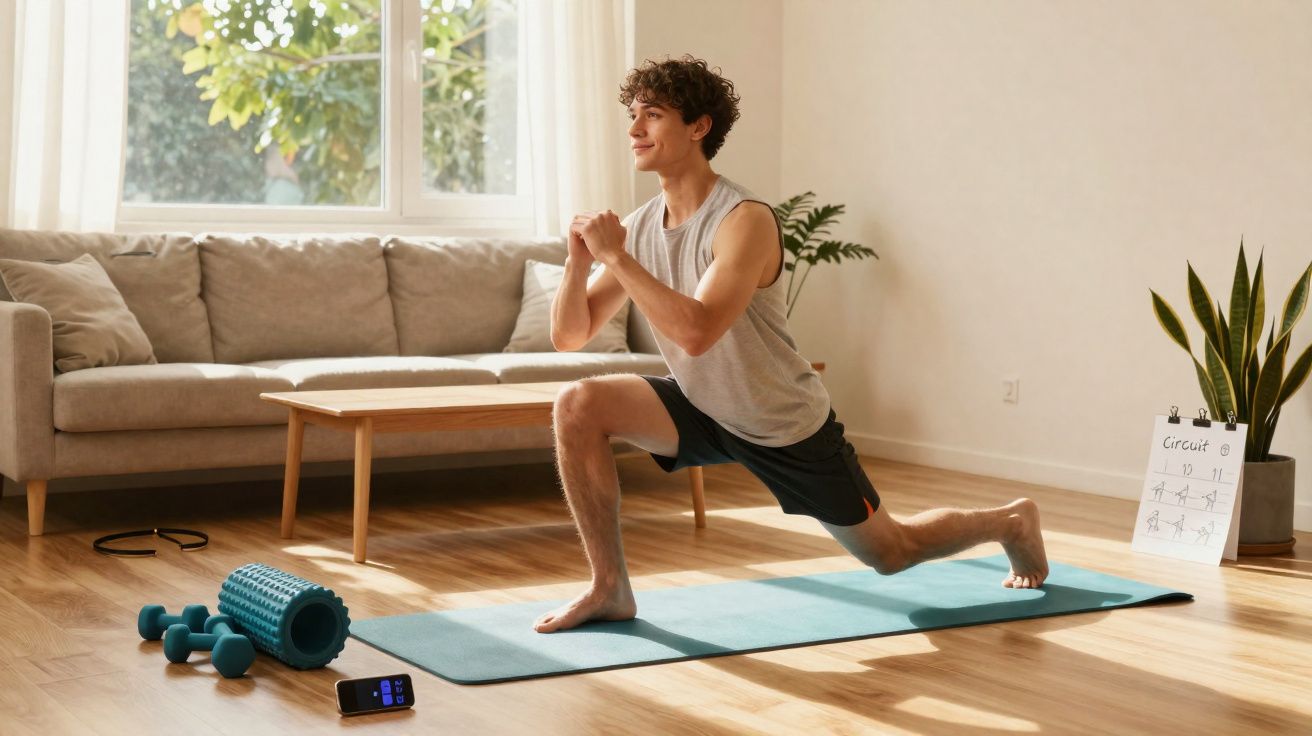
Many people have had enough of it - and are realising they make progress far faster in their own living room.
Rushing through traffic after work, only to fight for a free machine in an overcrowded gym, often burns more nerves than calories. More and more people are turning their backs on that routine and choosing a minimalist training set-up at home. No equipment, no performance pressure - just straightforward moves that challenge the whole body and make a noticeable difference with 15 to 20 minutes a day.
Why training at home works surprisingly well
For many, home workouts initially feel like the “lite version” of proper exercise. In reality, the opposite tends to happen: when you train at home, you do it more often, you make fewer excuses, and you typically develop a better feel for your body.
“The most important resource in training isn’t strength or endurance, but consistency - and that’s easier to achieve in the living room.”
No commute, no hunting for a parking space, no worry about strangers watching. The barrier to simply starting drops to almost nothing. Joggers on, coffee table pushed aside, done. That low “starting friction” is exactly why sessions don’t get skipped just because the day was stressful or the weather is awful.
Mental benefits: less pressure, more staying power
In the gym, it’s easy to compare yourself: Who lifts more? Who looks fitter? At home, that social pressure disappears. That reduces performance anxiety, which helps beginners in particular train with a clearer head. You don’t cut the session short because you’re “too slow” - you finish it at your own pace.
There’s another advantage: a short session before breakfast, ten minutes during your lunch break, a small block in the evening - it fits into everyday life without reorganising everything. After a few weeks, many people notice it’s not the length of the workout that matters most, but how often it happens.
Why bodyweight exercises are so effective
The cliché that only heavy weights build “real” muscle is stubborn - and bodyweight training proves otherwise. These movements usually recruit several muscle groups at once, while also improving stability, balance and coordination.
Take a bodyweight squat in open space: your core, hips and feet have to stabilise continuously. On machines, part of that stabilising work is handled for you. That can be useful, but practical, everyday strength is built more strongly through free movement.
“Bodyweight exercises don’t just change how you look - they build usable strength for everyday life, from carrying the shopping to playing with children.”
Another plus: your joints tend to take less of a beating, as long as your technique is sound. Your body learns to move along sensible patterns. That lowers injury risk and improves posture - a genuine issue for anyone who sits a lot.
The 10-exercise circuit: turn your living room into a mini training zone
The programme below targets the entire body and needs no equipment. You can run it as a circuit: each exercise for 30 to 45 seconds, 15 seconds rest, one to three rounds depending on your level.
Block 1: get your legs and cardiovascular system going
This block focuses on the lower body and your heart and lungs. It’s ideal at the start because it warms you up quickly.
- Squats: Feet shoulder-width apart, push your hips back as if sitting on a chair, keep your back tall, heels on the floor. Builds thighs and glutes, improves stability.
- Reverse lunges: Step one leg well back, keep the front knee over the ankle, then switch. Trains glutes and legs, improves balance and - with good form - is kinder on the knees.
- High knees on the spot: At a brisk pace, alternate pulling your knees towards your chest while your arms swing. Great for raising your pulse without needing much space.
- Glute bridge: Lie on your back, feet hip-width apart, drive your hips up, squeeze your glutes, hold briefly, lower. Activates the posterior chain and eases that “office sitting” feeling in the lower back.
- Side steps or jumping jacks: If you have joint issues, choose quick side steps with softly bent knees; more advanced trainees go for classic jumping jacks. Both options get oxygen flowing.
Block 2: strengthen your core and upper body
After the lower body comes the control centre: the core and shoulder girdle. Good technique is what separates progress from frustration here.
- Forearm plank: Elbows under shoulders, body in a straight line from shoulders to heels, brace your core, avoid a sagging lower back. Protects your back long term and strengthens deep core muscles.
- Press-ups: Hands slightly wider than shoulder-width, lower your chest towards the floor, don’t flare your elbows completely out. Easier options: against a wall or with knees on the floor.
- Superman: Lie on your stomach, extend arms forwards or out to the sides, lift upper body and legs a few centimetres. Trains spinal erectors, glutes and shoulders - a counterbalance to slumped sitting.
- Chair-edge dips: Hands on the edge of a stable seat, feet on the floor, hips just in front of the chair, bend and straighten your elbows. Targets the backs of the upper arms in particular.
- Mountain climbers: From a press-up position, dynamically alternate driving your knees towards your chest. Hits abs, shoulders and conditioning at the same time.
How to progress your training sensibly
Your body adapts fairly quickly. If the ten exercises barely challenge you any more, that’s a good sign - and exactly when you should start adjusting the dials.
Simple but effective: tempo, rest, variations
You can change three levers without any equipment:
| Lever | Example | Effect |
|---|---|---|
| Tempo | Lower slowly in the squat, rise explosively | More muscle tension, stronger burn, better stimulus |
| Rest | Reduce recovery from 30 seconds to 15 seconds | Heart and lungs work harder, fitness improves |
| Variation | Turn lunges into jumping lunges | More power, coordination and leg work |
You can also make the plank tougher: lift one foot or one arm at a time without letting your lower back collapse. Your obliques will feel it immediately. For press-ups, bring your hands closer together to involve the triceps more.
“Progress rarely comes from brand-new fancy exercises - it comes from small, smart tweaks to the basics.”
How the 10-exercise circuit fits into your day
A lot of people quit because they think they need an hour per session. With a packed schedule, 15 to 25 minutes is far more realistic - and that’s exactly what this programme is built for.
Possible split:
- Three sessions per week using all ten exercises as a full circuit.
- On two extra days, do only Block 1 or only Block 2 as a 10-minute “mini workout”.
- One deliberate day off - a walk is enough.
That way, you accumulate several short training stimuli without leaving your body permanently overloaded. If you’re starting from scratch, begin with one round and gradually work up to two or three.
Common mistakes and how to avoid them
Three stumbling blocks show up especially often in home training:
- Starting too fast: If you try to blast through three rounds after months off, you risk frustration and heavy soreness. Better: stay deliberately below your limit and build up.
- Ignoring technique: Knees collapsing inward on squats or an arched lower back in the plank often comes back as pain. Go slower, but do it properly.
- All or nothing thinking: Missing one session isn’t a disaster. Just don’t let one day turn into a week.
What to watch for with breathing, recovery and combining sessions
Many people instinctively hold their breath when it gets tough. A better approach: exhale during the hard part (for example, when pressing up in a press-up), inhale as you lower. That helps you stay stable and can prevent head pressure.
Recovery belongs in the plan. Sleep, easy walks and enough fluids help your muscles adapt. If you like, you can combine the programme on two days with easy runs, cycling or swimming - as long as your joints feel good and your heart rate settles back to normal.
What matters in the end isn’t a perfect set-up with dumbbells, mirrored walls and neon lighting, but your ability to stick to your own plan. Give your living room ten clear exercises and repeat them consistently, and you’ll quickly notice: for a strong, mobile body, you often need less - just the decision to genuinely begin.




Comments
No comments yet. Be the first to comment!
Leave a Comment