
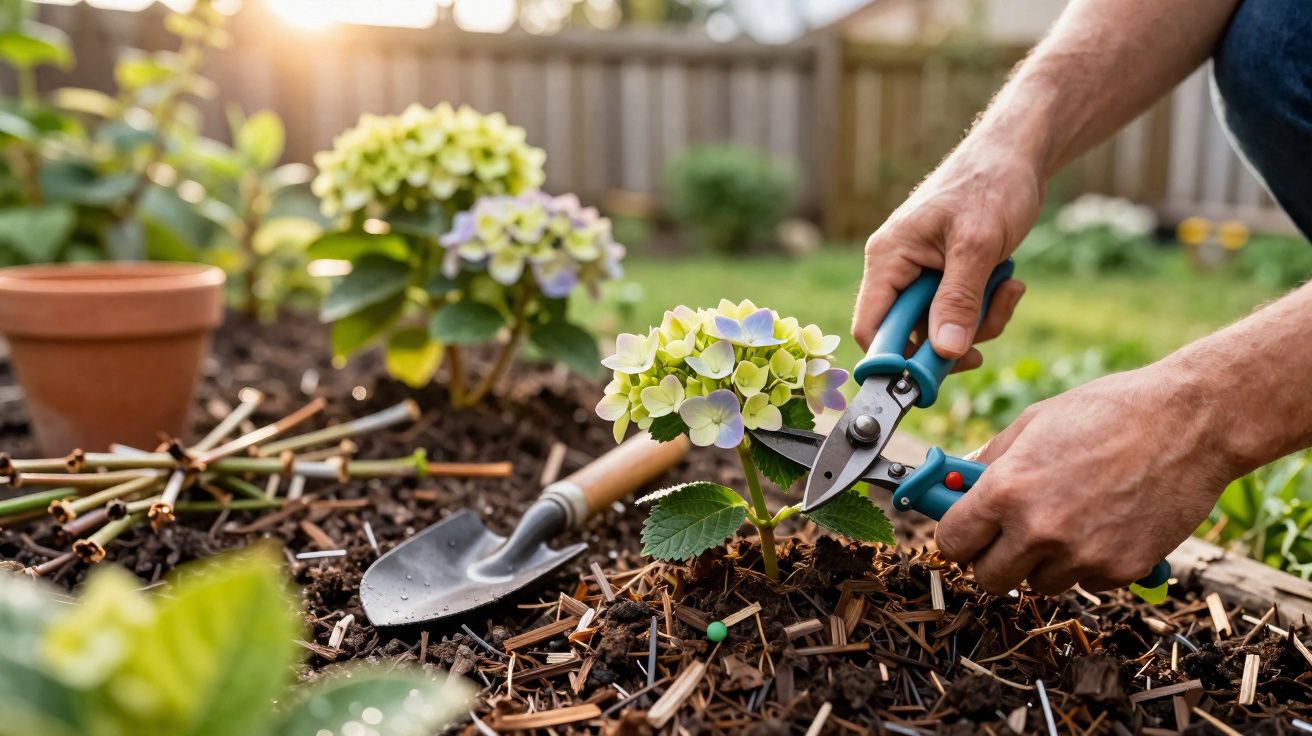
If you find yourself hoping for a floral explosion every year only to be left with a few tired-looking flower heads, the problem is usually not that you have done too little, but that you have done the wrong thing at the wrong time. British gardening expert Monty Don relies on a simple March routine that most people overlook, yet it consistently produces more flowers.
Why March decides how well your hydrangeas flower
Hydrangeas are often treated as easy-going shrubs that will still perform in partial shade. Even so, many plants remain surprisingly sparse in summer. Very often, the reason is a misunderstanding: tidying up is being mistaken for proper care.
This is especially true of the widely grown mophead hydrangeas, or Hydrangea macrophylla, which set their flowers on so-called “old wood”. In other words, the buds for next summer are formed the previous year and sit on the stems throughout winter.
If you cut away all the faded growth enthusiastically in late winter, you often remove those buds as well. The plant will still leaf up and look healthy, but the flowers will be gone.
The crucial point is not what you cut, but when you cut it and exactly where you place the secateurs.
Monty Don therefore recommends leaving the faded flower heads on the plant right through winter on purpose. They offer the delicate buds beneath a little protection from frost and wind. Only in March, once the hardest frosts have passed and the buds are clearly swelling, is it time to prune.
How Monty Don prunes in March, step by step
The main difference lies in a very precise cutting point. This is not about “tidying” the hydrangea, but about saving as many flower buds as possible.
Use clean, sharp secateurs for the job. Wiping the blades before you start helps reduce the risk of spreading disease from one stem to another, especially if any shoots have been damaged by winter wet or frost.
The correct cutting point on the flower head
Monty Don advises cutting each old flower back only very slightly:
Make the cut just above the uppermost strong pair of buds beneath the dried flower head.
That removes the dead flower and the often slightly frost-damaged shoot tip, while leaving the two sturdy buds in place. Those buds are the ones that will produce this year’s blooms.
- Wait for a mild, frost-free day in March.
- Find the old, dried flower head on each stem.
- Locate the first strong pair of buds underneath it, with two buds opposite each other.
- Use sharp secateurs to cut a few millimetres above that pair of buds.
In many hydrangeas, that really is all that is needed. Where some gardeners remove half the shrub, Monty Don limits himself to a few exact cuts.
When you can cut more heavily
Beyond removing the flower remains, March is only about keeping the plant in good health:
- remove any stems that are completely dead, cutting them back to ground level
- cut out very thin, weak stems
- take out a few older, tired stems to make room for younger growth
Monty Don saves real rejuvenation pruning - the kind that reduces the plant much more severely - for straight after flowering in late summer. By then, next year’s buds have not yet formed, so the shrub can rebuild without losing the coming season’s flowers.
The overlooked trick: mulching for stronger buds
Pruning is only half the story. What happens at the base of the shrub over winter and in the very early spring matters just as much. Monty Don has relied for years on a simple approach: a thick layer of mulch around the base of the plant.
He uses well-rotted organic material such as:
- mature garden compost
- mushroom compost
- bark mulch, ideally pine bark for hydrangeas
A mulch layer around 5 to 10 centimetres deep helps protect buds, holds moisture and releases nutrients slowly to the plant.
Apply the mulch on a cool but frost-free day in January or early March. The soil should not be frozen or completely waterlogged. Most importantly, leave the plant’s crown - the immediate area around the stem - clear. If mulch is piled up against the stems, it can lead to rot and frost damage on young buds.
What mulch actually does
The mulch layer performs several jobs at once:
- Frost protection: the soil does not freeze as deeply, so fine roots and buds suffer less damage
- More even moisture: the ground dries out less quickly in spring, so the plant is under less stress
- Slow nutrient release: as it breaks down, the mulch feeds the hydrangea where it needs it
- Less weeds: competition for water and nutrients is greatly reduced
Monty Don even suggests mulching one part of the garden properly rather than spreading a thin layer everywhere that barely makes any difference.
Typical mistakes that cost flowers
Many supposed care routines actually do harm. Three common mistakes show up again and again in gardens:
- Pruning too early: hydrangeas “tidied” in December or January often lose most of their buds
- Hard pruning back into old wood: cutting shrubs hard can easily remove the shoots that carry the flower buds
- Fresh mulch right against the stem: unrotted bark or grass clippings are often put too close to the base and damage buds and bark there
That is why many hydrangeas look healthy but flower poorly - the cause is often months earlier, in the secateurs and the wheelbarrow.
How different hydrangea types respond
To make the March trick work properly, it helps to know the main groups found in home gardens:
| Hydrangea type | Example | Flowers on | Pruning approach |
|---|---|---|---|
| Mophead hydrangea | Hydrangea macrophylla | old wood | only cut off the faded flower above the bud pair; stronger pruning after flowering |
| Smooth hydrangea | Hydrangea arborescens, for example ‘Annabelle’ | new wood | can be cut back hard in late winter and still flower generously |
| Panicle hydrangea | Hydrangea paniculata | usually new wood | prune moderately to hard in late winter to control shape and size |
Monty Don’s method is aimed above all at mophead hydrangeas, which dominate so many front gardens. If you do not know which variety you have, it is usually safer to leave a little more wood in place until the plant shows you in summer how it flowers.
A simple rule of thumb is to observe where the buds sit before making any big decisions. If you can see plump buds near the tips of last year’s stems, tread carefully; if the shrub flowers later on fresh growth, it is usually far more forgiving.
Practical examples for your own garden
If you want to test the principle, compare two shrubs in the same border: care for one using Monty Don’s method and prune the other in your usual way. After one summer, the difference in flower numbers is usually clear - as is the size of each individual bloom.
Many amateur gardeners report that the whole appearance of the border changes after just one year: instead of lots of long, leafy shoots with only a few heads, the plants produce more compact, sturdier stems carrying densely packed flower balls.
Other factors that help hydrangeas bloom well
Alongside pruning and mulch, a few other conditions play an important part:
- Water: hydrangeas need consistently moist soil in summer. Short dry spells quickly lead to drooping leaves and smaller flowers.
- Position: bright partial shade is ideal, such as on the north or east side of a house. Strong midday sun puts the plants under stress.
- Feeding: a light, balanced general fertiliser in spring is often enough. Too much nitrogen encourages leafy growth rather than flowers.
If you get these basics right and make the March trick part of your routine, your hydrangeas should become more reliable year after year. In smaller gardens especially, every extra bloom makes a difference - and it often appears simply because the secateurs were placed a few centimetres higher at exactly the right moment.
Comments
No comments yet. Be the first to comment!
Leave a Comment