
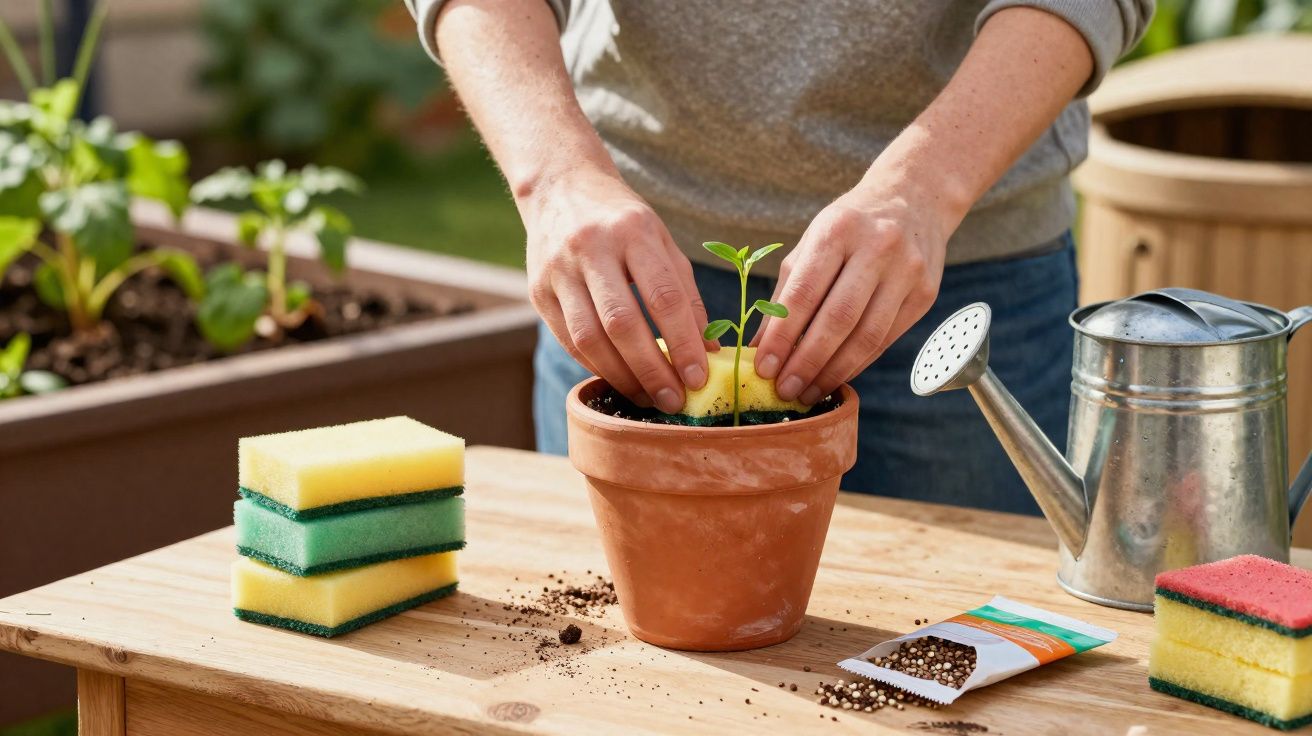
While gardeners are still dealing with changeable weather and irregular watering, one everyday helper usually ends up in the bin without a second thought: the old dish sponge. Gardening experts now recommend not throwing it away, but putting it to work in beds, pots and the compost heap as a small water store and a simple way to cut waste.
Why a Used Dish Sponge Helps Thirsty Plants
In spring, many plants are pushing out fresh growth, roots are still delicate, and the soil dries out quickly whenever wind picks up or the sun breaks through. At the same time, watering on a regular schedule is not always possible, especially for window boxes and container plants.
That is exactly where a discarded dish sponge can help. Its porous structure acts like a miniature water tank:
Placed in a pot, the sponge stores excess watering water and releases it back into the soil little by little, making it ideal during sudden dry spells.
If you place a sponge at the bottom of a pot, directly above the drainage holes, and cover it with soil, several things happen:
- the sponge soaks up surplus water instead of letting it run straight through
- the soil stays moist for longer without becoming permanently waterlogged
- roots are less likely to suffer from sudden moisture stress
- window boxes cope better with wind and the first hot spells of the year
For anyone who cannot water every day or who is away often, that extra buffer can make a real difference. It will not replace weeks of proper watering, but it can buy plants a valuable few extra hours until the next soak.
A further advantage is that this method can be tailored to the size of the container. In small pots, even a single strip of sponge can help steady moisture levels, while larger tubs may benefit from several pieces distributed across the base layer. That makes the trick especially useful on balconies and patios, where containers dry out far faster than garden soil.
Sponge as a Compost Moisture Store and Compost Booster
It is not only potted plants that benefit. Compost also dislikes being bone dry or soggy. Microorganisms work best when the heap stays slightly damp, roughly like a wrung-out sponge.
A sponge can take on exactly that role in the compost, provided it is made from the right material.
Natural sponges help to stabilise moisture in the compost while also improving aeration, which is a plus for earthworms and microorganisms.
If you cut a natural sponge into rough chunks and mix it through kitchen scraps, grass clippings or leaves, several effects follow:
- it absorbs excess moisture from wet kitchen waste
- it slowly releases moisture when conditions become too dry
- it creates small air channels through the heap
- it helps balance wet, nitrogen-rich material with dry structural matter
As a result, the compost heats more evenly, breaks down more effectively and smells less likely to turn rotten. Over time, a sponge made from natural material will itself decompose into humus.
Which Sponges Belong in the Garden - and Which Do Not
Material is the deciding factor. Not every dish sponge is suitable for soil or compost.
| Sponge type | Use in soil | Suitable for compost |
|---|---|---|
| Natural fibre (cellulose, loofah gourd) | suitable | suitable |
| Classic yellow plastic sponge | limited use only; do not bury in a vegetable garden | not suitable |
| Sponge with scouring side (green/blue) | only as a short-term water buffer; do not bury in beds | not suitable |
Natural sponges made from cellulose or loofah gourd break down over time and fit well with garden and compost projects. By contrast, ordinary plastic sponges contain synthetic materials and often additives that do not belong in the soil.
If you use synthetic versions, they should be limited to temporary use in pots as a short-lived water reserve, and then removed again. They should not go into beds, raised beds or compost intended for vegetables.
How to Make a Kitchen Sponge Suitable for Gardening
Before a used dish sponge goes into the garden, it needs a thorough clean. In the kitchen it collects grease, washing-up liquid residue and, above all, bacteria.
A damp sponge can become an ideal breeding ground for germs in a very short time, so it is better off outdoors than beside the sink.
To keep it from harming the environment, it should first be “de-kitchened”:
- rinse the sponge thoroughly under hot water until no suds remain
- boil it in a pan of water for a few minutes, or pour boiling water over it
- optionally soak it in a little household vinegar to reduce residue
- let it dry properly and label it clearly as “garden use only” or store it separately
After that, it should never return to the kitchen. It has effectively changed jobs, moving from the sink to the bed.
Four Clever Ways to Use a Sponge in Spring
1. Water Reservoir at the Bottom of a Pot
One or more sponges can be placed right at the bottom of a pot, directly above the drainage layer of gravel or expanded clay pellets. They cover the drainage holes, are topped with soil and work, quite literally, like a sponge in a flowerpot.
This is especially practical for:
- window boxes in full sun
- hanging pots that dry out quickly
- herbs and summer flowers with a high water demand
2. Support for Even Germination
Small pieces can also be used for raising seedlings. If you cut cubes from a natural fibre sponge, you can press one seed into each cube. The pieces are then placed in a tray, moistened and kept damp regularly.
As soon as the young plant has reached a few centimetres in height, the whole cube, seedling and all, can be moved into a pot or into the bed. The cube stays in the soil at first, keeping the area around the young root ball moist, and natural material breaks down slowly over time.
3. Moisture Protection and Mini Insulation
A sponge laid flat on the soil around a sensitive plant can act like a small shield. Secured with a stone or a wooden stake, the top layer helps reduce evaporation slightly and can soften the effect of very light late frosts.
If you like, you can treat the sponge with a few drops of essential oils that pests tend to avoid, such as clove or lavender. It is no substitute for proper pest control, but it can be one part of a gentle plant-protection approach.
4. Moisture Anchor in the Compost Heap
Only natural sponge pieces should go into a compost heap or compost bin. Mixed in with the material, they act as a lasting anchor for moisture. When the surface of the heap dries out, the inner zones stay active for longer thanks to the sponges.
How to Tell When the Sponge Has Reached the End of Its Life
Even in the garden, an old dish sponge will not last forever. If you use one, check its condition from time to time. Warning signs include:
- a strong, unpleasant smell
- visible mould growth
- material that crumbles into flakes
For natural sponges without washing-up liquid residue, the remains can go into the compost if you do not want them left in the vegetable bed. Plastic sponges belong in the residual waste bin as soon as they become brittle. Otherwise, they will just break down into ever smaller fragments.
Combining the Trick with Other Water-Saving Ideas
The sponge trick works especially well when it is part of a wider watering plan. Useful additions include:
- mulching with bark chips, grass cuttings or straw so the surface dries out more slowly
- watering in the early morning or late evening
- collecting rainwater in barrels or cisterns
- choosing plant varieties that cope better with dry spells
Anyone who combines these strategies not only saves tap water, but also helps plants avoid the stress caused by constant swings between wet and dry conditions.
For many amateur gardeners, the idea of burying a dish sponge may sound a little odd at first. But after the first hot days of the year, it often becomes clear that pots with an extra water reserve cope much more reliably through the critical periods. And as a bonus, part of the kitchen waste gets a useful second life - right where every drop of moisture matters.


Comments
No comments yet. Be the first to comment!
Leave a Comment