
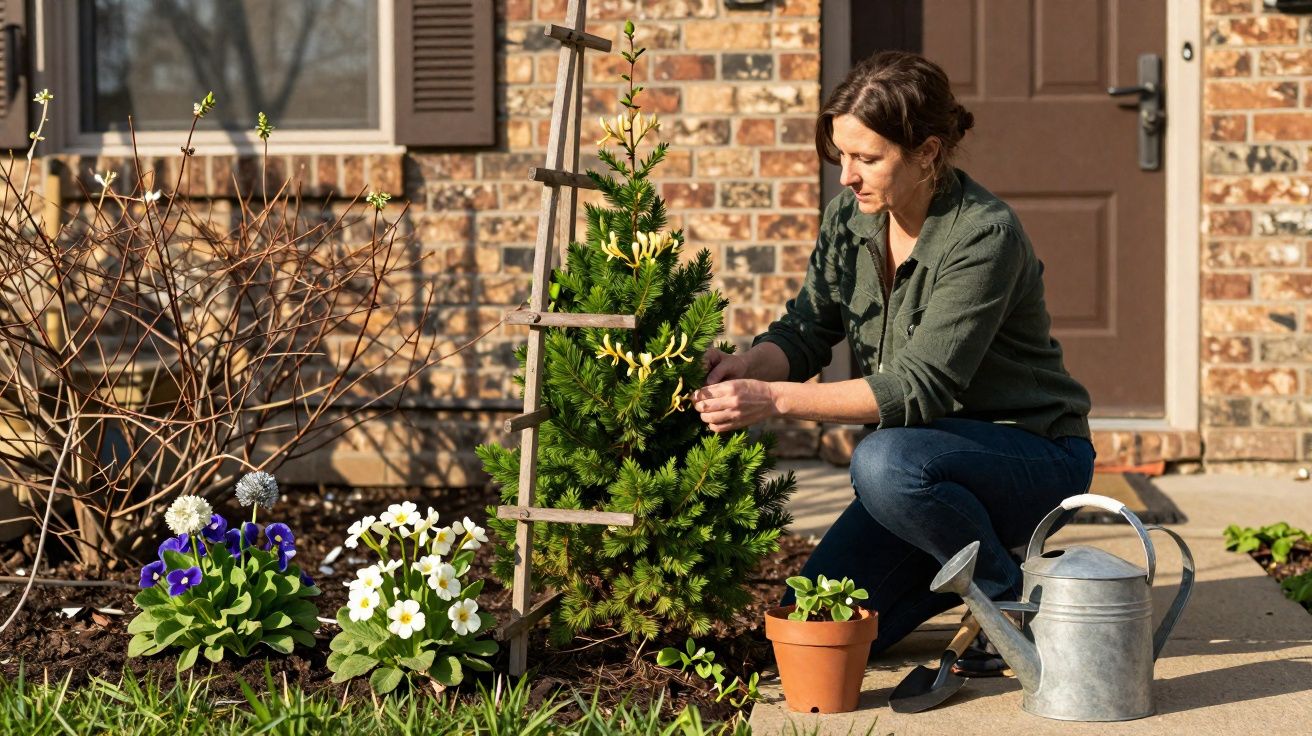
Many homeowners know the feeling: spring brings movement to the borders, yet the area right outside the front door still feels oddly uninspiring. There is little structure, not much greenery and hardly any fragrance. If you do not want to spend hundreds of pounds on new pots, beds and paving, you may be looking for a plant that delivers maximum impact for relatively little effort. That is exactly where an evergreen climber comes in - one that has long been a well-kept secret for hummingbird gardens in North America and is just as appealing here.
Why the front garden needs a vertical focal point
The front garden is the house’s calling card. Even so, it often receives very little attention: a bit of lawn, perhaps a box hedge, two containers - and that is about it. The main issue is that everything stays low, so the eye has nowhere to settle. By introducing a climbing plant, you naturally draw the gaze upwards and create a greater sense of depth.
An evergreen climbing plant brings structure, fragrance and life to the doorstep all year round.
Evergreen honeysuckle, botanically known as Lonicera, is particularly well suited to this role. These climbers keep their leaves through winter, grow rapidly over trellises, frames or pergolas, and flower from spring into late summer. The result is a green curtain that softens bare walls, frames the entrance and provides valuable habitat for insects and nectar-feeding birds.
The strengths of evergreen honeysuckle
If it is planted in April, a well-chosen specimen gets off to a strong start. Many varieties produce tubular flowers in yellow, cream, pink or orange, while some even show bright red blooms. In North America, hummingbirds are the main visitors, hovering like tiny helicopters in front of each flower. Their long beaks and tongues fit these tubular blossoms perfectly.
In Central Europe, no hummingbird performs that role, but the principle is the same: the flowers are rich in nectar and act as a refuelling station for insects. Bumblebees, solitary bees and butterflies benefit especially. If you garden with wildlife in mind, you will also attract local insect-eating birds that come to the honeysuckle in search of food.
Experts note that nectar-rich tubular flowers can be visited by some birds at rates of well over 1,000 blooms a day - a true all-you-can-eat buffet.
A scent you notice as soon as you reach the front door
Many evergreen honeysuckles are strongly scented. Their flowers give off a sweet aroma that is often compared with honey and vanilla. The fragrance usually becomes even more noticeable in the late afternoon and evening. Placing an arch near the entrance or mounting a trellis beneath a bedroom window means you can enjoy the effect almost like a natural perfume.
Another advantage is that the foliage remains on the plant through winter, either dense or slightly translucent depending on the variety. That means the front garden does not look completely bare even in January. At the same time, the honeysuckle offers hiding places for birds such as sparrows and tits that are looking for shelter from weather and predators.
Planting, soil and care: how to get started in April
April is an ideal month for planting evergreen honeysuckle. The soil has already warmed up, frost is becoming less of a concern at night, and the roots can settle in properly before summer heat arrives.
- Light: 6–8 hours of sun a day produces the strongest flowering.
- Soil: rich in humus, loose and well drained - no waterlogging around the roots.
- Climate: many varieties perform well in temperate regions, roughly in hardiness zones 5 to 9.
If you want results quickly, choose a container-grown plant that is already two to three years old from the garden centre. By that stage, many honeysuckles are reliably capable of flowering. Younger plants will also establish well, but they often need an extra year before they really begin to perform.
Before planting, it is worth soaking the root ball thoroughly and improving the planting hole with compost if the soil is thin or tired. A generous mulch helps to hold in moisture and keeps the roots cooler through the first summer, especially on a sunny front garden bed or against a warm wall.
Key care steps at a glance
- Watering: keep the plant evenly moist during the first year; after that, it can cope with short dry spells.
- Feeding: support growth in early spring with an organic all-purpose fertiliser or well-rotted compost.
- Pruning: trim lightly after the main flowering period in summer to maintain the shape.
- Support: always plant it beside a trellis, arch, pergola or obelisk, and tie in young shoots as they grow.
Container growing works just as well. A large, sturdy pot with drainage holes and a support fixed in the centre is enough to create a green column that emphasises the entrance. In pots, regular watering is essential because the compost dries out more quickly.
Turn the front garden into a nectar corridor
If you avoid chemical sprays, an evergreen honeysuckle can turn the front garden into a genuine nectar highway. The plant blooms for many weeks, sometimes in waves, and therefore supplies food continuously.
A single, well-placed honeysuckle can make the difference between a dead corner and a lively front garden full of buzzing life.
The effect is even stronger when you combine the honeysuckle with other nectar plants. The best choice is a sequence of varieties that flower at different times, so that there are hardly any gaps from April to October.
Good companion plants for a wildlife-friendly entrance scheme
- Early in the year: crocuses, pulmonaria, grape hyacinths.
- As the honeysuckle gets going: ornamental onions, catmint, cranesbill.
- Midsummer: lavender, coneflowers, agastache.
- Late summer: sedum, autumn asters, autumn anemones.
A mix of different flower shapes and colours is important. That way, short-tongued bumblebees, butterflies with proboscises and nectar-seeking birds all find suitable refuelling stops.
Choosing a variety: native beats exotic
Garden specialists point out that, in many regions, native or well-adapted varieties are used much more heavily by pollinators than exotic ones. In some cases, it is possible to record up to four times as many visits when plants are suited to the local climate and wildlife.
So if you choose a garden-centre hybrid with enormous but sterile flowers, you will not be helping wildlife very much. More useful are robust varieties that genuinely provide nectar and pollen for insects and birds. It is well worth asking your local garden centre for honeysuckle varieties labelled as bee-friendly or suitable for wildlife gardens.
Risks to keep in mind
As with many vigorous climbers, honeysuckle can really take off when conditions are good. Without pruning, it may sprawl over downpipes, reach into gutters and smother neighbouring plants. That is why giving it a trim once a year is part of the job.
Some species are considered invasive in certain countries because they spread uncontrollably. In German-speaking regions, this is mainly a concern with particular imported species. Choosing regionally recommended varieties and, where necessary, removing spent seed heads significantly reduces the risk.
Clever ways to place evergreen honeysuckle
The plant becomes even more effective when you treat it as a design feature from the outset. Three approaches that work well in everyday gardens are:
- A green entrance arch: place two large pots on either side of the front door, each planted with an obelisk and a honeysuckle. The shoots climb upwards and gradually form a living portal.
- A screen instead of a fence: a simple wire boundary fence can look like a green wall when covered with a strip of honeysuckle, without the need for a heavy timber fence.
- A fragrant seating nook: plant honeysuckle around a small gazebo or pergola on the patio. By evening, the space feels like an outdoor sitting room.
If you only have a narrow area available, use the slim strip beside the front door. In many cases, a planting bed just 30 to 40 centimetres wide is enough to create a dense, flowering screen.
Why April is the right time to choose a climber
Perhaps the biggest advantage is this: one carefully placed climbing plant can completely change the character of the front garden. What was once a flat, dull patch becomes a layered space with height, scent and movement. While many perennials are still getting established, honeysuckle visibly gets going from April and makes the transformation feel almost live.
There are also very practical benefits: more food for insects, more cover for birds and less of a view of blank, unattractive walls. If the front garden has been bothering you for some time, April is the moment to make the change - with an evergreen climbing plant that flowers for months and gives the entrance a noticeable lift.






Comments
No comments yet. Be the first to comment!
Leave a Comment