
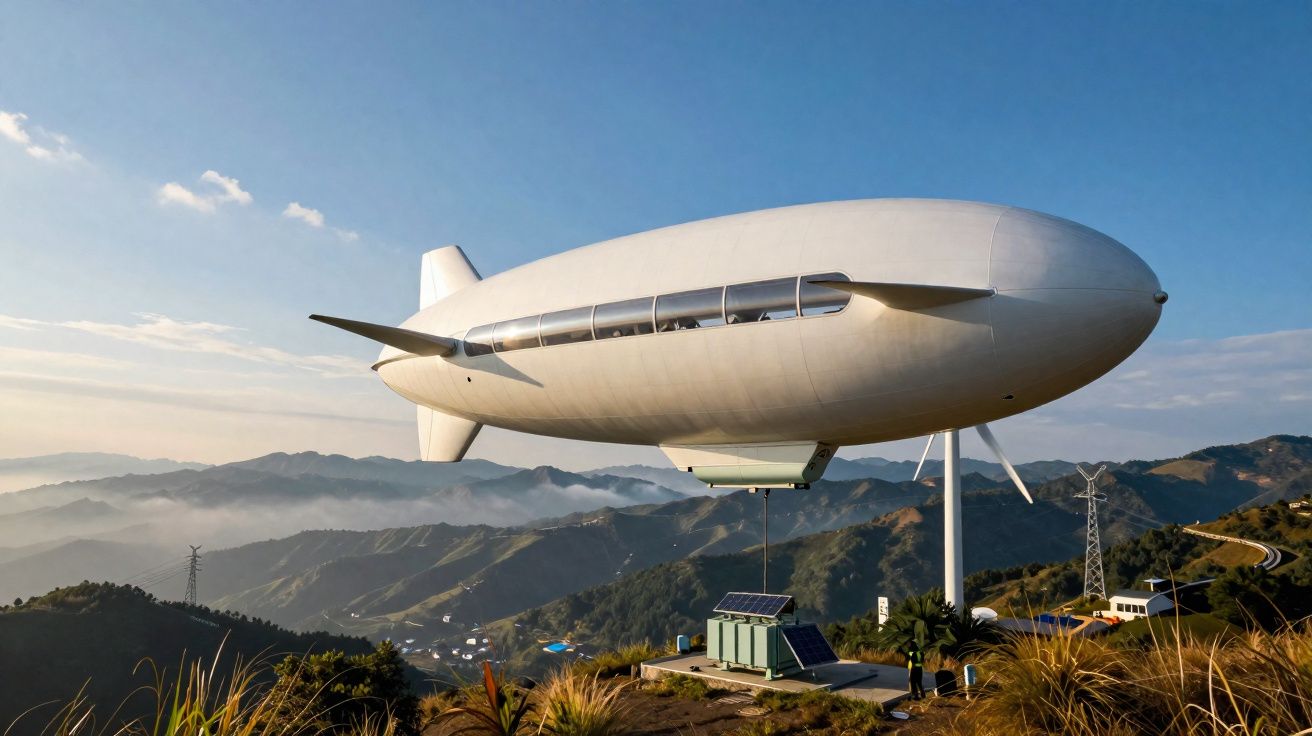
A vast white airship hangs almost silently over a mountainous part of China, held to the ground by a single cable.
At first glance it could be mistaken for an oversized weather balloon. Yet inside its elongated body, turbines spin continuously, converting high‑altitude winds into electricity that travels down the tether and feeds straight into the power grid.
A new milestone for high‑altitude wind power
China has successfully tested the S2000, a wind‑energy system mounted on an airship and operating at roughly 2,000 metres above ground level. Unlike conventional wind turbines fixed to towers on land or offshore, this platform quite literally floats in the sky, anchored by a cable that also carries the electricity it generates.
During a trial near Yibin in Sichuan Province, the S2000 produced 385 kWh of electricity and delivered it directly into the local grid. As a rough comparison, that is close to two weeks’ worth of electricity use for an average household in many developed countries.
The S2000 turns the sky into usable “energy real estate”, avoiding large land take while reaching stronger, more consistent winds.
How the electricity‑generating airship works
Design: balloon, wind tunnel and turbines
The S2000 sits within the field of airborne wind power, but it stands out in one important way: rather than relying on drone‑like wings or giant kites, it uses a helium‑filled aerostat to remain aloft. That lift is passive, meaning it does not depend on motors constantly pushing the system upwards.
That approach leaves more weight allowance and internal volume for the part that matters most: power generation. The platform is about 60 metres long, 40 metres wide and 40 metres high-dimensions comparable to a large onshore wind turbine installation, but with only a small footprint on the ground.
Around the airship’s main body, engineers have formed an annular volume-effectively a ring‑shaped duct. This ring guides air inwards to a set of 12 small wind turbines installed inside.
The ring structure behaves like an aerial funnel, “hugging” the wind and pushing the airflow directly onto the turbine blades.
In practical terms, the S2000 combines three roles in a single airborne platform:
- A helium‑filled lifting balloon that keeps the system at altitude.
- An aerodynamic duct structure that channels and concentrates the wind.
- An electrical generation module, integrating turbines and power‑conversion equipment.
Why operate at 2,000 metres
Close to the ground, wind is messy and unpredictable-disturbed by buildings, hills, forests and constant turbulence. A few kilometres up, airflow is typically steadier and often faster.
Physics explains why that matters. Wind power increases with the cube of wind speed: if wind speed doubles, the potential energy available can rise by as much as eight times. That is why the band around 2,000 metres is so appealing: stronger, more stable wind without the need for enormous towers.
The Sichuan trial: from the sky to the socket
In the Chinese demonstration, the airship took around 30 minutes to climb to its operating height. Once stabilised, it held a near‑fixed position in a hovering state while the turbines produced electricity.
Power travelled back to the ground through the mooring cable, which serves both as the mechanical tether and the electrical transmission line. From there it was fed into the local grid-completing the loop from high‑altitude generation to consumption on the ground.
| Parameter | Approximate value |
|---|---|
| Test altitude | 2,000 metres |
| Platform length | ~60 metres |
| Rated capacity | 3 megawatts |
| Energy generated during the test | 385 kWh |
The stated 3 megawatts refers to the system’s theoretical maximum output. The 385 kWh figure is the energy actually delivered during the trial window. In other words, the test demonstrated the entire chain working end‑to‑end: ascent, stable operation, transmission down the cable and injection into the grid.
Technical challenges and safety questions
The cable that holds everything together
The 2,000‑metre tether is among the most critical-and most demanding-elements of the design. It must withstand wind loads, carry the weight and forces from the platform, and simultaneously conduct electricity safely to the ground.
Any failure here could mean losing the platform, creating hazards on the ground, and interrupting supply. That drives the need for extensive fatigue testing, advanced materials and strict operating procedures-especially during storms or extreme wind conditions.
Air traffic and controlled airspace
A tethered airship connected by a cable of this length introduces a fixed obstacle that must be reflected in aeronautical charts, radar systems and flight planning. The most likely deployment model is to place units in remote areas, military zones, border regions, or locations with tightly managed air traffic.
If expansion were ever contemplated near major cities, it would require close coordination with aviation authorities, designated routes, and probably altitude restrictions within specific air corridors.
Maintenance and costs
A conventional wind turbine can be inspected at tower height using cranes and specialist crews. The S2000 is likely to require a more involved process: bringing the airship down fully, servicing it on the ground, and then launching and re‑stabilising it at altitude.
Those operational steps-combined with sensitivity to weather-could push up the cost per unit of electricity. The central question for analysts is whether the productivity gains from high‑altitude winds outweigh the additional logistical complexity.
The promise is real, but the balance between cost, safety and reliability still has to be proven through years of continuous operation.
Applications: from remote borders to coastal cities
The company behind the S2000 highlights two primary markets. The first is off‑grid locations: military outposts along borders, isolated islands, research stations, and mining sites far from population centres. In these settings, an airship generator could replace part of the diesel generation typically used, lowering fuel spend and reducing exposure to fragile supply chains.
The second market targets a combined approach, where onshore wind farms gain an extra vertical layer. The concept is to run conventional turbines on the ground while adding airships above them to harvest wind in a different band. That is particularly attractive in dense urban regions or anywhere land is scarce and contested.
According to publicly available information, the company has already begun small‑scale production and has signed letters of intent with coastal cities and high‑altitude regions, where upper‑level winds can be especially favourable. It also plans a production base for envelope materials in Zhoushan, aiming to reduce reliance on imported inputs.
What airborne wind power means
The term airborne wind power covers several technologies with a single shared idea: move the generator off the ground and into the sky. Within that umbrella, there are three main families:
- Helium airships or balloons, like the S2000.
- Large kites tethered by cables, flying controlled patterns to generate energy.
- Fixed‑wing drones flying circles or ellipses, converting wind force into electricity.
The S2000 positions itself as a more static solution designed for hovering operation. That can simplify control compared with continuously moving drones, but it also increases the demands placed on the balloon envelope and, especially, on the tether.
Future scenarios and the risks at stake
If systems like the S2000 prove dependable, one can envisage high‑altitude wind farms complementing large solar plants to create hybrid renewable supply in remote areas. In places with harsh winters, the airship could offset falling solar output, operating overnight and during overcast days when strong winds are available.
On the other hand, several risks remain: severe storms, icing at altitude, long‑term wear of envelope materials, and potential visual and noise impacts in tourist regions. Insurers and regulators are likely to play a decisive role in setting safety standards, defining operating limits and determining licensing requirements.
Grid integration and local resilience (additional context)
Beyond the engineering, how airborne wind power connects to the grid will matter. Because output can change rapidly with wind conditions, projects may need on‑site power electronics, curtailment capability, and-where networks are weak-support such as battery storage to smooth delivery and maintain voltage and frequency within acceptable limits.
Environmental and community considerations (additional context)
Although airborne systems can minimise land take, they still require careful siting. Planners will need to consider wildlife interactions (particularly birds and bats), lighting and marking requirements, and community acceptance-especially where the visible presence of a tethered platform could be viewed as intrusive.
For those tracking the energy transition, airborne wind power systems such as this Chinese airship act as a kind of open‑air laboratory. They enable trials of new materials, turbine arrangements and grid‑integration strategies. Even if not every approach scales commercially, the lessons learned are likely to shape future generations of wind technology-both in the sky and on the ground.



Comments
No comments yet. Be the first to comment!
Leave a Comment